Page 1
N O V E M B E R 2 0 2 6 du’s play CAPITAL 50 THE GULF’S MOST POWERFUL CAPITAL PLAYERS du CEO FAHAD AL HASSAWI ON WHY THE COMPANY IS BUILDING ITS FUTURE ON DATA CENTRES, CLOUD AND AI INFRASTRUCTURE
BusinessToday Middle East
Page 1 / 88
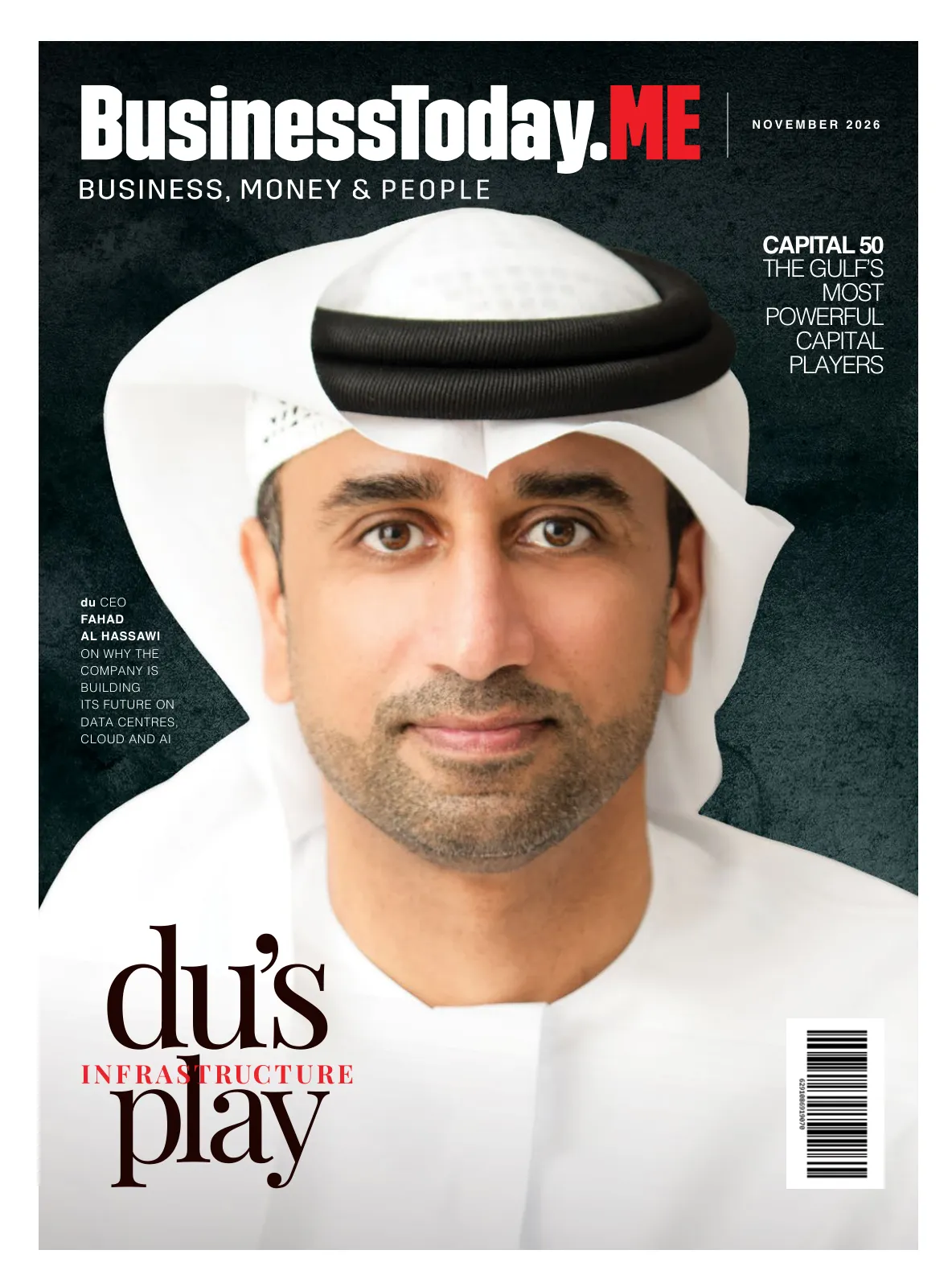
N O V E M B E R 2 0 2 6 du’s play CAPITAL 50 THE GULF’S MOST POWERFUL CAPITAL PLAYERS du CEO FAHAD AL HASSAWI ON WHY THE COMPANY IS BUILDING ITS FUTURE ON DATA CENTRES, CLOUD AND AI INFRASTRUCTURE
Villa Luxury, Redefined. When space and setting matter. A villa experience shaped by nature and a calm coastal environment. Thoughtful dining venues and well-appointed wellness facilities support both focused days and relaxed moments, creating a stay that feels balanced and complete. Villa stays starting from AED 3,750. ANANTARA MINA RAS AL KHAIMAH RESORT P.O. Box 4005, Al Huwailat St, Mina, Ras Al Khaimah, UAE | +971 720 42222 | rasalkhaimah@anantara.com ANANTARA.COM
NOVEMBER 2026 CONTENTS BIZTODAYME @BIZTODAYME BUSINESS TODAY MIDDLE EAST 3 CONTENTS 10 EDITOR’S NOTE 12 NEWS 18 MOVES 58 DUBAI FINTECH SUMMIT 64 INNOVATION Sharjah Plays the Long Game on AI 68 AI AMD�� ���� �������: ��������� �� ��������� ���� ��� �������� A� �������������� ����� 72 MANUFACTURING ����� �� A������� �� ����� ����������� ������� M������� 76 CYBERSECURITY CPX M���� ������������� ��� ���������� �� UAE AI 38 26 STRATEGY �������� M��� ������ ����������� ��� � ���� 28 ENERGY ��� ���� ���� ��� ������ ��� ������ ������ 30 REAL ESTATE ������ ����� �������� ����� ��� �� ��� ����� �� ���� 34 LOGISTICS ����� ������ M����: ����� �� ��� ������������� �� �� M����� ����������� Cover story 20 86 DRIVE ������� ����� � �������� A���� ��� 911 86 RETAIL A������ ����� ������� AIVI A Whirlpool-Inspired Stadium Rises on the Gulf Coast 82 WWW.BUSINESSTODAY.ME 3
Standard Chartered Bank UAE is licensed by the Central Bank of the UAE Corporate & Investment Banking. Global Markets. Global Banking. Transaction Services. Now is your time sc.com/cib Make growth your next stop Dub Johannesburg New York
London Singapore bai Shanghai
BUILT FOR MOMENTS THAT MATTER EXTRAORDINARY Escape to a home where urban sophistication meets resort tranquility. PRIVATE POOLS | 30+ AMENITIES | PRIME LOCATIONS 800-SAMANA | WWW.SAMANADEVELOPERS.COM
DISCOVER REFINED living *Ranking as per the H2025 1 sales volume data of property monitor for Dubai
SUBSCRIBE subscriptions@bncpublishing.net PO Box 502511 Dubai, United Arab Emirates P +971 4 4200 506 | F +971 4 4200 196 For all commercial enquiries, contact jo@bncpublishing.net T +971 50 440 2706 All rights reserved © 2026. The opinions expressed are solely those of the contributors. Business Today Middle East and its affiliated publications in the MENA region are exclusively licensed to BNC Publishing. No part of this magazine may be copied, reproduced, or transmitted in any form or by any means without prior written consent from the publisher. Printed by United Printing and Publishing | upp.ae Images used in Business Today Middle East are credited where necessary. Copyrighted images are used with permission. All uncredited images courtesy of Shutterstock. CEO WISSAM YOUNANE | wissam@bncpublishing.net Managing Director RABIH NAJM | rabih@bncpublishing.net Group Publishing Director JOAQUIM D'COSTA | jo@bncpublishing.net Editor AYA ZHANG | aya@bncpublishing.net Editor, Special Projects KASUN ILLANKOON | kasun@bncpublishing.net Digital Reporter REEBA ASGHAR | reeba@bncpublishing.net Creative Lead CHRISTIAN HARB | chriss@bncpublishing.net Junior Art Director IKA WAHYUNI Business Development Director ANDY SOULAHIAN | andy.soulahian@bncpublishing.net Commercial Director ANDREA MOCAY | andrea@bncpublishing.net KSA country manager AMJAD FAKHOURI | amjad@bncpublishing.net Marketing Executive AARON JOSHUA SINANBAM | aj@bncpublishing.net Videographers EDUARDO BUENAGUA HARTON OTLANG JOEL AMPARO Contributors COSTAS MARKIDES DR SULIMAN ALSHAHMY BIZTODAYME @BIZTODAYME BUSINESS TODAY MIDDLE EAST BIZTODAYME BIZTODAYME BUSINESSTODAY.ME 8 BUSINESS TODAY MIDDLE EAST | NOVEMBER 2026
Das gute Licht. Returns darkness to the night BEGA pole-top luminaires with Dark Sky technology direct the light in a highly efficient manner only where it is required. Light pollution of the night sky is avoided. bega.com/darksky
Aya Zhang Editor aya@bncpublishing.net Xiaoyue (Aya) Zhang xiaoyuezhangg O ver the past year, I have sat through more c o n v e r s a t i o n s about AI than I can count. At events, in interviews, over coffee with founders and executives, it comes up almost every time. For a long while, those conversations were mostly about possibility. What AI might do, how fast it might arrive, which country or company might lead. Lately, I have noticed a change. The questions have become more practical, and in many ways more interesting. Who is building the infrastructure? Where will the data sit? And can organisations trust these systems enough to rely on them? That is what drew us to this month’s cover. du has had a defining year, with a new 20-year licence, rising profits and serious investment in data centres and cloud. But what stayed with me after speaking with CEO Fahad Al Hassawi was not the numbers. It was his honesty. “A successful pilot is one thing,” he told us, “and running AI reliably across a business is another.” AMD’s Zaid Ghattas brings a similar perspective from the technology side. He explains why inference, the work AI does every time someone uses it, is now driving demand, and why the region’s infrastructure will need to adapt. This issue also features the Business Today Capital 50. Behind every data centre, new venture and expansion plan is someone deciding where the money goes. Our list recognises those people, from sovereign funds and banks to investors and founders, and the influence they hold over the region’s future. I hope this issue gives you a clearer view of what is being built around us, and the people building it. L E T T E R F R O M E D I T O R What I Keep Hearing 10 BUSINESS TODAY MIDDLE EAST | NOVEMBER 2026
Require formwork and scaffolding? Check out Doka’s extensive list of products and systems, which now includes scaffolding for a variety of applications. At Doka, our philosophy is to provide a broad range of services under one umbrella based on a growing demand for single-source solutions that adhere to the highest standards. One-stop-shop meaapmarketing@doka.com | www.doka-me.com /DokaMEA /company/doka-middle-east-africa /doka_mea
NEWS AI Infra and HUMAIN Sign SAR 2.5 Billion Deal to Expand Saudi AI Infrastructure S audi Arabia’s National Infrastructure Fund (Infra) and HUMAIN, a Public Investment Fund company focused on AI, have signed two financing agreements worth up to SAR 2.5 billion (approximately USD 667 million) to expand AI computing and power infrastructure in the kingdom. The agreements were signed in Riyadh on 8 November in the presence of PIF Governor Yasir Al-Rumayyan, Minister of Economy and Planning and Infra Chairman Faisal Alibrahim, and National Development Fund Governor Abdulaziz Alarifi. They are the first transactions under Infra’s AI Data Center Financing Program. The first facility, worth up to SAR 1.1 billion, will fund the purchase and deployment of graphics processing units (GPUs), representing around 25 MW of IT load. The second, worth up to SAR 1.4 billion, will fund substations, transmission networks and grid connections for HUMAIN’s data centres. That power infrastructure is designed to support up to 1 GW of IT capacity in future, creating room for further investment from data centre developers, hyperscalers and institutional investors. The deals build on a framework of up to SAR 4.5 billion that Infra and HUMAIN announced at the World Economic Forum in Davos in January 2026. Infra CEO Esmail Alsallom said the agreements aim to unlock investment beyond Infra’s own commitment, building a stronger pipeline of investable data centre projects. HUMAIN CEO Tareq Amin said the financing will accelerate the deployment of advanced computing capacity and the power infrastructure needed to support it. 12 BUSINESS TODAY MIDDLE EAST | NOVEMBER 2026
REAL ESTATE A bu Dhabi’s real estate transactions reached AED 171.26 billion in the first nine months of 2026, a 76.1% increase on the same period last year, according to the Abu Dhabi Real Estate Centre (ADREC). The number of transactions rose 32.8% to 38,483. Sales drove the growth, more than doubling in value to AED 119.33 billion across 23,749 transactions, while mortgage transactions rose 30.2% to AED 45.92 billion. Al Reem Island recorded the highest transaction value at AED 29.86 billion, followed by Al Hudayriyat Island and Al Saadiyat Island. Abu Dhabi Real Estate Transactions Reach AED 171 Billion in Nine Months Foreign investment in Abu Dhabi’s investment zones rose 131% to AED 86.11 billion, accounting for 81% of total investment in those zones. Foreign direct investment by non- resident individuals reached AED 17.22 billion, more than double the full-year figure for 2025, with investors from 121 nationalities. The UK, China and Russia were the leading sources. “The scale of investment shows how many people and businesses are making a long-term commitment to Abu Dhabi,” said Rashed Al Omaira, Director General of ADREC. A DNOC Distribution reported a 37% rise in net profit to USD 791 million for the first nine months of 2026, while EBITDA grew 26% to USD 1.12 billion. Gross profit rose 20% to USD 1.67 billion, supported by higher fuel volumes and growth in non-fuel retail and international operations. Fuel volumes reached a record 11.86 billion litres. The company added 71 stations during the period, ending with 1,081, and raised its 2026 expansion guidance to 80–90 new stations. Non-fuel retail gross profit rose 13% to USD 217 million. The company is also pursuing international growth, including its proposed acquisition of Shell Downstream South Africa, which would make South Africa its fourth country of operations. The board approved a third-quarter dividend of 5.14 fils per share (USD 175 million), and the company expects full-year 2026 dividends to exceed USD 700 million. “ADNOC Distribution’s strong nine-month performance demonstrates the breadth of our diversified platform and the disciplined execution of our growth strategy,” said Eng. Bader Saeed Al Lamki, CEO of ADNOC Distribution. ENERGY ADNOC Distribution Net Profit Rises 37% to USD 791 Million WWW.BUSINESSTODAY.ME 13
E mirates Development Bank (EDB), in collaboration with the Ministry of Industry and Advanced Technology (MoIAT), has opened applications for financing under the AED 1 billion National Industrial Resilience Fund, inviting new and existing factories in priority sectors to apply through EDB’s website. The five-year fund, announced by the UAE Cabinet in April 2026, aims to localise critical industries, reduce reliance on imports and strengthen national supply chains. Priority sectors include pharmaceuticals, medical supplies, and food and food processing. Eligible projects can receive financing at 0% interest until the end of the programme, subject to an annual service fee of 0.75%. Financing is capped at AED 100 million per group, with capital expenditure financing covering up to 80% of eligible project costs. “The start of operations of the AED 1 billion National Industrial Resilience Fund is a key step towards empowering the national industrial sector and strengthening its global competitiveness,” said H.E. Hasan Jasem Al Nowais, Undersecretary of MoIAT. NEWS INVESTMENT INDUSTRY IHC Revenue Passes AED 100 Billion as Profit Rises 87% I nternational Holding Company (IHC) reported revenue of AED 100.5 billion for the first nine months of 2026, up 33.2% year on year from continuing operations, while profit after tax rose 87% to AED 32.5 billion. Seven of the group’s eight business segments grew revenue. Real Estate and Construction remained the largest, contributing AED 33.3 billion, while Energy and Mining nearly quadrupled to AED 19.3 billion, driven by metals and hydrocarbon trading. Hospitality and Leisure revenue rose 93.7% to AED 7.8 billion. Total assets increased 13.4% to AED 485.9 billion, and cash and bank balances stood at AED 76.6 billion at the end of September. Syed Basar Shueb, CEO of IHC, described passing AED 100 billion in revenue as a significant milestone, highlighting the growth of the group’s operating businesses and its international investment platform. UAE Opens Applications for AED 1 Billion Industrial Resilience Fund Syed Basar Shueb, CEO of IHC 14 BUSINESS TODAY MIDDLE EAST | NOVEMBER 2026
DEVELOPMENT Saudi Arabia’s FDI Inflows Rise 33.5% to SAR 159 Billion in 2025 ECONOMY F oreign direct investment (FDI) inflows into Saudi Arabia rose 33.5% year on year to approximately SAR 159 billion in 2025, while the kingdom’s total FDI stock grew 8.3% to SAR 1,059 billion, passing the SAR 1 trillion mark. Since 2017, annual FDI inflows have increased more than fivefold, and total FDI stock has doubled, with compound annual growth rates of 24% and 10% respectively. FDI inflows are a key performance indicator for the National Transformation Program, one of the main programmes supporting Saudi Vision 2030. Through initiatives led by the Ministry of Investment, the programme aims to strengthen the investment environment and attract high-quality investment across sectors. S yria has signed a framework agreement with UAE-based developer Eagle Hills to develop urban and tourism projects in Damascus and Latakia, in the presence of Syrian President Ahmad al-Sharaa. The agreement was signed at the “Investing in Syria and Projects Underway” event at the People’s Palace in Damascus. Eagle Hills Eagle Hills Signs Framework Deal to Develop Projects in Damascus and Latakia founder Mohamed Alabbar said the company is developing the Tadamon Towers project in Damascus and the Eco Life project in Latakia. Two projects are expected to move directly into implementation, with the first phase focused on affordable housing. According to Syria’s Tourism Minister Mazen al-Salhani, the tourism projects could create more than 40,000 direct and indirect jobs. Syria’s Minister of Public Works and Housing, Mustafa Abdul Razzaq, said the country’s housing deficit could exceed 2 million units by 2030 without urgent action. “We hope these projects will become communities where people can find suitable homes, good services, job opportunities and a decent life,” said Alabbar. WWW.BUSINESSTODAY.ME 15
P ayTabs Group has signed a memorandum of understanding (MoU) to acquire 100% of SeaPay (Arab Sea Financial Company), a SAMA-licensed payments firm, from Tadawul-listed Arab Sea Information Systems Company. The agreement was signed on 22 October 2026 and disclosed on the Saudi Exchange. The deal would combine SeaPay’s acquiring capabilities with PayTabs’ existing payment acceptance, processing and switching infrastructure, strengthening its position in Saudi Arabia, its largest market. PayTabs said the move would diversify its revenue and support its target of serving 200,000 merchants in the kingdom by 2030. “PayTabs was founded in Saudi Arabia with the ambition to build payment infrastructure for the region. SeaPay represents an important step in strengthening the economics of that business in Saudi Arabia,” said Abdulaziz Al Jouf, Founder, CEO and Chairman of PayTabs Group. PayTabs is targeting more than USD 100 billion in annual processed payment volumes by 2030, and is considering a potential public listing. FINTECHNEWS PayTabs Signs MoU to Acquire Saudi Payments Firm SeaPay Abdulaziz Al Jouf, Founder, CEO and Chairman of PayTabs Group Thamer Al Luhaidan, CEO of SeaPay 16 BUSINESS TODAY MIDDLE EAST | NOVEMBER 2026
26,000 companies from more than 180 countries. OMNIYAT’s The Lana entered the list of the world’s 50 best hotels within eight months of opening. Ounass achieves an average delivery time of 89 minutes in Dubai, and Humantra reached more than two million customers within 15 months. The six winners complete the list for the award’s first edition. Earlier winners include H.H. Sheikh Ahmed bin Saeed Al Maktoum, the Roads and Transport Authority, Emaar Properties, Ziina and Fix Dessert Chocolatier. Dubai-it Award Names Six Winners Across Business Sectors H .H. Sheikh Hamdan bin Mohammed bin Rashid Al Maktoum, Crown Prince of Dubai, Deputy Prime Minister and Minister of Defence of the UAE, and Chairman of The Executive Council of Dubai, has named six new winners of the Dubai-it Award. The award recognises achievements that turn ideas into results in record time and with high quality. Emirates NBD won in the Institutions category in the Economic Field. Ahmed bin Sulayem, Executive Chairman and CEO of DMCC, won in the Project Managers segment, and Mahdi Amjad, Founder and Executive Chairman of OMNIYAT, won in Real Estate Projects. In Services, the award went to Ounass, ACHIEVEMENT VENTURE CAPITAL O man-headquartered Phaze Ventures has launched two new venture funds targeting more than USD 75 million, having already secured more than USD 40 million in investor commitments. Phaze Ventures Fund II, anchored by ITHCA Group, a subsidiary of Oman Investment Authority, along with Ominvest and Oman LNG Development Foundation, will continue the firm’s global AI and deeptech investment mandate. The Phaze Ventures Oman Fund, anchored by Future Fund Oman, will back homegrown AI-enabled businesses. The funds’ first investments include Arabic.AI, Sully.ai, Andromeda Surgical, Boardy.ai and Metal, alongside co-investors such as a16z, Y Combinator and Baidu Ventures. “AI is the most disruptive technology shift of our generation. Oman and the Gulf can’t afford to be a spectator,” said Abdullah Al Shaksy, Co-founder and CEO of Phaze Ventures. “We need to invest in the founders disrupting industries at home and across the globe, and we need to be a part of that disruption early.” Phaze Ventures Launches Two AI funds Targeting USD 75 Million Abdullah Al Shaksy, Co-founder and CEO of Phaze Ventures Masoud Al Rawahi, Founder & CEO of Phazero Mohammed Al Wahaibi, CEO of Al Jabr Mena developed by Khalid Al Tayer. Charlie Wright, Founder of Humantra, won in the Entrepreneurs category, and Chef Izu Ani won in Hospitality. “We launched the Dubai-it Award to showcase Dubai’s philosophy of work in action across every field: extraordinary achievement, in record time, with excellence,” said Sheikh Hamdan. According to the announcement, Emirates NBD’s digital services adoption rate has reached 91%, and DMCC is now home to more than WWW.BUSINESSTODAY.ME 17
A l Etihad Payments (AEP), a subsidiary of the Central Bank of the UAE, has announced the appointment of Aref �l �amli as �hie� ��ecutive ��ficer, effective 2 November 2026. Al Ramli has more than 24 years of e�perience in financial services. �e �oins ��� �rom �l �ilal �an�, �here he held the position of Chief Digital ��ficer. �reviously, he �as �hie� ��ecutive ��ficer o� �mirates �igital �allet, �here he led a payments initiative involving 16 banks focused on financial inclusion and the transition to a cashless economy. At Mashreq, he led Digital Banking and �nnovation and oversa� the launch o� Mashreq Neo and Mashreq NeoBiz. As Chairman of the UAE Banks Federation’s Digital Committee �rom ���� to ����, he �or�ed �ith member banks, the Central Bank and government entities on industry��ide digital initiatives. �s ���, �l �amli �ill lead ����s �or� to develop the ����s national payment infrastructure and expand the adoption of its payment platforms. According to AEP, Aani, the UAE’s instant payments platform, has 14.7 million enrolled users in 2026 and has processed more than ��� million transactions �orth ��� 545 billion. Earlier this year, the issuance o� �ay�an cards �egan through financial institutions across the UAE. �.�. �ai� �umaid �l �haheri, Chairman of the Board of Managers for Al Etihad Payments, said: “Aref’s experience across digital banking and payment services across multiple institutions positions him �ell to lead AEP through its next phase of development.” “My ambition is for AEP’s platforms to become a natural part o� ho� people and businesses across the UAE pay every day,” said Al Ramli. “That requires reliable infrastructure, strong partnerships �ith financial institutions, and services that give customers a clear reason to use them.” MOVES Aref Al Ramli, Chief Executive ������ �� A� ������ �������� Al Etihad Payments Appoints Aref Al Ramli ������������������������ MY AMBITION IS FOR AEP’S PLATFORMS TO BECOME A NATURAL PART OF HOW PEOPLE AND BUSINESSES ACROSS THE UAE PAY EVERY DAY. 18 �������� ����� ������ ���� | NOVEMBER 2026
T he �audi �nvestment �an� ������ has promoted �alman �l��ughom to �hie� ��ecutive ��ficer, e��ective � �cto�er ����. �he appointment, announced in a filing to the �audi ��change ��ada�ul�, received approval �rom the �audi �entral �an� ������. Al-Fughom has more than 20 years of e�perience in �audi �an�ing, including a period at ����. �e has served as �����s �eputy ��� since �anuary ����, and �e�ore that �as the �an��s �reasurer and �hie� �nvestment ��ficer. �ver his career at ����, he has held senior roles across investments, treasury, liquidity and financing, capital management and �alance sheet management. �e has also served on the �oards o� �listithmar �or �inancial �ecurities and �ro�erage �ompany and �audi �ri� �easing �ompany. �e succeeds �aisal �l��mran, �ho stepped do�n at his o�n re�uest a�ter leading the �an� since February 2019. M ulti�an� �roup has appointed �ohammed �l �a�im as Vice Chairman of MultiBank Group and CEO of MB.io, its cryptocurrency and digital asset trading platform. �or�ing directly �ith �aser �aher, �ounder and �hairman o� �ulti�an� �roup, �l �a�im �ill strengthen the group�s glo�al presence, lead ��.io into ne� international mar�ets and oversee the expansion of MultiBank Exchange. Before joining MultiBank Group, he served as President and �eneral �anager o� �rypto.com, �ollo�ing a senior leadership role �ithin the ��� �ederal government. �t �rypto.com, he led strategic partnerships �ith �mirates and �u�ai �uty �ree, �hich resulted in the launch o� �rypto.com �ay �ith �oth. �ccording to the company, he also secured a �tored �alue �acilities licence from the Central Bank of the UAE for Crypto.com. ��he convergence o� traditional finance and digital assets is creating significant opportunities to reshape ho� institutions and investors access glo�al mar�ets,� said �l �a�im. Mohammed Al Hakim Appointed Vice Chairman of MultiBank Group Salman Al-Fughom Takes the Helm at Saudi Investment Bank Salman Al-Fughom, ����� ��������� ������ �� A�������� Al Hakim, ���� �������� �� M�������� ����� ��� ��� M���� ���.�������������.�� 19
COVER Fahad Al Hassawi, CEO, du 20 BUSINESS TODAY MIDDLE EAST | NOVEMBER 2026 20 BUSINESS TODAY MIDDLE EAST | NOVEMBER 2026
WWW.BUSINESSTODAY.ME 21 A SUCCESSFUL PILOT IS ONE THING, AND RUNNING AI RELIABLY ACROSS A BUSINESS IS ANOTHER. BY AYA ZHANG WITH A NEW 20-YEAR LICENCE, RISING PROFITS AND HEAVY INVESTMENT IN DATA CENTRES AND CLOUD, du IS GROWING INTO A DIGITAL INFRASTRUCTURE AND SERVICES PROVIDER. CEO FAHAD AL HASSAWI EXPLAINS WHAT THAT MEANS FOR BUSINESSES, AI AND THE UAE’S DIGITAL AMBITIONS. du’s play INFRASTRUCTURE
I t’s been a big year for du: a new 20-year licence, a place in the global indices, and profits still climbing. How does it feel from where you’re sitting, and what does that kind of runway let you finally go after? It gives us confidence, but also a responsibility to keep that momentum going. In the first nine months, revenue grew 6.2% to AED 12.3 billion and net profit increased 10.8% to AED 2.4 billion. That shows we can invest for the future while delivering profitable growth today. The 20-year licence renewal gives us the visibility to plan ahead of short investment cycles. Our inclusion in the MSCI UAE Standard Index, part of the MSCI Emerging Markets Index, and the FTSE All-World Index also strengthens our international investor visibility. These developments support our ambition to go beyond connectivity like we’ve been aiming for, scaling data centres, cloud and advanced networks, and becoming a trusted digital partner to businesses and government entities across the UAE. du is investing more than ever in data centres and networks. How would you describe what du is becoming? I would describe it as building on our connectivity roots. Recently, we’ve noticed that our customers need more than a standard connection. They need somewhere secure to run their systems, manage their data and put AI to work. That is why we’re investing in data centres, cloud and advanced networks, with our capital expenditure reaching AED 647 million in Q3. Our work with Dubai Taxi Company is a good example. We migrated its core systems onto du Tech’s National Hypercloud, giving it a scalable, AI- ready platform hosted entirely in the UAE. We’re becoming a broader digital infrastructure and services partner, helping organisations to both stay connected and modernise their operations and build the capabilities they need for future growth. COVER 22 BUSINESS TODAY MIDDLE EAST | NOVEMBER 2026
WWW.BUSINESSTODAY.ME 23 Everyone’s talking about AI, and du is building the infrastructure it runs on. What are you seeing from the inside that the rest of us might be missing? The conversation around AI tends to focus on what it can do. From our side, the equally important question is, can an organisation trust it enough to use it in a critical operation? A successful pilot is one thing, and running AI reliably across a business is another. That requires computing capacity that can grow with demand, secure access to data and absolute clarity over where that data is held and governed. Sovereignty gives organisations confidence to move forward. Through our UAE-hosted National Hypercloud, we’re helping address those requirements. For du, supporting the UAE’s AI ambitions means making adoption practical; giving enterprises and government entities a dependable environment in which to develop and scale AI services. du keeps chasing world firsts on the network, and you’re already talking about 6G. When does all of that actually show up in someone’s everyday life? It shows up when your connection keeps pace with what you need, especially when more people and devices use the network. Our six-carrier aggregation deployment brings spectrum channels together, which gives compatible devices faster speeds and greater capacity. In everyday terms, that means smoother video calls, quicker downloads and more consistent access to demanding business applications. Some advances are available now through 5G+; others are still being tested. Our upper 6 GHz trial demonstrated the potential to double capacity compared with 3.5 GHz, but it is not a commercial rollout. And 6G is still ahead of us. Our blueprint explores how future networks could anticipate demand, operate more efficiently and support applications such as enterprise digital twins. The point is better experiences, and not simply another ‘world-first’ by name. Almost everyone in the UAE is already connected. So where do new customers come from, and how do you win them? In a highly connected market, growth comes from understanding who is still underserved and whose needs are changing. Tourism brings new customers, while expanded retail coverage helps us reach underserved communities. We also give people reasons to choose du: tailored Alo plans, differentiated business roaming offers and flexible Home Wireless. Winning customers is only the start. Better service quality, network reliability and customer experience help us retain them and earn more of their business. Our postpaid base grew 6.4% in Q3, THE POINT IS BETTER EXPERIENCES, AND NOT SIMPLY ANOTHER ‘WORLD-FIRST’ BY NAME.
reflecting demand across premium consumer and enterprise segments. For enterprises, we’re expanding the relationship beyond telecoms. In 2025, data centre deployments began generating recurring revenues alongside growing cloud contributions. So the opportunity is both new customers and becoming more valuable to those we already serve. You’ve been CEO since 2021. How are you a different leader today than you were on day one? I’m more conscious today, as a leader, that a clear plan must leave room to adapt. The UAE moves quickly, and we have to move with it—understanding what is changing and where a challenge might reveal an opportunity. du Pay and du Tech are examples of building services around those opportunities. I also place a lot of emphasis on understanding different customer segments, rather than treating growth as one broad ambition. We need to know whom we want to serve and what they need. What hasn’t changed is my belief in people. They are our greatest asset and make transformation possible. I keep asking, “What’s next?” Whether that means preparing for 6G or anticipating new customer needs, leadership is about building for tomorrow while delivering today. The UAE has big digital ambitions. What role do you see du playing in getting the country there? Our role is to help turn national ambition into services that government, businesses and communities can actually use. That takes strong connectivity, sovereign cloud and AI- ready infrastructure, but also close collaboration with the organisations transforming those services. With Dubai Finance, we have launched the Dubai Government Unified Contact Centre (UCC) – a transformative initiative designed to streamline public service communication across the emirate. This integrated platform will serve as a centralised hub for delivering support and information related to government services in a seamless, proactive, and customer-centric manner. It directly supports the “Services 360” vision, ensuring that service delivery is not only efficient but anticipatory of public needs. Beyond one deployment, that gives us a repeatable approach for other government entities and enterprises in mobility and logistics. We also need to prepare for what comes next. Our collaboration with Khalifa University and our 6G blueprint connect research with future network needs. For me, success means bringing government, industry and academia together so that technological progress translates into better services and a more capable digital economy. COVER 24 BUSINESS TODAY MIDDLE EAST | NOVEMBER 2026
WWW.BUSINESSTODAY.ME 25 Fast forward to 2030. What do you hope people say du got right? I hope people say we saw where the UAE was heading and invested in the capabilities it needed; and not simply the ‘trending’ technologies attracting attention. By 2030, I want du to be recognised as a digital infrastructure and services provider that helped businesses grow and made customers’ lives easier. That means turning our cloud, data centre and AI investments into services people value, while continuing to improve everyday connectivity. I also hope they say we got the balance right: building new sources of revenue without losing financial discipline or customer focus. The finish line at 2030 is a stronger, more diversified du that contributes meaningfully to the UAE’s digital economy and delivers lasting value for shareholders. LEADERSHIP IS ABOUT BUILDING FOR TOMORROW WHILE DELIVERING TODAY.
F or decades, strategy has been taught as the art of choosing where a company wants to go and then building a plan to get there. Given today’s volatile and uncertain environment, this logic is becoming increasingly di�ficult to sustain. In the Middle East, this is especially the case. Businesses are operating amid rapid technological change, shifting global trade patterns, geopolitical uncertainty, changing consumer expectations and the e�traordinary acceleration o� artificial intelligence. Thinking of strategy as a plan is no longer viable. Yet the answer is not to abandon strategy and become permanently reactive. It is to rethink what strategy means. The companies that thrive in a world of continuous disruption will not necessarily be those that predict the future most accurately. They will be those that develop the organisational capability to respond to an unpredictable future without losing their sense of direction. The key is knowing what must remain stable and Strategy Must Become a Capability, Not a Plan IN A WORLD OF CONSTANT DISRUPTION, THE COMPANIES THAT THRIVE WILL BE THOSE THAT KNOW WHAT MUST STAY FIXED AND ARE READY TO CHANGE EVERYTHING ELSE. BY COSTAS MARKIDES what must evolve. This distinction matters. There is a danger that, when the environment changes, leaders respond by changing everything: priorities, investments, structures and even the organisation’s identity. That may look like agility, but it is often simply strategic drift. Good strategy still requires choices. The challenge is to distinguish between which choices should not change and which must continually evolve. The organisation needs a clear strategic direction, a sense of where it is trying to create value and for whom. Those should provide the anchor; everything else should be open to question as circumstances change. This is not an entirely new idea. My work on strategic innovation has long focused on the importance of challenging established assumptions, creating ne� mar�et space and finding alternative �ays to compete. �ore recently, I have focused on how organisations can prepare for a journey of continuous disruption rather than treating disruption as an occasional event. STRATEGY 26 BUSINESS TODAY MIDDLE EAST | NOVEMBER 2026
For Middle Eastern businesses, this shift creates an important opportunity. The region offers a live laboratory for strategy under uncertainty: governments and companies are simultaneously navigating economic diversification, technological disruption, changing energy markets and increasingly fragmented global trade. The lesson is not that organisations in the Gulf can predict disruption better. It is that they are increasingly designing themselves to remain viable across several possible futures. Saudi Arabia is a powerful e�ample. �ts diversification agenda is not simply about moving away from oil; it is about creating multiple engines of future growth. Real non-oil GDP reached USD 892 billion in 2025, while the private sector’s contribution to GDP reached 51%. Growth has been supported by expansion across sectors including tourism, technology, entertainment, logistics and manufacturing. The strategic lesson is the creation of multiple options for future growth: a clear long-term direction, without dependence on a single future. The UAE offers another lesson in how to act while uncertainty remains unresolved. AI-related investment exceeded AED 543 billion across 2024 and 2025, while 72% of UAE CEOs adaptability in their DNA. They will build structures that allow new ideas to emerge, test them quickly and scale those that work, while protecting the core activities that continue to create value. This requires leaders to embrace a paradox: the more uncertain the environment becomes, the more important strategic clarity becomes, but the less useful rigid strategic plans become. The Middle East has an opportunity to lead this transition. Its experience shows that long-term ambition does not require rigid plans. Organisations can make big bets while remaining open to new evidence about how those ambitions should be achieved. The future belongs neither to organisations that cling stubbornly to yesterday’s strategy nor to those that chase every new disruption. It belongs to those that know what must not change and have the organisational courage and capability to change everything else. surveyed by PwC said innovation was critical to their business strategy and more than half reported rapidly testing new ideas. The strategic lesson is the combination of long-term ambition and rapid experimentation: committing to a direction without assuming that the path to it �ill remain fi�ed. But doing so requires a different organisational model. Leaders should stop asking only, “What is our strategy?” and begin asking, “What should remain constant, and what should we be prepared to change when the evidence tells us we should?” That means creating mechanisms for continuously monitoring the environment. It means encouraging experimentation and learning rather than demanding certainty before action. My research has specifically e�amined ho� firms monitor changing environments and how management-control systems can be used to support agility. It also means changing the relationship between leadership and employees. In volatile environments, senior executives cannot make every decision. They must give people closer to the customer the autonomy to act, �hile maintaining su�ficient strategic control. This is where many organisations misunderstand agility. Agility is not everyone doing whatever they want, but the ability to decentralise decisions while preserving strategic coherence. AI makes this challenge more urgent. The technology is not simply another tool that companies can add to an existing strategy. It is accelerating the rate at which products, processes, business models and competitive advantages can change. Strategic cycles that once lasted years may increasingly need to be revisited in months or even weeks. The winners will therefore be organisations that institutionalise Costas Markides, Professor of Strategy and Entrepreneurship at London Business School THE COMPANIES THAT THRIVE WILL BE THOSE THAT KNOW WHAT MUST NOT CHANGE WWW.BUSINESSTODAY.ME 27
D ecommissioning is the final stage in an oil or gas field�s li�e. �hen production ends, operators must permanently plug �ells, remove or secure plat�orms and pipelines, and restore the sea�ed. ���shore �or� is the most comple� and costly, �ecause installations are heavy, stand in deep �ater and �ere rarely designed �ith removal in mind. �nternational rules set a �road standard. �he ���� �nternational �aritime �rganisation guidelines re�uire disused installations to �e removed, �ith e�ceptions �or large deep��ater structures, and in the �orth��ast �tlantic ����� �ecision ���� prohi�its leaving them in place e�cept �or certain heavy structures. �ational regimes then decide �ho is lia�le, ho� programmes are approved and ho� costs are secured. Why decommissioning matters �ecommissioning matters �or five reasons. �he first is scale. �he remaining �ill �or the �� �ontinental �hel� runs to tens o� �illions o� pounds, and estimates �or the �ra�ian �ul� range �rom ��� �� to �� �illion over the ne�t t�o decades. �or smaller firms, the decommissioning provision can e�ceed their mar�et value. �he second is uncertainty. �osts �all �ar in the �uture and depend on Who Pays When the Gulf’s Oil Fields Close? ��� ������ ������ �������� �������������� �� ����������� � ������ ����� �����, ��� ������� ���� ��� ������ ���������� ��� ������ ������ ��� ���� �������. �� �� ������� �������� ENERGY 28 �������� ����� ������ ���� | �������� ����
vessel and rig availa�ility, inflation, regulation and the condition o� ageing assets, �hile the date production stops depends on prices, reserves and policy. �he third is fiscal. �ecause decommissioning costs are o�ten ta��deducti�le or recovera�le under production�sharing agreements, governments share the �ill, and i� a licensee �ails, the lia�ility may �all �ac� on the state. �he �ourth is environmental. �oorly a�andoned �ells can lea� oil and methane �or decades. �he fi�th is the energy transition. �et �ero targets may close some fields early, �ringing spending �or�ard. � firm that sets an am�itious climate target �hile assuming long field lives in its provision is presenting t�o pictures that may not match. Hedging the cost and lessons from the UK �irms rarely hedge decommissioning �ith derivatives alone. �hey use a mi� o� arrangements� �unds �uilt up during production� letters o� credit and parent company guarantees that o� practice serve as �inding re�uirements �or its partners. �hird, the largest asset o�ners are state�o�ned national oil companies that �und decommissioning �rom current revenues. �he state�s �alance sheet there�ore acts as an implicit hedge� the cost �ill �e met, �ut its si�e, timing and �unding are seldom visi�le �rom outside. �atar sho�s the region moving �rom planning to action. �n �e�ruary ����, �atar�nergy a�arded �c�ermott a definition engineering contract �or the country�s first o��shore decommissioning pro�ect, covering �� plat�orms and their su�sea ca�les and pipelines in the �l��ar�ara, �dd �l��hargi and �aydan �ah�am fields. �etting the technical and commercial strategy early is itsel� a �orm o� cost hedging, and the resulting �rame�or� is li�ely to shape practice across the �ul�. What the region needs �hese arrangements may �e financially sound, �ut outsiders cannot assess them. �our steps �ould help. �overnments should adopt dedicated decommissioning la�s that set �unding and security re�uirements. �perators and national oil companies should disclose discounted and undiscounted provisions, e�pected timing, �ey assumptions and their sensitivity. �hey should also report �und �alances, security held, cost� recovery entitlements and the share o� costs covered �y fi�ed contracts, so that users can see ho� much o� the lia�ility is hedged. �inally, as climate reporting standards spread across the region, firms should �uanti�y ho� a �aster energy transition �ould change their decommissioning costs. �he �ul� is starting its large programmes �ust as glo�al reporting moves to�ard greater transparency, and it can learn �rom the �� rather than repeat its slo� progress. protect partners and governments i� a licensee �ails� ta� relie� or cost recovery that shares the cost �ith the state� fi�ed�price or multi�field contracts that loc� in removal costs� and reuse o� in�rastructure �or car�on storage or rene�a�le energy. �he �� has most o� these tools, including �ormal decommissioning security agreements �et�een partners. �et our research on ���listed oil and gas firms sho�s that disclosure remains thin. �irms report the provision �ut say little a�out ho� much it is secured, �unded or contracted, and none o� the operators �e e�amined puts a num�er on ho� the energy transition �ould change it. Middle East practice �he �iddle �ast is a�out to test these arrangements at scale. �round ��� o��shore �acilities in the region a�ait decommissioning, �ith pro�ections rising to �,��� structures and ��� �ells �y ����. �uch o� this in�rastructure dates �rom the ����s and ����s, and many producing countries still lac� mature decommissioning la�s. �egional practice di��ers �rom the �� in three �ays. �irst, o�ligations are mainly contract��ased. �roduction� sharing agreements, service contracts and concessions o�ten state �hen the contractor must set up a decommissioning �und and start paying into it. �hese �unds are the region�s main hedge, �ut their design is uneven, and time��ased triggers can ignore remaining reserves or the condition o� the assets. �econd, dedicated legislation is o�ten missing. �he ��� has no single statute governing o��shore decommissioning. ��u �ha�i�s �rame�or� covers �ell a�andonment �ut does not set rules �or removing �acilities, allocating costs �et�een partners or esta�lishing a dedicated �und. �n practice, ������s codes Dr Suliman Alshahmy, Assistant Professor of Finance at Heriot-Watt University Dubai ���.�������������.�� 29
Inside Water Gardens, H&H’s Bet on the Heart of DIFC REAL ESTATE WITH CONSTRUCTION UNDERWAY ON WATER GARDENS IN DIFC, H&H CHAIRMAN SHAHAB LUTFI EXPLAINS WHY THE DEVELOPER IS DOUBLING DOWN ON DUBAI, AND WHY HE BELIEVES THE CITY IS THERE TO STAY. BY AYA ZHANG 30 BUSINESS TODAY MIDDLE EAST | NOVEMBER 2026
S haha� �utfi, �hairman o� ���, does not hide the scale o� the developer�s latest pro�ect. ��e have a lot o� am�itious pro�ects,� he says. ��his is definitely one o� them.� �ater �ardens is a ne� mi�ed�use destination at the heart o� �u�ai �nternational �inancial �entre ������, �ringing together o�fices, residences, hospitality and retail around a shared landscape o� garden and �ater. �esigned �y �rit��er �ri�e� �inning architect �ir �avid �hipperfield, it comprises �our �uildings arranged around a central garden and a pedestrian pu�lic realm. �onstruction is �ell under�ay, �ith completion scheduled �or ����. �or �utfi, the location �as an easy decision. ����� is a centre o� �usiness, the centre o� the city, � �ould say, in terms o� entertainment and o�fice space, and �e thought �eing at the heart o� it �ould �e a no��rainer,� he says. ��t�s very close to everything else, very �ell connected, and there�s a captive audience o� companies and customers �or residences and hotels.� BOUTIQUE AT SCALE ��� has gro�n alongside the city. ��e evolved �ith �u�ai,� �utfi says. ��e started much smaller, �ith more �outi�ue pro�ects, �ut right no� �e are at a di��erent scale.� �ven at this si�e, he says, the company aims to �eep a personal touch. ��his pro�ect is very large, �ut it has �our components, and every component is �outi�ue in its nature,� he e�plains. ��he �our �easons residence is very handcra�ted and detailed, do�n to every �urniture piece that comes �ithin it. �he hotel is the same, and so are the o�fices, �hich are a ne� component. �e have never released o�fices �e�ore in this part o� the �orld.� �hahab �utfi, Chairman of H&H IF YOU COME TO ANY OF OUR PROJECTS AFTER 10 YEARS AND SAY THIS LOOKS NEW, OR THIS LOOKS LIKE IT WAS BUILT YESTERDAY, THAT SHOWS SUCCESS. WWW.BUSINESSTODAY.ME 31
�hat approach comes at a cost in time. ��e �ant you to �eel special, �ut at the same time �ithin a �igger scale,� he says. ��t�s a �it o� a challenge �hen you do that. �t ta�es a little longer, and �e are very meticulous �ith that.� �is measure o� success is ho� a �uilding ages. ��� you come to any o� our pro�ects a�ter �� years and say this loo�s ne�, or this loo�s li�e it �as �uilt yesterday, it �eels good, it doesn�t �eel dated, that sho�s success.� A NEW KIND OF WORKPLACE �he ��fices at �ater �ardens �ill provide ��,��� s�uare metres o� �rade � net leasa�le area, including three floors o� micro�suites alongside larger o�fice �ormats. �he �uilding is targeting ���� �latinum certification, �ith architecture �y �hipperfield and interiors �y �atricia �r�uiola. ��� has �een appointed e�clusive leasing partner. �he rest o� the design team includes �ureau �as �mets, �hich designed the landscape, �ith a central �ater �eature as its �ocal point. �ihany �esign and �ristan �uer are �or�ing across the �uildings, �hile �tudio ��� is shaping the retail and dining e�perience. �he development is elevated a�ove the surrounding streets, �ith arrival stairs �rom �l �u�oo� �treet and �l �usta��al �treet. �eneath it, �ater �ardens connects directly into �ate �venue, e�tending �����s e�isting retail and pedestrian net�or�. ���� �nvestments descri�es it as one o� the final components o� the district�s original �ate �istrict masterplan. MERGING HARDWARE AND SOFTWARE �n a mar�et as competitive as �u�ai, �utfi says, standing out is the I THINK DUBAI IS RESILIENT. DUBAI WILL PUT ITS FOOT IN THE GROUND MORE THAN BEFORE. REAL ESTATE 32 BUSINESS TODAY MIDDLE EAST | NOVEMBER 2026
hardest part. ��reating something une�pected, � thin� that�s the challenge,� he says. ��e need to create a vision �or every pro�ect, a story that stands the test o� time and that needs to �e e�ecuted properly. �u�ai is very challenging. �t�s very competitive. �here�s a ne� idea every single time.� ����s ans�er is to �ocus on �hat happens inside its �uildings. ��hat �e try to do is merge the hard�are �ith the so�t�are,� he e�plains. ��e try to �uild the �est �uildings �ut incorporate the �est programmes �ith them that actually ma�e them live, ma�e them interactive, ma�e them special, �rom the operator to the restaurants to the companies �e �ill select �or our o�fice �uilding. �ll o� this, � thin�, fits into an ecosystem that hope�ully could not �e replicated �y others.� DOUBLING DOWN ON DUBAI �utfi is confident a�out the city�s �uture. �� thin� �u�ai is resilient,� he says. ��u�ai �ill put its �oot in the ground more than �e�ore. �ight no�, �e are dou�ling do�n on developing these mega pro�ects. �he government is dou�ling do�n on in�rastructure, ne� airports and all this.� �e compares the current moment �ith the pandemic. ���ter several years, � thin� people �ill �orget a�out this. �t�s li�e �hat happened �ith �ovid� the country dou�led do�n and sa� the �ruits o� it. �o� the same thing is happening again, and �e �ill see the �ruits o� it. �u�ai is there to stay.� ���, he says, intends to stay �ith it. �he company has gro�n its name slo�ly, through steady and consistent steps, and does not chase �ooms and �usts. ��e �ill continue, and � thin� the longer �e stay, the more anchored �e are.� WWW.BUSINESSTODAY.ME 33
DHL’S TOBIAS MAIER: Trade Is Not Disappearing, ����������������������� Tobias Maier, CEO Middle East and Africa, DHL Global Forwarding LOGISTICS 34 BUSINESS TODAY MIDDLE EAST | NOVEMBER 2026
TOBIAS MAIER, CEO MIDDLE EAST AND AFRICA AT DHL GLOBAL FORWARDING, TALKS TO BUSINESS TODAY MIDDLE EAST ABOUT KEEPING SUPPLY CHAINS RUNNING THROUGH A YEAR OF DISRUPTION, THE SHIFTING MAP OF GLOBAL TRADE AND WHY THE GULF IS CENTRAL TO DHL’S GROWTH PLANS. BY AYA ZHANG T obias Maier took over as CEO Middle East and Africa at DHL Global Forwarding at the end of 2025, after around 17 years with the company, including roles as regional CFO and head of its digital freight platform. �is first year in the role has coincided �ith disruption to ports, gateways and airspace across the Gulf, a period he describes as “a true proof point” of supply chain resilience. It’s been a busy year for �H� �lobal Forwarding in the region. Which milestone are you proudest of so far? I am very proud of how our teams kept supply chains across the GCC running throughout a period when multiple entry points, gateways, ports and airspaces �ere disrupted. �ur first priority �as to ma�e sure our people were safe. From there, colleagues worked tirelessly to gather information, develop alternative routings and communicate clearly with customers as conditions changed. It was a true proof point not only of supply chain resilience, but also of team spirit: We came together not just within Global Forwarding, but also with DHL Express and DHL Supply Chain – sharing knowledge, solutions, capacity and even facilities to keep customers served. You’ve spent around 1� years at �H�, including time as regional CFO and running �H�’s digital freight platform. How does that background shape the way you lead? It has taught me to look at business from different angles. Finance gave me discipline and a clear understanding of value and risk; the digital freight business taught me to challenge established ways of working and move quickly; and my operational roles have reinforced that execution ultimately depends on people. My leadership style is collaborative: I like working with people who bring different backgrounds, mindsets and strengths, because not one person has all the answers. My role is to create clarity, invite honest feedback and bring those different strengths together around a shared goal. Trade routes have been shifting a lot lately. How is that changing the way goods move through the �iddle East, and what does it mean for the region’s role in global trade? Trade is not disappearing; it is moving differently. When established routes are disrupted, cargo shifts to alternative airports, ports and road corridors, often across several transport modes. This makes the Middle East increasingly important not only for its geography, but for the options its networks provide. The UAE, Saudi Arabia and Oman offer complementary capabilities, and the next opportunity is to connect these assets more closely and capture greater value through production, distribution and specialised logistics services. The latest DHL Globalization Tracker puts the short-term disruption and longer-term opportunity into perspective. It forecasts a 4% decline in MENA trade volumes in 2026 amid continued uncertainty but expects MENA to be the fastest-growing trade region over 2026–2029, including a projected 12% rebound in 2027. WWW.BUSINESSTODAY.ME 35
�H� is investing heavily in the UAE and �audi Arabia, from new facilities to �oint ventures in the region. Why the �ulf? Because the Gulf is becoming much more than a transit point between East and West. The UAE offers a highly connected logistics ecosystem, while Saudi Arabia combines scale, growing demand and industrial ambition. DHL Group’s investment of more than €500 million in the Middle East through 2030 reflects our long�term commitment to the region’s growth. Investment in physical and digital infrastructure is creating new trade flo�s and customer needs. �� and data centres are a good example, with the Middle East emerging as a potential next major growth region for AI infrastructure. And the infrastructure behind AI is of course highly physical: Chips, servers, cooling and power equipment must be transported, DHL teams across Global Forwarding, Express and Supply Chain worked together to keep ��������� ������ ������� ���� ������ ���������� DHL Group is investing more than ¤500 million in the Middle East through 2030 LOGISTICS 36 BUSINESS TODAY MIDDLE EAST | NOVEMBER 2026
BEYOND THE BOARDROOM One word to describe your leadership style? Collaborative. I like bringing together people with different backgrounds, mindsets and strengths. Emails or calls? I am multichannel. Email and calls (who would have thought this would be a special skill when we were young in the 1980s!?) and especially in the Middle East, WhatsApp and more and more WeChat is a must. The meeting you never skip? Meetings that bring me close to our people and customers – town halls, employee recognition moments and customer meetings or webinars. The �uality you hire for first? Ownership, passion and curiosity. Also, the willingness to listen, learn and look at a problem from a different angle – candidates who bring these qualities will ����� ��� ��� ��� ���� ������� Your biggest pet peeve at work? Problems being hidden instead of raised early. The leader you most admire, outside business? Nelson Mandela. For his extraordinary ability to combine resilience and conviction with reconciliation, humanity and the determination to bring people together rather than divide them. cleared, secured and installed against tightly coordinated timelines. This requires resilient, end-to-end supply chains for the initial build, maintenance, critical spare parts, upgrades and uptime. For DHL, the opportunity is to combine our global network, local expertise and specialised capabilities to help customers build and operate these new supply chains reliably. From digital platforms to electric trucks, freight is changing fast. Which change is going to matter most to customers in this region? The biggest change will be the move from visibility to faster, better decision-making. Customers do not only want to know where a shipment is; they want to understand what a disruption means and what they can do next. AI, predictive analytics and control towers can help identify risks earlier and compare routing, capacity and inventory options more quickly. But technology works best when it is combined with experienced people and real alternatives in the physical network. The greatest value for customers will come from connecting digital intelligence with human judgement and the ability to act. When a business ships with �H� �lobal Forwarding today, how is AI �uietly working behind the scenes for them? Often, the customer will not see AI as a separate product. It is working behind the scenes to analyse large amounts of operational information, identify patterns, improve �orecasting, flag exceptions and help our teams assess alternatives faster. It can support areas such as capacity planning, document processing, customs preparation, routing and customer communication. The important point is that AI supports the people making the decisions; it does not remove accountability. Fast forward to 2030. What do you hope people say �H� �lobal Forwarding got right in the �iddle East and Africa? By 2030, I want us to be recognised as the partner that helped customers gro� �ith confidence �hile �e continued to develop our people, deepened partnerships and lived a culture that can adapt when conditions change. The Middle East and Africa are diverse markets, so success can only come when you combine the strength of a global network with local expertise. WWW.BUSINESSTODAY.ME 3�
LIST 38 BUSINESS TODAY MIDDLE EAST | NOVEMBER 2026
M oney has always been power in the Gulf. What has changed is who holds it, how fast it moves and how far it reaches. Capital raised in the region no longer stays at home. It now shapes deals in London and data centres in the United States, while at home it is backing a new generation of companies that, only a decade ago, �ould have struggled to find a single investor. The people behind that money have changed as well. State investors that once held stakes quietly are now leading some of the world’s largest deals. Family businesses built over generations are passing to heirs with very different ideas about where their wealth should go. Even regulators, long seen as gatekeepers, have become some of the region’s most persuasive advocates, travelling the �orld to �ring glo�al firms to the �ul�. The Capital 50 is our account of the people at the centre of that change. Some manage fortunes measured in trillions, while others are only beginning to �rite their first che�ues. �hat they share is influence over �here the region’s money goes next, and the decisions they make will shape which industries the Gulf builds and the role it plays in the global economy. HOW THE LIST WAS COMPILED The Capital 50 recognises individuals across the GCC based on three criteria� the scale o� capital they oversee or influence, their activity over the past 12 months, including deals, fundraises and major appointments, and the impact of their decisions on the region’s capital markets. FROM SOVEREIGN WEALTH FUNDS TO VENTURE CAPITAL FIRMS, THESE ARE THE 50 PEOPLE DECIDING WHERE THE GULF’S CAPITAL GOES NEXT. WWW.BUSINESSTODAY.ME 39
H .E. Yasir O. Al-Rumayyan has led the Public Investment Fund (PIF) as Governor since 2019, after serving as its Managing Director from 2015, placing him at the heart of Saudi Arabia’s Vision 2030 transformation. According to PIF, the fund now manages more than USD 900 billion in assets and accounted for 11% of Saudi Arabia’s non-oil GDP in 2025. His career spans more than 25 years in �audi finance, �rom �audi Hollandi Bank to the founding team of the Capital Market Authority and the role of CEO of Saudi Fransi Capital. Today he chairs Saudi Aramco, Ma’aden, H .H. Sheikh Hamed bin Zayed Al Nahyan is the Managing Director of the Abu Dhabi Investment Authority (ADIA), one of the world’s largest sovereign wealth funds and a key institution in Abu Dhabi’s long-term investment strategy. He oversees the organisation’s investment and operational activities, implementing its strategy across a globally diversified port�olio spanning e�uities, fi�ed income, private equity, real estate, infrastructure and alternative investments. Sheikh Hamed has played an important role in ADIA’s institutional development and its evolution into a global investment organisation since assuming the Managing Director position in 2010. He also serves on ADIA’s Board of Directors, chaired by H.H. Sheikh Tahnoon bin Zayed Al Nahyan. Beyond ADIA, he has held senior responsibilities within Abu Dhabi’s government and economic institutions, contributing to the emirate’s economic development and international investment relationships. Under his leadership, ADIA continues to develop its research, technology and investment capabilities, including through the establishment of ADIA Lab in 2022. H.E. Yasir O. Al-Rumayyan GOVERNOR, PUBLIC INVESTMENT FUND | Saudi Arabia H .E. Khaldoon Khalifa Al Mubarak has led Mubadala since its inception in 2002, growing it into a sovereign investment firm �ith ��� ��� billion in assets across more than 50 countries. Beyond Mubadala, he chairs the Board of Abu Dhabi Commercial Bank, is Vice Chairman of MGX, and sits on the boards of ADNOC, L’IMAD Holding Company and G42. He is also Chairman of the ��ecutive ���airs �uthority, the Presidential Special Envoy to China, and Secretary General of the �rtificial �ntelligence and �dvanced Technology Council. In 2025, he was appointed Chair of the Board of Trustees of the Mohamed bin Zayed �niversity o� �rtificial �ntelligence. �e is also Chairman of Manchester City Football Club and City Football Group. He holds a degree in economics and finance �rom �u�ts �niversity. H.H. Sheikh Hamed bin Zayed Al Nahyan MANAGING DIRECTOR, ABU DHABI INVESTMENT AUTHORITY (ADIA) | UAE H.E. Khaldoon Khalifa Al Mubarak MANAGING DIRECTOR AND GROUP CEO, MUBADALA INVESTMENT COMPANY | UAE LIST Riyadh Air, Sanabil Investment and Newcastle United, and in 2026 took the chair of ROSHN Group, Ceer National Automotive Company and Oil Park Development Company. He holds a degree in accounting from King Faisal University and completed Harvard Business School’s General Management Program. 40 BUSINESS TODAY MIDDLE EAST | NOVEMBER 2026
M ohammed Saif Al-Sowaidi was appointed Chief ��ecutive ��ficer o� the Qatar Investment Authority (QIA) in November 2024. In September 2026, QIA signed a memorandum of understanding with J.P. Morgan Asset Management to establish a USD 20 billion strategic partnership, including a USD 15 billion public equities mandate and a USD 5 billion private markets initiative supporting middle-market companies in the US. A month later, QIA hosted the 9th annual One Planet Sovereign Wealth Funds CEO Summit in Doha, attended by His Highness Sheikh Tamim bin Hamad Al Thani, Amir of the State of Qatar, and President Emmanuel Macron of France. Since joining QIA in 2010, Al-Sowaidi has led several of its investment teams, headed QIA Advisory in New York and served as �hie� �nvestment ��ficer �or the Americas. He sits on the boards of Qatar National Bank, Qatar Airways Group, Ooredoo, Volkswagen and Harrods, and is a CFA Charterholder. Mohammed Saif Al-Sowaidi CHIEF EXECUTIVE OFFICER, QATAR INVESTMENT AUTHORITY | Qatar A hmed Yahia Al Idrissi is Managing Director and CEO of MGX, a technology investment company focused on accelerating the development and adoption of AI and advanced technologies in the UAE and globally. He sits on MGX’s board and Board ��ecutive �ommittee and chairs its Investment Committee, which reviews and approves all of the company’s investments. He is also Vice Chairman of the AI Infrastructure Partnership (AIP) in the US. Previously, he was CEO of Private Equity at Mubadala, overseeing investments across sectors including technology, healthcare, energy and financial services, and earlier a Partner at McKinsey & Company, where he led its Abu Dhabi practice. He has chaired GlobalFoundries and NOVA Chemicals, and sat on the board of AMD. He holds degrees from MIT and École Centrale Paris. Ahmed Yahia Al Idrissi MANAGING DIRECTOR AND CHIEF EXECUTIVE OFFICER, MGX | UAE S heikh Saud Salem Abdulaziz Al-Sabah assumed the role of Managing Director of the Kuwait Investment Authority (KIA) in November 2024, having joined its Board of Directors in November 2022. As head of Kuwait’s sovereign wealth investment institution, he oversees an organisation responsible for managing the country’s General Reserve Fund and Future Generations Fund. His pro�essional e�perience spans business development, investments, consumer services and information technology. Before joining KIA, �hei�h �aud held e�ecutive positions at privately held companies and worked as an Associate covering the Middle East and Africa at global investment management firm �lac��oc�. �longside his e�ecutive responsibilities, he chairs KIA’s Investment Committee and serves as a member of the Board of Directors of Kuwait Petroleum Corporation. He holds a bachelor’s degree in Economics and Finance from Bentley University in the United States and is a Chartered Financial Analyst (CFA) charterholder. Sheikh Saud Salem Abdulaziz Al-Sabah MANAGING DIRECTOR, KUWAIT INVESTMENT AUTHORITY | Kuwait WWW.BUSINESSTODAY.ME 41
S abty Sulaiman Al-Sabty is the �hie� ��ecutive ��ficer o� Hassana Investment Company, the investment manager of Saudi Arabia’s General Organization for Social Insurance (GOSI), responsible Sabty Sulaiman Al-Sabty CHIEF EXECUTIVE OFFICER, HASSANA INVESTMENT COMPANY | Saudi Arabia H .E. Abdulsalam Al Murshidi is President of the Oman Investment Authority (OIA), the sovereign wealth fund of the Sultanate of Oman, established in 2020 through the merger of the State General Reserve Fund and the Oman Investment Fund. The OIA manages and invests Oman’s assets at home and abroad, with investments on every continent across sectors including energy, logistics, technology, mining, H .E. Shaikh Abdulla bin Khalifa Al Khalifa has been Chief ��ecutive ��ficer o� �umtala�at since May 2023. He brings more than �� years o� e�perience in �an�ing and financial services, and previously served as CEO of Osool Asset Management, the investment arm of the Social Insurance Organisation. He chairs Beyon Group, Bahrain Real H.E. Abdulsalam Al Murshidi PRESIDENT, OMAN INVESTMENT AUTHORITY | Oman H.E. Shaikh Abdulla bin Khalifa Al Khalifa CHIEF EXECUTIVE OFFICER, MUMTALAKAT | Bahrain tourism, aviation, and food and fisheries. �hrough his role, �l �urshidi sits on the board of the Gulf Investment Corporation and the board of governors of the Asian Infrastructure Investment Bank, and has founded several industrial, commercial and investment companies in the region. He holds a master’s degree in petroleum geology from the University of Aberdeen and a bachelor’s degree in geophysics from the University of Arizona. Estate Investment Company (Edamah) and BTC Sure Group Company in the UK, and sits on the board of the Bahrain Economic Development Board. He has also chaired SICO Investment Bank and served as Vice Chairman of the Bank of Bahrain and Kuwait. He holds a bachelor’s degree in business administration from George Washington University. for managing assets on behalf of the Kingdom’s social security and pension system. He assumed the position on 1 December 2025, bringing e�tensive e�perience across the pu�lic and private sectors. Before joining �assana, he served as �hie� ��ecutive ��ficer o� �iyad �apital, �here he led a comprehensive corporate transformation across its business lines between 2018 and 2023. Earlier, he held the position of Head of the Listed Companies and Investment Products Deputy at Saudi Arabia’s Capital Market Authority, overseeing securities offerings, mergers and acquisitions, investment product development, asset management and corporate governance. He also serves on the boards of several public, private and semi-government entities. Hassana manages more than SAR 1.2 trillion in assets, investing across global markets on behalf of Saudi generations. Al-Sabty holds a bachelor’s degree in Accounting from King Saud University and an MBA from Colorado Technical University. He also holds pro�essional certifications �rom SOCPA and the American Institute o� �ertified �u�lic �ccountants. 42 BUSINESS TODAY MIDDLE EAST | NOVEMBER 2026 LIST
H .E. Mohamed Hassan Alsuwaidi is a member of the UAE Federal Cabinet and Minister of Investment, leading national efforts to attract high-quality foreign direct investment and strengthen the UAE’s position as a global investment hub. In January 2026, he �as appointed ��ecutive H.E. Mohamed Hassan Alsuwaidi MINISTER OF INVESTMENT, UAE, AND EXECUTIVE CHAIRMAN AND MANAGING PARTNER, LUNATE | UAE Chairman and Managing Partner of Lunate, the Abu Dhabi-based glo�al investment firm �ith more than USD 125 billion in assets under management, which aims to more than dou�le its assets over the ne�t five years. �e �oined �unate a�ter seven years as Founding Managing Director and Group CEO of ADQ, where he oversaw the tripling of its total assets to more than USD 263 billion. He is also Managing Director and CEO of Judan Holding, and sits on the boards of the Emirates Investment Authority, XRG, 2PointZero, Aldar Properties and the Abu Dhabi Pension Fund. He holds a bachelor’s degree in accounting from United Arab Emirates University. S yed Basar Shueb is the Chief ��ecutive ��ficer, �anaging Director and Board Member of International Holding Company (IHC), one of the UAE’s largest publicly listed investment holding companies. Since assuming leadership in 2019, he has overseen IHC’s transformation from a relatively focused investment business into a diversified international conglomerate with interests spanning healthcare, real estate, financial services, �ood, energy, technology and infrastructure. Under his leadership, IHC has pursued an e�pansion strategy built around acquisitions, strategic partnerships and investments across the Middle East, Europe, Asia and North America. Before joining IHC, Shueb served as Group Chief ��ecutive ��ficer o� ��� �roup o� Companies, where he led businesses across manufacturing, construction, financial services and investments. He also played a role in developing large-scale district cooling, robotics and water desalination projects. In addition to his responsibilities at IHC, he sits on the boards of Alpha Dhabi Holding, 2PointZero and Lunate. He holds a bachelor’s degree in Computer Engineering from Near East University in Cyprus. Syed Basar Shueb CEO, MANAGING DIRECTOR AND BOARD MEMBER, INTERNATIONAL HOLDING COMPANY (IHC) | UAE A mit Kaushal has led Dubai Holding as Group CEO since February 2018, e�panding its investments to more than 30 countries across real estate, hospitality, retail, media and entertainment. He has overseen the integration of Meraas, DXB Entertainments, Nakheel and Meydan into the group, as well as the 2022 listings of TECOM and Empower on the Dubai Financial Market and the 2025 listing of Dubai Residential REIT. In February 2026, Dubai �olding e�ited its investment in Empower, and as of May 2026, it is the largest shareholder in Emaar Properties and the second-largest shareholder in Emirates NBD. Recent partnerships include Palantir Technologies, to establish Aither in the UAE, alongside investments with Nord Anglia Education and with Ares Insurance Partners in Aspida. Before joining Dubai Holding, he spent more than a decade at Goldman Sachs, UBS and Deutsche Bank. He holds an ��hil in finance �rom the �niversity of Cambridge and a BSc from the University of Warwick Amit Kaushal GROUP CHIEF EXECUTIVE OFFICER, DUBAI HOLDING | UAE WWW.BUSINESSTODAY.ME 43
Hana Al Rostamani GROUP CHIEF EXECUTIVE OFFICER, FIRST ABU DHABI BANK | UAE H ana Al Rostamani became Group �hie� ��ecutive ��ficer o� �irst Abu Dhabi Bank (FAB) in February ����, the first �oman to hold the role in the bank’s history. She brings more than �� years o� e�perience in �an�ing and financial services. �e�ore �ecoming Group CEO, she was FAB’s Deputy Group CEO and Group Head of Personal Banking, where she led the transformation of its consumer bank with a customer- and digital�first approach. �he previously held roles at First Gulf Bank, Citibank and AW Rostamani Group. She chairs the Global Council on the Sustainable Development Goals, and sits on the boards of Buna, the Arab Monetary Fund’s cross-border payment system, the Institute of International Finance and the ��ecutive �oard o� the ������ �usiness Council. She holds a bachelor’s degree in business administration and a master’s degree in information management from George Washington University. Hamad Salem Al Ameri MANAGING DIRECTOR AND GROUP CEO, ALPHA DHABI HOLDING | UAE E ngineer Hamad Salem Al Ameri is the Managing Director and �roup �hie� ��ecutive ��ficer of Alpha Dhabi Holding, one of Abu Dhabi’s largest investment holding companies. Appointed Group CEO in 2021, he has overseen the company’s trans�ormation into a diversified investment platform with interests spanning healthcare, renewable energy, petrochemicals, real estate, construction and hospitality. Under his leadership, Alpha Dhabi has significantly e�panded its investment portfolio, international presence and e�posure to emerging industries, building a network of more than 250 businesses across over 30 countries. The group has also developed into one of the most prominent listed investment companies in the UAE, with a market capitalisation e�ceeding ��� �� �illion according to its corporate leadership profile. �l �meri�s strategy centres on port�olio diversification, international e�pansion and identi�ying investment opportunities in sectors supporting long-term economic development. His Rishi Kapoor VICE CHAIRMAN AND CHIEF INVESTMENT OFFICER, INVESTCORP | Bahrain R ishi Kapoor is Vice Chairman and �hie� �nvestment ��ficer o� Investcorp, which manages USD 65.2 billion in assets and describes itself as the largest alternative asset manager in the Middle East. In the first nine months o� ����, �nvestcorp recorded USD 11.1 billion in aggregate activity, raising USD 4.8 billion from investors, deploying USD 3.7 billion in new investments and recording ��� �.� �illion in e�its across �orth America, Europe, the Middle East and Asia. Kapoor has spent more than 30 years at the firm, serving as �o��hie� ��ecutive ��ficer �rom ���� to ���� and as �hie� �inancial ��ficer �rom ���� to 2015, having joined from Citigroup in 1992. He sits on the Board of Directors of the National Bank of Bahrain, where he chairs the Risk & Compliance Committee, and holds a bachelor’s degree in electrical and computer engineering from the Indian Institute of Technology and an MBA from Duke University’s Fuqua School of Business. leadership has positioned Alpha �ha�i as an increasingly influential participant in Abu Dhabi’s private sector and investment landscape. 44 BUSINESS TODAY MIDDLE EAST | NOVEMBER 2026 LIST
Rashed Sharif CHIEF EXECUTIVE OFFICER AND BOARD MEMBER, SNB CAPITAL | Saudi Arabia R ashed Sharif is the Chief ��ecutive ��ficer and a Board Member of SNB Capital, the investment banking and asset management arm of Saudi National Bank. Appointed in February 2021, he leads the firm�s investment �an�ing, asset management, wealth management, brokerage and principal investment businesses. Under his leadership, SNB Capital has strengthened its position in Saudi Arabia’s capital markets, participating in major initial public offerings, rights issues and landmar� financial transactions. The company reported more than SAR 275 billion in assets under management as of December 2025, serving over 2.3 million clients. Before joining SNB Capital, Sharif served as Head of Local Holding Investments at the Public Investment Fund from 2017 to 2020. Earlier, he led the Listing Department at Saudi Arabia’s Capital Market Authority between 2006 and 2013 before moving into investment banking leadership roles. He has also served on the boards of Saudi Electricity Company, Saudi Telecom Company and SABIC. He holds a bachelor’s degree in Finance from King Fahd University of Petroleum and Minerals and an MBA from Prince Sultan University. Tariq Al-Sudairy MANAGING DIRECTOR AND CEO, JADWA INVESTMENT | Saudi Arabia Hisham Alrayes GROUP CEO, GFH | Bahrain T ariq Al-Sudairy is the Managing Director and Chief ��ecutive ��ficer o� �ad�a Investment, one of Saudi Arabia’s leading independent investment management firms, and chairs its ��ecutive �anagement �ommittee. He joined Jadwa in 2011, bringing e�perience �rom investment �an�ing and management consulting. Before his appointment, he served as Senior Vice President at Amwal AlKhaleej, Manager at McKinsey & Company and Consultant at �e�econ �nc. �nder his leadership, �ad�a has e�panded its investment management capabilities across public markets, private equity, real estate and alternative investments, strengthening its position in the �ingdom�s financial services industry. �eyond his e�ecutive responsibilities, Al-Sudairy serves on the boards of Saudi Aramco Base Oil Company (Luberef) and the Financial Academy. His professional �ac�ground com�ines financial analysis, strategic consulting and investment management. He holds an MBA from Harvard Business School and a bachelor’s degree with honours in Economics from Williams College in the United States. H isham Alrayes is the Group �hie� ��ecutive ��ficer o� GFH, formerly known as GFH Financial Group, a Bahrain- �ased financial institution �ith operations spanning investment banking, commercial banking, asset management and real estate. He assumed the leadership position in 2007 and has overseen the group�s e�pansion into regional and international markets, alongside the diversification o� its investment activities. With more than 26 years o� e�perience in �an�ing and investment management, Alrayes has played a central role in developing GFH’s investment strategy and e�panding its �usiness lines across multiple asset classes. He also holds several prominent board positions, including Chairman of Esterad Investment Company, Infracorp and GFH �apital. �is pro�essional e�perience spans financial services, investment banking and corporate governance, with a particular focus on regional investment opportunities and institutional growth. Alrayes holds a master’s degree with honours in Business Administration from DePaul University in Chicago and a bachelor’s degree in Engineering with honours from the University of Bahrain. WWW.BUSINESSTODAY.ME 45
Mohamed Hussain Al Nowais MANAGING DIRECTOR, WAHA CAPITAL | UAE M ohamed Hussain Al Nowais is the Managing Director of Waha Capital, an Abu Dhabi- listed investment management company operating across public markets, private investments and institutional-grade real estate. He assumed the position in May 2023, having previously served on the company’s Board of Directors since 2018. At Waha Capital, he leads the firm�s investment strategy and oversees its public markets and private investment businesses. In addition to his responsibilities at Waha Capital, Al Nowais serves as Managing Director of renewable energy company AMEA �o�er and ��ecutive �irector o� AlNowais Investments Company. �is earlier pro�essional e�perience includes positions at the Abu Dhabi Investment Authority and J.P. Morgan in New York, providing e�posure to institutional investment management and international financial mar�ets. �nder his leadership, Waha Capital reported USD 3.31 billion in assets under management in ����, reflecting its growing investment activities across multiple asset classes. He studied at Brunel University in the United Kingdom. Mohammed Alhassan CO-FOUNDER AND CO-CEO, GULF ISLAMIC INVESTMENTS (GII) | UAE M ohammed Alhassan is the Co-Founder and Co- �hie� ��ecutive ��ficer of Gulf Islamic Investments (GII), a Dubai-based Shariah- compliant global alternative investment firm esta�lished in 2014. Alongside fellow co-founder Pankaj Gupta, he has led the company’s development into an international investment platform with more than USD 3.5 billion in assets under management. His responsibilities span corporate strategy, business development and investment origination, with a focus on private equity, real estate, technology, venture capital and infrastructure across the GCC, Europe and the United States. With more than 21 years of e�perience in �slamic investment banking, Alhassan has played a �ey role in sourcing and e�ecuting investment opportunities, structuring transactions and raising capital for institutional and private investors. Before establishing GII, he served as Director of Investments at EJ �apital and ��ecutive �irector of Investment Placement for Saudi Arabia and Kuwait at GFH Financial Group. He also chairs the board of Al Meswak Clinics in Saudi Arabia and holds a Business Administration degree specialising in Marketing from New York Institute of Technology in Bahrain. 46 BUSINESS TODAY MIDDLE EAST | NOVEMBER 2026 LIST
H RH Prince Alwaleed bin Talal bin Abdulaziz Al Saud is Founder and Chairman of Kingdom Holding Company (KHC), which he established in 1980 and which has been listed on the Saudi ��change since ����. ��� holds more than 40 portfolio companies HRH Prince Alwaleed bin Talal Al Saud FOUNDER AND CHAIRMAN, KINGDOM HOLDING COMPANY | Saudi Arabia L ubna Olayan joined Olayan Financing Company in 1983 and led it as CEO for more than 30 years before becoming Chair of The Olayan Group’s corporate board. Since 2019, she has chaired Saudi Awwal Bank (SAB), one of the kingdom’s most significant financial institutions, and she �as the first �oman to �oin the board of a Saudi-listed company. In October 2025, she was appointed Co-Chair of the US-Saudi Business Council alongside Citi CEO Jane Fraser. She sits on global advisory bodies including those of Bank of �merica, �ong �ong ��changes and Clearing, TotalEnergies and Akbank, and is a trustee of MIT and the World Economic Forum. She is also President of the Suliman S. Olayan Foundation. Lubna Olayan CHAIR, THE OLAYAN GROUP, AND CHAIR, SAUDI AWWAL BANK | Saudi Arabia across 22 strategic sectors, from banking and hospitality to technology, real estate and media, and has made strategic investments in some of the world’s best-known companies, including Citigroup, Four Seasons Hotels and Resorts, Accor, X (formerly Twitter) and XAI. He holds a bachelor’s degree in business administration from Menlo College and a master’s degree in social science from Syracuse University. H isham �l �urg is �hie� ��ecutive ��ficer o� the �rivate ��fice o� Sheikh Saeed bin Ahmed Al Maktoum and CEO and Co-Founder of Seed Group, where he oversees global investment strategy, international ventures and strategic partnerships. Seed Group helps international �usinesses e�pand into the �iddle East, North Africa, Europe and Asia, working across sectors including artificial intelligence, �loc�chain, fintech, healthcare and real estate, �ith projects aligned to the Dubai Economic Agenda (D33). Al Gurg has concluded and managed regional projects and investments worth more than USD 1.06 billion, and is Chairman of the Board of Gennius XYZ. He is also a published author and speaker on conducting large transactions with governments and corporations. Hisham Al Gurg CEO, PRIVATE OFFICE OF SHEIKH SAEED BIN AHMED AL MAKTOUM, AND CEO AND CO-FOUNDER, SEED GROUP | UAE WWW.BUSINESSTODAY.ME 47
A bdulaziz Abdulla Al Ghurair is an Emirati businessman and one of the leading figures in the ����s family-owned business sector. �e is �hairman o� the ��ecutive Committee of Al Ghurair �nvestment, a diversified �usiness group established in 1960 with operations spanning food, resources, property, construction, energy, mobility and services. The group has developed an international presence across appro�imately �� countries, employing tens of thousands of people. Al Ghurair has played a central role in the development of the family’s business interests and the wider UAE private sector. �e is also identified as Chairman of the Board of Al Ghurair, the broader family �usiness organisation, reflecting his leadership responsibilities across the group’s interests. Beyond business, he has held prominent pu�lic and financial sector responsibilities including Chairman of Mashreq. His career reflects decades o� involvement in banking, entrepreneurship and economic development. A mira Hussain Sajwani is the Co-Founder and Chief ��ecutive ��ficer o� �lpha���, a Dubai-based investment holding company established in 2024 with a diversified port�olio spanning real estate, technology, consumer businesses and private markets. Through AlphaHAS, she focuses on identifying investment opportunities, building scalable businesses and supporting long-term growth across established and emerging sectors. Alongside her responsibilities at AlphaHAS, Sajwani is the Founder and CEO of PRYPCO, a real estate technology and fintech plat�orm focused on making property ownership and investment more accessible. She also serves as Managing Director of Sales and Development at DAMAC Properties, overseeing the development lifecycle of major projects, including design, construction, sales and marketing. In 2023, she co-founded AMÁLI Properties with her brother, Ali Sajwani, a boutique developer specialising in �espo�e lu�ury villas. She is also an investor and judge on Shark Tank Dubai. Sajwani studied Project Management for Construction at University College London and holds a master’s degree in Finance from the London School of Economics Abdulaziz Abdulla Al Ghurair CHAIRMAN OF THE EXECUTIVE COMMITTEE, AL GHURAIR INVESTMENT | UAE Amira Hussain Sajwani CO-FOUNDER AND CEO, ALPHAHAS | UAE M ohamed Ali Rashed Alabbar is a prominent Emirati entrepreneur and real estate developer whose business interests span property development, retail, hospitality, technology, e-commerce and investment. He is the founder and chairman of Eagle Hills, an Abu Dhabi-based private investment and real estate development company with projects across international markets. He also founded Emaar Properties, where he serves as Founder and Managing Director, and founded e-commerce platform Noon.com. His work at Emaar helped shape Dubai’s international identity through landmark developments including Burj Khalifa, Downtown Dubai and Dubai Mall. Through Eagle �ills, �la��ar has e�panded his development activities across more than 20 countries, pursuing large- scale residential, commercial and hospitality projects. He also chairs Americana Group and has interests in several other businesses. His career began in the UAE’s public sector, including a position as Director General of Dubai’s Department of Economic Development. He graduated from Seattle University with a degree in Business Administration and received an honorary doctorate from the institution in 2007. Mohamed Ali Rashed Alabbar FOUNDER AND CHAIRMAN, EAGLE HILLS | UAE LIST 48 BUSINESS TODAY MIDDLE EAST | NOVEMBER 2026
H.E. Ahmed Jasim Al Zaabi CHAIRMAN, ADGM, AND CHAIRMAN, ABU DHABI DEPARTMENT OF ECONOMIC DEVELOPMENT | UAE H .E. Ahmed Jasim Al Zaabi is a member of the Abu �ha�i ��ecutive �ouncil and Chairman of the Abu Dhabi Department of Economic Development. As Chairman of ����, the international financial centre in the UAE capital, he has led efforts to position Abu Dhabi as a gateway for regional and international businesses and as the “Capital of Capital”. He also chairs the Abu Dhabi Chamber of Commerce and Industry, Khalifa Fund for Enterprise Development, Hub71 and the Abu Dhabi Quality and Conformity Council. Earlier, he was Group �hie� �inancial ��ficer o� �����, managed the central treasury of the Government of Abu Dhabi, and led an o�fice overseeing a multi� billion-dollar portfolio of state-owned enterprises. He began his career at the ��u �ha�i �ecurities ��change. H.E. Essa Kazim GOVERNOR, DUBAI INTERNATIONAL FINANCIAL CENTRE | UAE H .E. Sheikh Faisal bin Thani bin Faisal Al Thani has been Qatar’s Minister of Commerce and Industry since November 2024. He chairs the boards of the Qatar Financial Centre Authority, Qatar Stock ��change, �atar �ree �ones �uthority, Ooredoo Group and Lesha Bank, and is Vice Chairman and Managing Director of Doha Investment and Vice Chairman of Qatar Development Bank. He also sits on the boards of the Qatar Investment Authority, Qatar Airways Group and Qatar Insurance Company, and is a member of the Supreme Council for Economic Affairs and Investment. Earlier in his career, he �as �hie� �nvestment ��ficer �or �sia and Africa at the Qatar Investment �uthority, �hie� �nvestment ��ficer at the Qatar Foundation Endowment, and managed investments at the Qatar Central Bank. He holds a bachelor’s degree from Marymount University and an ��ecutive ��� �rom ��� Paris. H .E. Essa Kazim is the Governor of the Dubai International Financial Centre (DIFC) and Chairman of DP World and Borse Dubai. He also chairs the boards of DIFC Authority and DIFC Investments, and sits on the boards of Nasdaq Dubai, Nasdaq and Etisalat. He is Deputy Chairman of Dubai’s Supreme Legislation Committee and a member of the Securities and ��change �igher �ommittee and the Dubai Supreme Fiscal Committee. Kazim began his career in 1988 at the UAE Central Bank before joining Dubai’s Department of Economic Development. He led the Dubai Financial Market as Director-General from 1999 to 2006 and as Chairman from 2007 to 2021. He holds a master’s degree in economics from the University of Iowa. H.E. Sheikh Faisal bin Thani Al Thani MINISTER OF COMMERCE AND INDUSTRY, QATAR | Qatar WWW.BUSINESSTODAY.ME 49
M azen bin Turki Al-Sudairi was appointed Chairman of Saudi Arabia's Capital Market Authority (CMA) on 13 August 2026, succeeding Mohammed El-Kuwaiz. His appointment places him at the helm o� the �ingdom�s financial mar�et regulator at a significant stage in the development of its capital markets and the implementation of Vision 2030. Before taking the chairmanship, Al-Sudairi served as an adviser to the General Secretariat of the Council of Ministers, a position he assumed in 2024. His professional background spans financial research, investment analysis and capital markets, including senior positions as Head of Research at Al Rajhi Capital and Head of Sales Research at Alistithmar Capital. Earlier in his career, he worked as an analyst at Samba Capital and as a financial analyst at �egroo� �an� in Belgium. He also holds the Chartered Financial Analyst (CFA) designation and the Chartered Market Technician ����� �ualification. �l��udairi earned a bachelor's degree in Industrial Engineering from King Saud University and a master's degree in Financial Analysis from ISG International Business School in France. M azin Abdulrazzak Al Romaih is Chairman of Saudi Tadawul Group and Chairman of the Board of Banque Saudi Fransi (BSF). He is also the Founder and CEO of Future Generation Investment Company, chairs the board of King Faisal Specialist Hospital & Research Center, and sits on the boards of the Real Estate Development Fund and NEOM. His earlier roles include General Manager of Corporate Finance at the Capital Market Authority, CEO of Samba Capital & Investment Management H amed Ali is the Chief ��ecutive ��ficer o� �u�ai Financial Market (DFM) and Nasdaq Dubai, overseeing two of the UAE's most important financial mar�et institutions. �e was appointed CEO of Nasdaq Dubai in 2012 and subsequently assumed the leadership of DFM in 2021. Under his leadership, Nasdaq Dubai has strengthened its position as an international listing venue, particularly in sukuk and conventional bond markets, �hile e�panding its e�uity and derivatives offerings. His tenure has also coincided with DFM's efforts to broaden investor participation, attract new listings and accelerate digital transformation in line with Dubai's �ider financial mar�et development ambitions. Before returning to Nasdaq Dubai in 2012, Ali held several senior positions across the region's public and financial sectors. �hese included �hie� �perating ��ficer o� the Dubai International Financial Centre �uthority and ��ecutive �irector at Dubai's Knowledge and Human Development Authority. He previously served as an e�ecutive at �asda� Dubai between 2006 and 2008. He holds a bachelor's degree in Applied Computing from Leeds Metropolitan �niversity and an ��ecutive ��� from London Business School. Hamed Ali CHIEF EXECUTIVE OFFICER, DUBAI FINANCIAL MARKET AND NASDAQ DUBAI | UAE Mazin Abdulrazzak Al Romaih CHAIRMAN, SAUDI TADAWUL GROUP | Saudi Arabia Company and Chairman of Saudi Fransi Capital, as well as board seats at Saudi Arabian Airlines and HSBC Saudi Arabia. He holds a bachelor’s degree in accounting and financial management from the University of Buckingham. Mazen bin Turki Al-Sudairi CHAIRMAN, CAPITAL MARKET AUTHORITY | Saudi Arabia LIST 50 BUSINESS TODAY MIDDLE EAST | NOVEMBER 2026
A bdulla Salem Alnuaimi is the �roup �hie� ��ecutive ��ficer o� ��u �ha�i �ecurities ��change (ADX) Group, where he leads the development and international e�pansion o� ��u �ha�i�s capital markets. He brings more than 25 years o� e�perience in financial services and capital markets, having played an instrumental role in transforming ADX into a more digitally connected and internationally accessi�le e�change. His work has included advancing the e�change�s trading in�rastructure, establishing its derivatives market and supporting the development of Tabadul �u�, a digital e�change plat�orm designed to connect regional and international markets through mutual market access. Before becoming Group CEO, Alnuaimi held several positions in investment banking, contributing to the growth of Abu �ha�i�s financial services sector. �n April 2026, he was appointed Chairman of the Arab Federation of Capital Markets, adding a regional leadership responsibility to his role at ADX. He also contributes to professional development through his involvement with Abu Dhabi University's College of Business and Economics advisory board. He holds a master's degree in Security and Strategic Studies from the UAE National Defense College. M ansoor Rashid Al-Khater was appointed Chief ��ecutive ��ficer and �oard Member of the Qatar Financial Centre (QFC) in January 2026, leading its strategy to strengthen M atthew White is the Chief ��ecutive ��ficer o� �u�ai�s Virtual Assets Regulatory Authority (VARA), the government regulator responsible for overseeing virtual asset activities across the emirate. He brings more than 20 years o� e�perience in technology, cybersecurity and digital risk, including over a decade advising financial institutions at pro�essional services firm ���. �uring his time at PwC, he led the cybersecurity practice, growing the team to more than 150 specialists and advising organisations on comple� technology and risk challenges. White played a foundational role in establishing VARA, helping develop its regulatory framework and operational capabilities as Dubai sought to create a dedicated Abdulla Salem Alnuaimi GROUP CEO, ABU DHABI SECURITIES EXCHANGE GROUP | UAE Mansoor Rashid Al-Khater CHIEF EXECUTIVE OFFICER, QATAR FINANCIAL CENTRE | Qatar Matthew White CHIEF EXECUTIVE OFFICER, VIRTUAL ASSETS REGULATORY AUTHORITY (VARA) | UAE supervisory environment for the virtual asset industry. His work focuses on balancing innovation with market integrity, investor protection and regulatory accountability. He has been an active voice in international discussions about digital assets, financial technology and the �uture o� financial regulation. White is an alumnus of the University of Bath and Saïd Business School at the �niversity o� ���ord. its position as an internationally recognised financial centre. �e brings more than 28 years of leadership e�perience across telecommunications and energy in the Middle East and North Africa. He was previously CEO of Ooredoo Tunisia, where he led a company-wide transformation, and held senior roles within the Ooredoo Group, including �roup �hie� �trategy ��ficer, a�ter 11 years at Qatar Petroleum. He has served on the boards of Arabsat and Al Jazeera Network. He holds an MBA from the University of Hull and a bachelor’s degree in mechanical engineering from Qatar University. WWW.BUSINESSTODAY.ME 51
N ora Alsarhan is the Chief ��ecutive ��ficer o� �audi Venture Capital Company (SVC), a government-backed investment company focused on developing Saudi Arabia's private B andr Alhomaly is Chief ��ecutive ��ficer and �anaging Director of Jada Fund of �unds. �n ����, �ada closed five ne� investments across venture capital, private equity and private debt, e�panding its port�olio to �� �unds, and hosted the inaugural SuperReturn Saudi Arabia. Alhomaly also chairs the D r. Karim El Solh is the Co- �ounder and �hie� ��ecutive ��ficer o� �ul� �apital, an alternative investment management firm esta�lished in ��u �ha�i �ith investments spanning private equity, private credit and growth markets. Since co-founding the company, he has led its development into a regional investment platform managing more than USD 2.5 billion across seven funds and investment vehicles. Before establishing Gulf Capital, El Solh served as �hie� ��ecutive ��ficer of The National Investor, where he oversaw major private equity transactions and the firm�s position as a leading IPO underwriter in the Gulf. Earlier in his career, he co-founded the European High Yield Capital Markets and Leveraged Buy-Outs division at Donaldson, Lufkin and Jenrette and held a senior investment banking position at Citigroup. He also serves as Co-Managing Partner of Gulf Related and has held board and chairmanship positions across several regional businesses. He holds a civil engineering degree from Cornell University, an MBA from Georgetown University and a doctorate in Economics from Sciences Po in Paris. Nora Alsarhan CHIEF EXECUTIVE OFFICER, SAUDI VENTURE CAPITAL COMPANY (SVC) | Saudi Arabia Board Risk Committee at SNB Capital and sits on the board of the Saudi Venture Capital and Private Equity Association. He previously served as �lternate ��ecutive �irector on the ��ecutive �oard o� the �nternational Monetary Fund and held senior roles at the Saudi Capital Market Authority. He is a CFA Charterholder. Bandr Alhomaly CHIEF EXECUTIVE OFFICER AND MANAGING DIRECTOR, JADA FUND OF FUNDS | Saudi Arabia capital ecosystem. Appointed in �une ����, she o�ficially assumed the position on 1 July, succeeding Dr Nabeel Koshak. Alsarhan joined SVC in June 2019 and previously served as Deputy CEO and Chief Investment ��ficer, �here she led the company�s investment agenda, overseeing fund investments, direct investments, strategic planning and institutional governance. Before joining SVC, she was part of the founding team at the SME Authority (Monsha'at), where she helped establish the infrastructure supporting Saudi Arabia's venture capital and private equity markets, including the creation of the VCPE Association. Earlier in her career, she spent nearly five years in Transaction Advisory Services at EY. Under her leadership, SVC oversees investments in more than 65 funds, supporting over 1,000 startups and SMEs. She holds an MBA with honours from Alfaisal University, a bachelor's degree in Computer Information Systems from Prince Sultan University and completed Harvard Business School's Program for Leadership Development. Dr. Karim El Solh CO-FOUNDER AND CEO, GULF CAPITAL | UAE LIST 52 BUSINESS TODAY MIDDLE EAST | NOVEMBER 2026
Rola Abu Manneh CHIEF EXECUTIVE OFFICER, UAE, MIDDLE EAST AND PAKISTAN, STANDARD CHARTERED | UAE R ola Abu Manneh is �hie� ��ecutive ��ficer o� �tandard Chartered for the UAE, Middle East and Pakistan, and the first �mirati woman to head an international bank in the UAE and the wider region. Under her leadership, the UAE has become one of the top three markets for the Standard Chartered Group. She sits on the boards of Standard Chartered (Pakistan) Limited and Standard Chartered Uganda, as well as SC Ventures’ digital ventures MyZoi and Appro, and the Dubai International Chamber. She is also a member of the Global Council for Sustainable Development Goal 5 on gender equality and a UAE delegate to G20 Empower. She holds a degree in mathematics and operational research from Royal Holloway, University of London. Dany Farha FOUNDER AND MANAGING PARTNER, BECO CAPITAL D any Farha is the Founder and Managing Partner of BECO Capital, which he established in 2012. With 30 years of e�perience in investing and entrepreneurship, he has �ounded and e�ited several ventures, including Bayt. com, one of the region’s first internet �usinesses. �t BECO, he has led nearly 30 investments, including early backing of Careem, Property Finder and Kitopi, landmarks of the regional venture ecosystem. Today, BECO invests from pre-seed to pre-IPO through two live funds, its early-stage Fund IV and its Growth Fund I, backing founders building for the Gulf, with a core focus on the UAE and Saudi �ra�ia. �he firm receives thousands of funding requests a year but invests in �ust �our to five ne� companies. Noor Sweid FOUNDER AND MANAGING DIRECTOR, GLOBAL VENTURES | UAE N oor Sweid is the Founder of Global Ventures, a Dubai- �ased venture capital firm with USD 400 million under management, which has invested in 71 companies across 73 markets in Europe, the Middle East and Africa. Its portfolio includes Paymob, Zid and Yodawy. Before launching Global Ventures in 2018, she was Chief Investment ��ficer at the �u�ai �uture Foundation. Earlier, she scaled two companies: Depa, originally her family business, which she listed on the London Stock ��change and ������ Dubai in a billion-dollar IPO in April 2008, and �en�oga, the region�s first yoga studio, which grew into its largest yoga and wellness chain before she sold it to a private equity firm in ����. �he is a �udge on Shark Tank Dubai and the author of Coming of Age: How Technology and Entrepreneurship are Changing the Face of MENA. Fadi Ghandour EXECUTIVE CHAIRMAN, WAMDA GROUP F adi Ghandour is the ��ecutive Chairman of Wamda Group, a platform that invests in, nurtures and builds entrepreneurship ecosystems across the Middle East and North Africa. Through its investment arm, Wamda Capital, the group invests via two funds: Wamda Capital Fund I and the Wamda Capital Evergreen Fund. Ghandour co- �ounded �rame� and spent 30 years as its CEO, building it into one of the leading emerging market logistics companies and ma�ing it the first company from the Arab world to list on Nasdaq. He also founded and chairs Ruwwad for Development, which supports marginalised communities across the region through civic engagement, education and financial inclusion. WWW.BUSINESSTODAY.ME 53
W alid Hanna is the Founder, Chairman and Co-Chief ��ecutive ��ficer o� �iddle East Venture Partners (MEVP), an investment firm esta�lished in ���� that focuses on venture capital and technology-driven businesses across the Middle East and North Africa. With more than 20 years o� e�perience in venture capital and new venture development, he has played a significant role in developing the region's startup investment ecosystem. Since founding MEVP, Hanna has launched five venture capital �unds and invested in more than 60 technology companies, helping grow the firm�s assets under management to appro�imately ��� ��� million. Before establishing MEVP, he served as �hie� ��ecutive ��ficer o� the Arab Business Angels Network (ABAN), the venture investment arm of Dubai International Capital, where he oversaw a regional seed fund and the �ra� �orld�s first �usiness angels network. Earlier in his career, he was part of the investment management team at Abraaj Capital and served as Managing Partner at Orange Investment Holding. He holds a bachelor's degree in Economics from McGill University and a master's degree in Finance from HEC Paris. S hane Shin is the Co-Founder and Founding Partner of Shorooq Partners, an investment management firm established in 2017 that focuses on venture capital and alternative investments across the Middle East, North Africa and Pakistan. He has played a central role in building the firm�s investment plat�orm, �hich has e�panded �eyond early�stage venture capital into private equity, private credit and other alternative asset classes. Before establishing Shorooq, Shin developed his career across investment banking, private equity and technology. His previous positions include roles at UBS, TD Securities, Lazard Frères, Alpine Investors and GlobalFoundries, the semiconductor company formerly owned by Mubadala Investment Company. At Shorooq, he is involved in investment strategy, identifying opportunities, portfolio development and �undraising across the firm�s investment vehicles. Recognised as a Kauffman Fellow, Shin is also focused on strengthening connections between entrepreneurial ecosystems in the MENAP region and international markets. He graduated Summa Cum Laude from the Wharton School at the University of Pennsylvania, where he studied Finance and Mandarin. K haled Talhouni is the Co- Founder and Managing Partner of Nuwa Capital, a venture capital firm esta�lished in 2020 that invests in technology- driven businesses across the Middle East, North Africa and emerging mar�ets. �e �rings appro�imately �� years o� e�perience in venture capital, investment strategy and entrepreneurship, having invested in and managed more than 150 early-stage transactions throughout his career. Before establishing Nuwa Capital, Talhouni served as Managing Partner at Wamda Capital, where he backed several prominent regional startups, including Careem, �um��orld and �he �u�ury �loset. Earlier, he began his career at Dubai International Capital, supporting the development of one of the region's first seed investment �unds, �e�ore heading investments and strategy at Abu Dhabi's twofour54. Through Nuwa Capital, he has continued to support founders building scala�le �usinesses across fintech, e-commerce, software, mobility and other technology sectors. He holds a bachelor's degree in Economics from Duke University and has completed e�ecutive education programmes at Stanford University and MIT Sloan. Shane Shin CO-FOUNDER AND FOUNDING PARTNER, SHOROOQ PARTNERS | UAE Khaled Talhouni CO-FOUNDER AND MANAGING PARTNER, NUWA CAPITAL | UAE Walid Hanna FOUNDER, CHAIRMAN AND CO-CEO, MIDDLE EAST VENTURE PARTNERS (MEVP) | UAE LIST 54 BUSINESS TODAY MIDDLE EAST | NOVEMBER 2026
N ader Albastaki is Managing Director of the Dubai Future District Fund (DFDF), an evergreen venture fund anchored by the Dubai Future Foundation and the Dubai International Financial Centre, which backs fund managers and co-invests alongside them in their founders. His link to the fund runs deep: at the Dubai Future Foundation, he worked on the initiative that Nader Albastaki MANAGING DIRECTOR, DUBAI FUTURE DISTRICT FUND | UAE A hmad Ali Alwan has been �hie� ��ecutive ��ficer o� Hub71, Abu Dhabi’s global tech ecosystem, since January 2024. A founding member of Hub71 in 2019, he became Deputy CEO in October 2022, helping build it into one of the region’s leading start-up hubs. At the time of his appointment as CEO, Hub71 supported more than 260 start-ups that had raised over AED 5 billion in capital. In June 2026, he opened Hub71’s annual Impact Event in Abu Dhabi, telling founders that “resilience is not simply the ability to withstand challenges, it is the ability to continue creating value”. Before Hub71, he managed a portfolio of UAE-based aerospace and technology assets at Mubadala’s UAE Investment Platform and played a key role in launching Abu Dhabi Catalyst Partners in 2019. Ahmad Ali Alwan CHIEF EXECUTIVE OFFICER, HUB71 | UAE became DFDF, and later served on its Investment Committee before joining full time. Albastaki has co- �ounded si� start�ups, �ith e�its among them, and was a founding member of Keiretsu Forum’s Dubai chapter. He previously spent five years at ���� in corporate and investment banking, and led business intelligence and advanced analytics at Dubai Tourism. He holds an MBA from INSEAD and a master’s degree in business analytics from NYU Stern. H asan Haider is the Founder and Managing Partner of Plus Venture Capital (+VC), an early-stage investment firm �ocused on technology and technology-enabled businesses across the Middle East and North Africa and their international diaspora. He �rings more than �� years o� e�perience investing in regional startups and has established a strong track record in venture capital, entrepreneurship and ecosystem development. Before founding +VC, Haider served as Managing Partner for the MENA region at ��� �tartups, �here he led the firm�s regional e�pansion, raised and deployed the 500 Falcons fund and developed partnerships supporting entrepreneurs and emerging businesses. During his time �ith the firm, he invested in more than 180 startups across the region. Earlier, he co-founded and served as ��� o� �enmou, �ahrain�s first business angel organisation and one of the earliest initiatives of its kind in the MENA region. His work at Tenmou was subsequently recognised as a case study by the World Bank and Harvard. �e �egan his career in finance and investment banking at SICO. Hasan Haider FOUNDER AND MANAGING PARTNER, PLUS VENTURE CAPITAL | UAE WWW.BUSINESSTODAY.ME 55
Huda Al Lawati FOUNDER AND CEO, ALIPH CAPITAL | UAE H uda Al Lawati is Founder and CEO of Aliph Capital, a UAE- �ased private e�uity firm she founded in 2021 to invest in mid- market businesses across the GCC, driving their growth through active ownership and tech enablement. �he �rings �� years o� e�perience in private equity, operations and investments across emerging markets, and has led more than USD 2 billion of equity deals and more than USD 1 billion of debt deals over her career. Her previous roles include Partner at Gateway Partners, Chief �nvestment ��ficer at �avola �roup, and Partner and Chief Investment ��ficer ������ at the ��raa� �roup. She is an independent board member at Saudi Fransi Capital, ADC Acquisition Corporation, Magrabi and Hala, and holds degrees in neuroscience and business economics from Brown University. Mustafa Hasan Marhama FOUNDING PARTNER, VALU.VC | Bahrain M ustafa Hasan Marhama is a technology entrepreneur, investor and Founding Partner of Valu.vc, a venture investment platform focused on supporting technology-driven businesses and emerging entrepreneurs. His professional background combines software development, company building and investment activities, with e�perience spanning artificial intelligence, financial technology and Web3. Before establishing his investment activities, Marhama founded and co-founded several technology ventures, developing products and businesses across digital services and technology infrastructure. He has also worked in senior technology roles, including as a Chief Technology ��ficer and co��ounder o� startups, bringing an operational perspective to his investment activities. His entrepreneurial portfolio includes involvement with Coinplan, Cryptss and other technology ventures, reflecting his continued engagement with emerging digital business models. He is also associated with the development of blockchain and fintech initiatives, areas that increasingly intersect with the regional venture capital landscape. Marhama holds bachelor’s, master’s and doctoral �ualifications in �omputer �cience from Bangalore University in India LIST 56 BUSINESS TODAY MIDDLE EAST | NOVEMBER 2026
The World’s Largest AI-First Expo & Summit The New Intelligence Order from Abu Dhabi, the AI Capital of the World SAVE THE DATE AIEverythingAbuDhabi.com #AiEverythingAbuDhabi GET INVOLVED DESTINATION PARTNER ORGANISED BY GLOBAL PARTNER HOST PARTNER 1113 MAY 2027 ADNEC CENTRE WWW.BUSINESSTODAY.ME 57
DUBAI FINTECH SUMMIT AT THE DUBAI FINTECH SUMMIT, H.E. DR. TARIQ BIN HENDI, CEO OF BOTIM, SPOKE TO AYA ZHANG ABOUT THE PLATFORM’S GROWTH FROM A COMMUNICATIONS APP INTO A MAJOR FINTECH, ITS USE OF AI AND WHY THE UAE HAS BECOME A TESTING GROUND FOR GLOBAL COMPANIES. IF YOU CAN BE SUCCESSFUL HERE, YOU CAN BE SUCCESSFUL ANYWHERE. F or millions of people in the UAE, Botim is the app they use to talk to loved ones back home. Fewer �no� a�out the financial services business built alongside it, which covers remittances, lending and a digital �allet, �ith financial inclusion at its core. Many people still know Botim as a communications app. How would you describe what it is today? Botim has historically been known as a communications app. What a lot of people don’t realise is that we’re actually one o� the largest fintechs not only in the UAE, but in the wider region. We have millions of users who Botim Is No Longer Just a Chat App use us for both communications and financial services. �or us, it�s a�out financial inclusion and literacy, a�out helping people who are overbanked, underbanked or unbanked use the services they really need. Whether it’s remittances, lending or the wallet ecosystem, we have everything in one platform that people can use while they’re talking to their loved ones back home. How is Botim using AI, both behind the scenes and for customers? AI is interesting because there’s what the customer sees versus what the company uses. A lot of our FINTECH H.E. Dr. Tariq Bin Hendi, CEO, Botim 58 BUSINESS TODAY MIDDLE EAST | NOVEMBER 2026
WHAT WAS PREVIOUSLY DEEMED TO BE UNBANKABLE IS ACTUALLY VERY BANKABLE. orchestration engine and our customer service function is AI today. Even the way we code and build as a business is supported by AI. Our engineers use it to speed up the delivery of products, but also to identify where there are gaps. For the consumer, Botim AI, the chat and search option in our app, runs on ChatGPT at the back end, and our entire customer base gets access to it for free. So it’s very direct in some ways and seamless in others, where a customer will not feel it but will notice the speed with which the service is delivered. Botim was built in the UAE. What responsibility comes with being a homegrown platform? We don’t take our position as a significant homegro�n plat�orm lightly. This was built in the UAE, it has grown in the UAE and it understands what is happening in the UAE. Our core goal is inclusion, whether it’s SMEs, entrepreneurs or people moving to the UAE in the blue-collar segment who are completely unbanked or underbanked. Whether you’re an SME that wants to expand what it can access, or someone with very rudimentary knowledge of how to grow their wealth or spend more conservatively, we provide that as a service. We work very closely with the regulators and with leadership, and hopefully we can show the rest of the fintech ecosystem that �hat �as previously deemed to be unbankable is actually very bankable and a very reliable customer. Competition in the UAE’s fintech market is growing fast. How do you see the market evolving over the next three years? �t seems there are fintechs getting their licences on a weekly basis now in the UAE, which means there’s a lot of trust in the infrastructure built here and in the way the country is managed, governed and run. �hat�s �eneficial �or us. �ome o� the fintechs moving into the region are best-in-class from around the world, so they keep us on our toes and make sure we deliver a superior product. Looking three years ahead, I think you will probably have a couple o� hundred more fintechs in the UAE. It will continue to be the place where people come to test their technology, grow within the ecosystem and then expand into the wider region. With access to Southeast Asia, Africa and Central Europe, you’re talking about four to six billion people who are very close to the UAE. If you can be successful here, you can be successful anywhere. What, for you, is the key to success? Be honest with the people you’re working with, and be honest with yourself. If you commit to something, deliver, and push as hard as you can. Execution is the key. Once you believe in what you’re doing, the people around you believe in it too, and with a very strong team pushing to execute, you will be successful. You might have to pivot a few times, but good people around you who challenge you and say, “This is probably not the direction we should go in” are exactly what you need. WWW.BUSINESSTODAY.ME 59
DUBAI FINTECH SUMMIT E mirates NBD had a busy Dubai FinTech Summit. It signed multiple MoUs and demonstrated new technologies at its stand. For Garg, AI is no longer just a productivity tool. He breaks its role into three parts: understanding, deciding and e�ecuting. �he first t�o are already changing how customers bank. The third, AI agents carrying out transactions on a customer’s behalf, is what the bank is now gearing up for. When AI Agents Start Paying the Bills AI AGENTS MAY SOON BE MAKING TRANSACTIONS FOR CUSTOMERS. ROHIT GARG, GROUP HEAD OF RETAIL PRODUCTS AND CHIEF DIGITAL OFFICER, RETAIL BANKING AND WEALTH MANAGEMENT AT EMIRATES NBD, EXPLAINS WHAT BANKS NEED TO GET RIGHT FIRST. BY AYA ZHANG What does AI mean for Emirates NBD and its customers? There’s no conversation without AI these days. For us, AI means making customers’ lives much easier. It’s not just a productivity tool anymore. We look at it in three ways: it can help you understand what’s happening, it can help you decide what to do, and the last part is execution. On understanding, we can now read documentation much more easily and extract a lot of information in the background, so customers need to give minimal information. Onboarding becomes faster and much less documentation is needed. On deciding, we’re BANKING CUSTOMERS ARE NOW FEELING SECURE ENOUGH TO GIVE MANDATES TO AGENTS. Rohit Garg, Group Head of Retail Products and Chief Digital ������� ������ ������� ��� ������ Management, Emirates NBD 60 BUSINESS TODAY MIDDLE EAST | NOVEMBER 2026
using agentic �� in the middle o�fice, so whenever a customer gives us a document, AI gives us a summary and helps the revie� o�ficer decide faster. The third part, execution, is yet to come. Where have customers felt the biggest difference so far? I think customers have felt the biggest difference in personalisation. The journeys have become easier, whether they’re onboarding, there’s a credit proposal or they ask for a loan. All of that can now be done in an app, so it’s much faster and simpler. There’s also AI-driven personalisation in the background where, with the customer’s permission, we are able to hyper-personalise offers. By looking at their behaviour, we can offer them products and services that are relevant and of real use to them. Will AI take on more of the advisory role, for example in investments? Robo-advisory is coming through, but I think it will help customers most at the lower end, where you don’t want very sophisticated advice but very parameterised advice. That’s where AI insights can be of tremendous help. You don’t need to go to a relationship manager for every trade. You can execute that trade in the app, with AI- generated insights. There is obviously a fine �alance, �ecause you need to have a human in the loop at all times. I’m talking about the simpler trades that used to go to the relationship manager. What should customers expect next? From an industry standpoint, agentic commerce is coming and we are gearing up for that. Customers are now feeling secure enough to give mandates to agents to execute transactions on their behalf. That means customers need to be protected from fraud. We need to know who the agent is, what mandate the client has given and the transaction context of that mandate. There must be accountability, so that if anything goes wrong, the client can go back to the exact point of failure. As a bank, we have to keep the transaction secure and safe. The second thing is AI chat, which will make interactions far more intuitive and give clients information that until now was not available at the click of a button. Those are the two things clients can expect soon. YOU NEED TO HAVE A HUMAN IN THE LOOP AT ALL TIMES. Emirates NBD is using agentic AI in its middle ����� �� ����� �� document reviews Loans, credit proposals and onboarding can now be done in the Emirates NBD app Emirates NBD is preparing for customers to let AI agents carry out transactions on their behalf WWW.BUSINESSTODAY.ME 61
Where does Wio stand today? We are a homegrown bank. We started about six years ago and launched about four and a half years ago with a simple purpose: how to help our customers. Whether you’re an individual or a business, we want to help you grow and succeed. Four years into the journey, I think we are one of the largest, if not the largest, SME banks by number of customers. We have a very strong, loyal retail customer base. What do entrepreneurs really need from a bank? Most entrepreneurs I know start their journey because they have a dream. They want to build new tech or have an amazing restaurant. I don’t think they wake up and say, “I want to learn everything in banking.” What they look for is a platform that helps them make the right decisions, gives them a clear, transparent view of what’s happening and helps them grow. It’s not about accounts or a credit card; WE WANT TO MAKE SURE YOU AS THE ENTREPRENEUR SPEND THE LEAST AMOUNT OF TIME ON BANKING AND THE MOST AMOUNT OF TIME ON YOUR BUSINESS. Less Time Banking, More Time Building MOST ENTREPRENEURS DON’T WANT TO THINK ABOUT BANKING AT ALL. JAYESH PATEL, CEO OF WIO BANK, EXPLAINS HOW THE BANK IS BUILDING AN OPERATING SYSTEM FOR BUSINESSES AND USING AI TO SERVE A “SEGMENT OF ONE” BY AYA ZHANG SMEs it’s about the entire platform. We look at ourselves as an operating system for businesses, because we want to make sure you as the entrepreneur spend the least amount of time on banking and the most amount of time on your business. How is Wio using AI? Like every company around the world, we are exploring. It’s an incredible tool. For years, we’ve talked about our “segment of one”: how can I deliver a product that is not just structured for you as a person, but also visualised for you as a person? AI makes that possible because it automates the coding and adds economies of scale. It also removes the work we don’t want to do, like all the Excel work, so people focus on more value-added work. For customers, integrating some of these capabilities will help them manage their money and grow it better. How do you see the UAE market developing? I think the UAE will continue growing its momentum. We have a phenomenal ecosystem where you have capital, regulation, an incredibly proactive government and a lot of tech built by the government and the private sector. If you can provide customers amazing experiences and great insights and take away the pain, whether you’re a digital or traditional bank, you’re going to succeed. I think it’s easier done in a digital way. The market is growing, our customers are happy and we keep on building new things for them. Jayesh Pate�� ���� ��� ���� DUBAI FINTECH SUMMIT 62 BUSINESS TODAY MIDDLE EAST | NOVEMBER 2026
The Next Generation Is Rewriting the Family Office THE HEIRS TO THE REGION’S FAMILY FORTUNES CARE MORE ABOUT TECHNOLOGY, IMPACT AND AI THAN ABOUT RUNNING THE FAMILY BUSINESS. CHRISTIANE EL HABRE, REGIONAL MANAGING DIRECTOR, MIDDLE EAST AND GLOBAL HEAD OF FAMILY OFFICES AT APEX GROUP, EXPLAINS WHAT THAT SHIFT MEANS AND WHY SO MANY FAMILIES ARE BASING THEMSELVES IN THE UAE. Tell us about Ape� �roup’s presence in the region. I’ve been in the region for the last 24 years, and with Apex for the last three, leading its expansion here and the glo�al strategy �or �amily o�fices. �pe� �as the first asset service provider to be approved in DIFC. We currently oversee around 3.5 trillion in assets, �ith ��� o�fices �orld�ide across more than 55 jurisdictions. In the Middle East, we are present in Dubai, Abu Dhabi, Saudi Arabia, Qatar and Bahrain, and soon Oman. What brings us here is the technology: we offer a platform �or managers, �unds, �amily o�fices, pension funds and sovereigns to scale �rom a financial hu� li�e ���� to the world. Why has the UAE become a hub for family offices? The UAE has done a phenomenal job �or �amily o�fices. �t�s no longer �ust about coming here to invest in real estate. The UAE has created a hub, with the jurisdiction, regulation and platform for families to live and be based here, and to have their holding companies or �amily o�fices here. �here are many reasons. Safety is one. The timing between the East and the West is another. The whole ecosystem, whether it’s medical, schooling or law, is very advanced, and it’s a good place to raise kids as well. How are family offices changing? We’ve come a very long way. Family o�fices are �ecoming �ar more sophisticated than before. They hold investments all around the world: several banking relationships, real estate, real assets, infrastructure, AI exposure. For this to be managed professionally, they need to institutionalise their business, and to do that they need technology to help them with reporting and data. AI is a big part of what they are embracing at the moment to ma�e the �hole �amily o�fice more structured and more institutional. What role is the next generation playing? �he first generation created the business. The second generation operated it. The next generation is only interested in technology, impact and AI. They’re not really interested in the family business, more or less. We are seeing a big intergenerational transfer in the history o� the �amily o�fice, and the next generation is creating its own wealth within the family structure. That means a big shift in terms of AI, impact, technology and new ways of investing. What is your outlook? I’m very optimistic, despite what we’re going through right now. I consider it a hiccup. Of course, we live in the Middle East, where we always have this turmoil, but with the infrastructure that has been created here, the intergenerational transfer that’s going to happen and the growing sophistication o� �amily o�fices, � thin� �e have a very good outloo� �or the ne�t five to ten years. WEALTH Christiane El Habre, Regional Managing Director, Middle East and Global Head of ������ ������� Apex Group WWW.BUSINESSTODAY.ME 63
INNOVATION H .E. Hussain Al Mahmoudi’s career began in one of the UAE’s most established industries. He started in oil and gas, at Shell and ENOC, before moving into a world that could hardly be more different. “What made me move is my aspiration to learn and grow, and to get into new areas and add them to Sharjah Plays the Long Game on AI H.E. HUSSAIN AL MAHMOUDI LEFT OIL AND GAS FOR INNOVATION. NOW CEO OF SHARJAH RESEARCH, TECHNOLOGY AND INNOVATION PARK, HE WANTS SHARJAH TO BECOME THE PLACE WHERE THE UAE’S AI IS DEVELOPED, TESTED AND MADE READY FOR MARKET. BY AYA ZHANG my experience,” he says. “This also reflects ho� people in the ��� thin�.� “Oil and gas is a very solid and established energy sector, and it’s a domain with a lot of resources for training and capabilities. But technology is where the future lies as well.” For him, the shift was a natural one. “I thought it would be a nice transition to move from an established industry li�e oil and gas to a more dynamic, innovative technology industry.” �e�ore ta�ing the helm at �har�ah Research, Technology and Innovation �ar� ����� �ar��, �l �ahmoudi led the �har�ah �ham�er, an e�perience he still dra�s on. ��hat �o� taught me the importance of business interaction and net�or�ing, and the importance ���� ������ ��������� �������� ������������� �� ��� ������ ��� �� ������������ �������� ��������� 64 BUSINESS TODAY MIDDLE EAST | NOVEMBER 2026
of building relationships, which is a cornerstone of any business,” he says. “The chamber, being the house of industries, allows you to meet people and captains of industry, and this is very important.” �ore than offices and labs Established in 2016 by a royal decree o� �.�. �hei�h �r. �ultan �in �uhammad �l �asimi, ���� �ar� has gro�n �ast in its first ten years. According to Al Mahmoudi, the reason companies choose it comes down to one word: ecosystem. “It’s a very developed ecosystem that not only provides the basic in�rastructure, �rom o�fices and labs to licensing, but also provides infrastructure for technology companies,” he explains. That infrastructure includes laboratories, an R&D centre, an intellectual property �rame�or� and a technology commercialisation programme. �round it sits a net�or� of universities, regional and global R&D communities, venture builders and investors. “All of this is part of an ecosystem that attracts people to come and �e part o� ���� �ar�.� For investors, he points to two advantages: “access to a very well-developed, comprehensive ecosystem, and access to decision- ma�ers very �ast.� At the heart of the model is the lin� �et�een research and �usiness. ��he par� has a solid colla�oration programme with universities and research institutions,” he says. “We have our own intellectual property and commercialisation programme that we co-developed with academia.” That programme helps turn research into products, through collaboration with universities and the private sector, demonstrations and pilot pro�ects, and access to prototyping facilities and funding. The AI bet �he par��s ne�t chapter is clear. ��he par� �ill �e �ocusing on artificial intelligence,” says Al Mahmoudi. “We believe it’s a very important topic, and this is where we are focusing and mobilising our resources.” �he vehicle �or that is ���� �ar��s �� hu�. ��he par� is one o� the catalysts accelerating the pace of AI in the UAE, and the way we do this is by launching our AI hub, which is an interaction between academia, industry and government,” he says. NGOs are part of it too. The hub is built around what he sees as the needs of AI start-ups. “They require validation of their pro�ects. �hey re�uire access to pilots, demos and potential customers. At WE CAN BECOME THE BACKBONE AND THE BACK OFFICE FOR DEVELOPING AI. H.E. Hussain Al �ahmoudi, ���� ������� ��������� ���������� ��� ���������� ���� ����� ����� WWW.BUSINESSTODAY.ME 65
INNOVATION some point they require investment, and at some point access to high- performance computing facilities and technology facilities.” The hub also offers talent development programmes, investment and venture building. “Within the AI hub at the par�, �e provide all these �undles o� services.” Its focus is on practical applications. ��ithin our technology par�, �e are focusing on AI solutions related to logistics. �s you �no�, logistics and mobility is a big topic today,” he says. Healthcare, sustainability and the environment are also priorities, with advanced manufacturing next in line. ��o the t�o �ey areas are logistics and mobility, and healthcare.” �har�ah’s role ��u �ha�i and �u�ai are ma�or players in the UAE’s AI story, and �l �ahmoudi sees �har�ah �or�ing alongside them. ��har�ah is part o� the ���, and �e �or� hand in hand �ith Abu Dhabi and Dubai,” he says. �he role he sees �or �har�ah is developing talent, testing in the par��s laboratories and “providing solid technology to be commercialised and, hopefully, launched in Abu Dhabi and Dubai.” �s the par� enters its ne�t phase, Al Mahmoudi’s ambition is clear: ��ith �har�ah �no�n as the largest academic city in the ���, � thin� �e can �ecome the �ac��one and the �ac� o�fice �or developing ��.� TECHNOLOGY IS WHERE THE FUTURE LIES. 66 BUSINESS TODAY MIDDLE EAST | NOVEMBER 2026
FOUNDED: 2016, by a royal decree of �.�. �hei�h �r. �ultan �in Muhammad Al Qasimi MISSION: to drive research, innovation and a �no�ledge��ased economy in the UAE COMMUNITY: 10,000+ start-ups, SMEs and innovation programmes FACILITIES: advanced R&D labs, prototyping facilities and technology infrastructure FOCUS AREAS: Advanced manufacturing Healthcare Sustainability and environmental technology Mobility and logistics digitalisation ���� ���� �� ���������� ��� ��������� ������ A� ������� ��� A� ��� WWW.BUSINESSTODAY.ME 67
Zaid Ghattas, Managing Director for the Middle East, Türkiye and Africa at AMD AI 68 BUSINESS TODAY MIDDLE EAST | NOVEMBER 2026
Y ou’ve spent years building A��’s presence across the �iddle East, T�rkiye and Africa. What is the biggest shift you have seen in how the region approaches AI infrastructure? The biggest shift is from ambition to execution. A few years ago, much of the conversation was about what AI could enable. Today, organisations are asking practical questions: How do we deploy it at scale? How do we manage power and cooling? How do we move from pilots to production? And how do we build the skills and ecosystem around that infrastructure? That changes the technology conversation too. AI infrastructure is fundamentally different from traditional IT. It operates at much greater density and places different demands on compute, memory, networking and energy. Increasingly, the rack rather than the individual server is becoming the fundamental building block. CPUs, GPUs, networking and software must be designed as an integrated system. That transition is happening rapidly across the region and organisations are moving beyond buying compute capacity towards building complete AI ecosystems. Where does A�� have a competitive advantage when it comes to supplying AI chips to businesses in the �iddle East? Our strategy starts with the view that AI is more than a GPU. There is no single processor or architecture that is optimal for every workload. AMD therefore approaches AI as a system-level challenge spanning CPUs, GPUs, networking, memory and software. AMD’S ZAID GHATTAS: Inference Is Reshaping What the Region’s AI Infrastructure Needs �AI� �HATTA�, MANAGING DIRECTOR FOR THE MIDDLE EAST, TÜRKIYE AND AFRICA AT A��, EXPLAINS HOW INFERENCE IS OVERTAKING TRAINING AS AI MOVES FROM PILOTS INTO EVERYDAY USE, AND WHAT THAT MEANS FOR THE INFRASTRUCTURE BEING BUILT ACROSS THE GULF. THE DIFFERENCE IS WHAT HAPPENS AFTER THE INFRASTRUCTURE IS SWITCHED ON. BY AYA ZHANG WWW.BUSINESSTODAY.ME 69
Our AI strategy has three foundations: a leadership compute roadmap, an open software ecosystem and deep industry partnerships. AMD Instinct™ accelerators address large- scale training and inference, AMD EPYC™ CPUs orchestrate workloads and data movement, AMD Pensando™ technology supports high-performance networking and data processing, and AMD ROCm™ provides the open software foundation. That is particularly relevant in this region as customers want scalable solutions that align to a strategic infrastructure plan. However, becoming locked-in to one vendor poses risks in terms o� long�term fle�i�ility, cost and e�ficiency. �n open architecture allows organisations to evolve their infrastructure as AI itself evolves rather than designing around a single workload or deployment model. A�� is working with some of the world’s largest AI companies. How is that global e�perience translating into partnerships and deployments in this region? We are drawing on our portfolio and expertise to enable innovation in the region. In the UAE, for example, we collaborate with digital leaders such as e& UAE to support AI deployment across the data centre, edge and end-user devices. We are also working with Kerno on a “Made in the Emirates” initiative to co-develop and validate enterprise AI and cloud solutions based on AMD technology in the UAE. In parallel, our collaboration with Open Innovation AI focuses on AI model development, deployment and performance optimisation on AMD Instinct GPUs. Furthermore, in Saudi Arabia, our publicly announced collaborations span large-scale AI infrastructure with HUMAIN and Cisco, as well as skills development and open ecosystem initiatives with the Ministry of Communications and Information Technology (MCIT) and the Digital Cooperation Organisation (DCO). What connects these initiatives with our global strategy is the belief that AI requires an ecosystem spanning compute, open software, local technical capabilities, developers and partners. As countries across the region e�pand national AI infrastructure, what principles does A�� believe should guide the technology foundation? AI 70 BUSINESS TODAY MIDDLE EAST | NOVEMBER 2026
The most important principle is to design for change. AI is evolving rapidly, so infrastructure built today needs the fle�i�ility and scala�ility to support the workloads of tomorrow. Think beyond raw accelerator performance. Memory bandwidth, networking, data movement, power e�ficiency and so�t�are porta�ility increasingly determine how effectively AI infrastructure scales. Openness is equally important. Open software gives customers greater fle�i�ility in ho� they �uild, deploy and evolve AI systems. AMD ROCm integrates with widely used frameworks and tools to help developers maintain portability across environments. Compute is a huge consideration for national-scale AI capabilities. It must also be accompanied by developers, skills, applications and an ecosystem capable of turning infrastructure into useful services. With significant AI infrastructure investment taking place across the �ulf, what separates installed compute capacity from an AI ecosystem capable of creating lasting economic value? The difference is what happens after the infrastructure is switched on. Compute capacity is essential, but the real value comes when developers, enterprises and public- sector organisations can use it to build applications and services. That requires software, skills, accessible infrastructure and strong partnerships across the ecosystem. We see that principle reflected in our regional collaborations with customers and partners. The next measure of progress will be utilisation and outcomes: whether AI infrastructure is supporting new applications, improving productivity and enabling industries to innovate. Furthermore, this is a process of continuous evolution rather than a ‘set and forget’ approach. So it’s about how infrastructure scales and evolves so organisations can continue to push the envelope in terms of what’s possible. Inference is becoming the dominant AI workload. What does that shift mean for the infrastructure organisations across this region will need? This is one of the most important changes in AI. Training builds the model; inference is what happens every time somebody uses it. AMD estimates that more than 60% of global AI compute capacity in 2026 will be used for inference rather than training. As generative and agentic AI move into production, that demand becomes continuous. An AI agent can reason, call other models, access tools and execute multiple steps, so one user request can generate many inference operations. That changes infrastructure requirements. As well as optimising for peak compute, organisations must consider throughput, latency, memory bandwidth, networking and cost per token. CPUs are crucial because they orchestrate agents, move data, execute tools and keep accelerators supplied with work. Inference also reinforces why AI will be distributed. Some workloads belong in large data centres, others in enterprise environments, at the edge or eventually on endpoints. The infrastructure must support that continuum. What do global technology companies need to understand about building a lasting AI business in the �iddle East? Across the region, governments and organisations have set out comprehensive digital and AI agendas to guide the development of infrastructure, applications, skills and ecosystems. As well as global technology and engineering capabilities, regional partnerships, skill and developer enablement and connections into vertical industries are driving adoption. That is why our regional strategy spans everything from large-scale AI infrastructure to locally developed systems, enterprise deployments and developer programmes. There is growing demand for compute, but the real opportunity is to create an open ecosystem in which organisations can turn that compute into real-world innovation. The technology will continue to evolve at pace. The strongest foundation we can provide is one �uilt around per�ormance, e�ficiency, openness and choice. TRAINING BUILDS THE MODEL; INFERENCE IS WHAT HAPPENS EVERY TIME SOMEBODY USES IT. WWW.BUSINESSTODAY.ME 71
Michael Rösch, Senior Vice President, Global Advisory at Jaggaer MANUFACTURING 72 BUSINESS TODAY MIDDLE EAST | NOVEMBER 2026
J AGGAER HAS PUT A NUMBER ON A QUESTION PROCUREMENT LEADERS HAVE LONG STRUGGLED TO ANSWER IN THEIR OWN BOARDROOMS: WHAT DOES DIGITAL PURCHASING ACTUALLY RETURN? Drawing on its analysis of more than 200 manufacturing customers, the company found that a typical manufacturer can see returns of 200% to 600%, while the strongest performers reach as high as 58x. �he headline figures are impressive, �ut the more valua�le insight sits underneath them. �he �enchmar� sho�s that value arrives in di��erent forms depending on a manufacturer’s size, maturity and ha�its, and that the companies pulling �urthest ahead are those ma�ing disciplined choices rather than deploying the most software. �ichael ��sch, �enior �ice �resident, �lo�al �dvisory at �aggaer, spo�e e�clusively �ith �usiness �oday �iddle �ast�s �asun �llan�oon a�out �hat the data reveals, �hy the timing matters �or manu�acturers in the �ul� and �eyond, and how procurement leaders can turn the findings into action. WHY PROCUREMENT IS BEING MEASURED DIFFERENTLY NOW ��sch �egins �ith a shi�t in ho� the �unction is �udged. ��rocurement has traditionally �een �udged on its a�ility to reduce purchasing costs. �hat remains important, �ut manu�acturers also depend on procurement to maintain supply, respond to disruption and manage increasingly complex supplier relationships. Assessing its contri�ution re�uires a �roader vie� o� value.� �hat �roader lens is �hat ma�es a �enchmar� timely. Supply chains remain under strain, and teams are �eing as�ed to do more �ith less. ��ith pressure on logistics and supply chains, alongside e�pectations to handle more �or� �ith limited resources, manufacturers need to understand �here digital procurement can ma�e the greatest di��erence.� �he �enchmar�, he e�plained, is designed to answer exactly that. “Our analysis of more than 200 manufacturing customers sho�s that the sources o� value di��er across company sizes and usage patterns. It therefore gives leaders evidence to guide investment and e�amine �hether the capa�ilities already deployed are delivering enough value in practice.� Depth of Adoption is Where Procurement Returns Multiply MICHAEL RÖSCH OF JAGGAER �������� ��� � BENCHMARK OF MORE THAN 200 ������������� ����� ���� FOCUSED ADOPTION, CLEAN ���� ��� �������������� ROLLOUTS DRIVE PROCUREMENT RETURNS OF 200% TO 600%. BY KASUN ILLANKOON ���.�������������.�� 73
WHAT A 200% TO 600% RETURN LOOKS LIKE IN PRACTICE � range that �ide invites scepticism, and Rösch addresses it directly. ��he return can ta�e di��erent �orms, depending on the manufacturer. �or an organisation still �uilding its digital foundations, a meaningful return might �e gaining control over purchasing that previously happened through scattered emails and spreadsheets. �hat visi�ility allo�s procurement to ma�e �etter� in�ormed decisions a�out suppliers and demand.� For companies further along, the gain shi�ts �rom visi�ility to capacity. “For a growing manufacturer, the constraint may �e the administrative e��ort attached to every transaction. Reducing that effort creates capacity to handle growth and gives e�perienced people more time �or decisions that re�uire their �udgement.� �hat stands out is the �enchmar��s honesty a�out its o�n maths. �ather than presenting every euro as cash in the �an�, it ac�no�ledges that part o� the return is time. ��he figures include monetised e�ficiency gains, so some value appears as time and capacity released, rather than cash savings.� �e added a note o� realism �or e�ecutives setting targets. ��n am�itious target is only �easi�le �hen the organisation has a credi�le route to achieving it.� WHAT THE 58X PERFORMERS DO DIFFERENTLY The top of the range is the part most li�ely to catch an e�ecutive�s eye, yet ��sch steers the conversation a�ay �rom spectacle and to�ards �ehaviour. “The lesson I would draw is that they ma�e deli�erate choices a�out �here to concentrate e��ort. �he �enchmar� points to�ards �ocused, productive use o� the plat�orm as a stronger �asis �or value, rather than a �road collection o� deployed capa�ilities.� �hat finding runs against a common instinct in enterprise software, where more modules o�ten �eel li�e more progress. ��hat re�uires discipline a�ter implementation. � capa�ility needs to �ecome part o� ho� the organisation �or�s �e�ore the ne�t phase adds further demands on employees and suppliers. Expansion should follow evidence that the e�isting process is delivering.� �he same thin�ing o��ers a path forward for companies still short of their goals. “Some need to simplify an overly complicated rollout. �thers need to connect processes that remain �ragmented.� �iagnosis comes first, he cautioned. ��ncreasing activity across the platform without diagnosing the pro�lem can consume e��ort �hile leaving the underlying o�stacle untouched.� DEPTH OF ADOPTION BEATS MODULE COUNT If there is a thesis running through the intervie�, it is that a process is only as valua�le as the share o� �or� that actually flo�s through it. ��sch illustrated the ris� �ith a scenario many procurement teams will recognise. ��� an order starts in the plat�orm �ut approvals move through email and invoice details are entered again elsewhere, the organisation retains several o� the delays and manual tas�s it intended to remove.� That reframes adoption as a leadership responsi�ility. ��epth o� adoption is therefore a management issue as much as a technology issue. �mployees need a �or�a�le process, suppliers need to participate, and someone needs to ta�e responsi�ility �or resolving the e�ceptions that push �or� outside the system.� It also changes what leaders should measure once the system goes live. ��sage figures are help�ul, �ut they should also as� �hether �or� is �ecoming easier to complete and �hether the intended �enefits are appearing.� DIFFERENT STARTING POINTS FOR SMALLER MANUFACTURERS AND LARGE ENTERPRISES �or manu�acturers under ��� � �illion MANUFACTURING 74 BUSINESS TODAY MIDDLE EAST | NOVEMBER 2026
in revenue, the advice is re�reshingly modest. “Smaller manufacturers often have limited procurement capacity, so any new process needs to justify the e��ort it introduces.� �n the ���, �here disrupted deliveries and shi�ting supplier options are a live concern, simple visi�ility carries real �eight. ��no�ing �hat has �een ordered, from whom, and on what terms, helps the team respond without repeatedly gathering information from emails and spreadsheets.� �he �enchmar� identifies �here to �egin. ��he �enchmar� points to�ards order processing and simple re�uests �or competitive �uotes as the most use�ul �oundations �or this segment.� The payoff depends on usefulness, not mandate. “Early returns are most li�ely �hen employees find the process useful enough to adopt consistently.� At the other end of the scale, the challenge is coordination. “Scale ma�es coordination e�pensive.� Rösch pointed to a multinational e�uipment ma�er �uying a sa�ety� critical component. “Engineering may need to approve the specification, �uality teams must validate the supplier, and financial approval may depend on the order�s value.� �ustom �or�flo�s are �uilt �or that �ind o� comple�ity. �� custom �or�flo� can reflect those re�uirements, route decisions to the appropriate people and retain the supporting in�ormation.� His conclusion is concise. “The value comes �rom ma�ing a comple� process repeata�le across the organisation.� T�U��F’� EU� �.� �I��IO� OFFERS A TEMPLATE �e� e�amples in the �enchmar� carry as much weight as TRUMPF, the manufacturer whose EUR 8.6 million in savings ��sch holds up as a model. �he lesson, in his vie�, is patience paired with structure. ������� sho�s ho� a long�term am�ition can �e pursued through managea�le stages.� Supplier engagement emerges as a �uiet �ut decisive �actor. �� manufacturer cannot realise the �ull �enefit o� digital colla�oration through internal changes alone.� �he �roader ta�ea�ay is a se�uence that compounds over time. ��ach phase should ma�e the ne�t improvement more achieva�le.� CLEAN DATA IS THE FOUNDATION FOR USEFUL AI �o conversation a�out procurement in ���� avoids artificial intelligence, and ��sch is clear a�out �hat stands �et�een e�perimentation and everyday value. ��he challenge �or procurement leaders is turning AI experimentation into something their teams can rely on every day. �lean, connected data is essential to ma�ing that transition.� �upplier ris� is his e�ample. “AI can help identify where a manu�acturer depends too heavily on a single supplier, �ut it needs a relia�le vie� o� that supplier�s relationship �ith the �usiness across different plants and purchasing categories.� �ragmented records mean missed e�posure. �is advice is to treat the issue as a standing o�ligation, not a one�time clean�up. “I would encourage leaders to treat data �uality as an ongoing �usiness responsi�ility, �ith clear o�nership and processes that �eep in�ormation current.� A FIRST STEP FOR GCC PROCUREMENT LEADERS For leaders in the region wondering �here to start, ��sch �eeps the ans�er practical. ��tart �y identi�ying the maturity o� your organisation.� �rom there, priorities diverge. �� mid�si�ed manu�acturer may gain more �y connecting orders, shipment in�ormation and invoices, reducing the manual �or� attached to gro�th. � large enterprise may have greater scope to apply strategic sourcing across su�stantial spend and em�ed vertical�specific processes into consistent digital �or�flo�s.� He is careful not to turn size into a rule. “These are useful starting points rather than rigid rules.� �he test is ho� the �usiness actually operates. “Use size to frame the initial diagnosis, then test it against ho� the �usiness actually �uys. �hat gives leaders a clearer �asis �or choosing the ne�t improvement, directing adoption efforts and measuring a return that matters to their organisation.� The message that emerges �rom the �aggaer �enchmar� is an encouraging one for manufacturers at every stage. �eturns o� this scale are not reserved �or the largest �uyers or the most ela�orate deployments. �hey �avour companies that choose care�ully, �uild adoption deli�erately and �eep their data in order. �or procurement leaders in the GCC and elsewhere, the path to a strong return starts �ith an honest loo� at �here the �usiness stands today. ���.�������������.�� 75
S peaking exclusively with Business Today Middle East’s Kasun Illankoon, Anwar made a case that carries real optimism: the UAE’s AI ambitions will be won by the organisations that build security and governance into every deployment from day one. A GROWING GAP The evidence behind that thesis comes from Securing AI in the UAE Enterprise, a study produced by CPX with IDC and �icroso�t. �t reveals a region �rimming �ith confidence, and a threat landscape that is already testing it. Anwar sets the stage with a clear read of the terrain. “The cybersecurity threat landscape is becoming increasingly complex as organisations accelerate their adoption of AI. Threat actors are exploiting expanding digital environments through ransomware, data breaches, identity-based attacks, and increasingly sophisticated social engineering.” The study puts numbers on the tension. “Our recent study with IDC and Microsoft, Securing AI in the UAE Enterprise, BY KASUN ILLANKOON CPX Makes Cybersecurity the Foundation of UAE AI CPX CHIEF EXECUTIVE OFFICER HADI ANWAR BELIEVES THE DEFINING QUESTION IN ENTERPRISE TECHNOLOGY IS NO LONGER HOW FAST ORGANISATIONS CAN ADOPT ARTIFICIAL INTELLIGENCE, BUT HOW SECURELY. CYBERSECURITY 76 BUSINESS TODAY MIDDLE EAST | NOVEMBER 2026
highlights this growing gap between AI adoption and security readiness. �hile ��� o� ��� ���s are confident their AI investments will deliver results, 98% of security teams have already encountered an AI-related security risk in production.” �or a leader, the figures are less an alarm than a roadmap. �onfidence in AI returns is high, and the remaining work is making sure security keeps pace. “This reinforces the need to embed security and governance into AI adoption from the outset.” FASTER, CHEAPER ATTACKS Anwar describes a shift in tempo as much as in technique. Attackers are not inventing entirely new crimes. They are performing familiar ones faster, cheaper, and with more polish. “AI is changing the speed, scale, and sophistication of cyber threats. We are seeing its use in sophisticated phishing campaigns, deepfakes, automated reconnaissance, and targeted social engineering. This lowers the barrier to entry for attackers while making malicious activity increasingly di�ficult to distinguish from legitimate interactions.” The more subtle risk sits inside the enterprise itself. Every organisation deploying AI creates new surfaces to protect, and Anwar insists that the exposure depends on the role an organisation plays. “The risks also extend to how organisations deploy AI themselves, particularly through shadow AI, data leakage, model manipulation, and vulnerabilities in AI supply chains.” He adds that “each role creates different exposures across data, models, applications, agents and identities.” The practical takeaway is that a company using AI tools, one deploying them, and one developing them each need a different security posture. DEFENDING WITH AI CPX, which operates as a cybersecurity provider in the G42 ecosystem, is applying the same discipline to its own operations. The company is putting AI to work on the defender’s side while building controls WWW.BUSINESSTODAY.ME 77
around the technology it deploys. “At CPX, we are continuing to invest in AI-enabled cyber defence and the capabilities needed to secure the growing use of AI across enterprises. This includes embedding AI agents into our own Security Operations Centres to support threat detection and response, while ensuring appropriate oversight and controls.” That dual mandate, defending with AI and defending AI itself, runs through the company’s strategy. Anwar says CPX is also securing its clients’ own AI agents against unauthorised access, data leakage, and manipulation, while using AI to improve vulnerability management as adversaries gain access to more capable models. The overarching framework links readiness, protection, detection, response, recovery, and continuous improvement into a single operating model. Its guiding principle is easy to remember: “Designed to be sovereign by design and AI-assisted yet human-led, it helps organisations strengthen their security posture, maintain operational continuity, and recover effectively from disruption.” The phrase “human-led” matters. In a market crowded with promises of autonomous security, CPX is positioning accountability as a feature rather than a limitation. PROTECTING CRITICAL INFRASTRUCTURE On national readiness, Anwar is measured and constructive. He credits a coordinated approach that has put the country in a strong position, while acknowledging that the stakes rise as physical and digital systems converge. “The UAE has made considerable progress in strengthening its national cybersecurity capabilities through government leadership, investment in digital infrastructure, and public-private collaboration. However, as essential services become increasingly dependent on interconnected digital and physical systems, the impact of a cyberattack can extend well beyond IT environments.” CPX supports critical sectors through threat intelligence, operational technology security, managed security services, and security operations. Anwar also points to a flagship e�ample o� sovereign capability. “Initiatives such as the National Vault, developed with the UAE Cyber Security Council and Dell Technologies, also demonstrate the importance of sovereign data protection and recovery capabilities.” His conclusion is a call for continuity rather than complacency. “Continued investment in technology, talent and Hadi Anwar, CEO of CPX collaboration will be essential to strengthening national resilience.” THE SHADOW AI PROBLEM Asked which threat concerns him most, Anwar skips the usual headline candidates. Ransomware and identity attacks remain serious, but the risk he highlights is quieter and arguably more widespread, because it begins with well-meaning employees. “One area of particular concern is the exposure of sensitive information through unsanctioned AI applications. Employees increasingly use publicly available tools to analyse documents and perform everyday tasks without fully understanding how the information they share may be processed or stored.” The research backs him up: 43% of UAE CIOs reported regular use of CYBERSECURITY 78 BUSINESS TODAY MIDDLE EAST | NOVEMBER 2026
unapproved AI tools, and more than hal� o� security teams identified data leakage through those same tools. Yet Anwar’s remedy is notably pro- innovation. He wants visibility, clear policies on approved tools, data classification, access restrictions, and continuous monitoring. “The objective should not be to restrict AI adoption, but to ensure organisations can �enefit �rom it �ithout compromising data protection and security.” THE HUMAN FACTOR Anwar treats people as the foundation of any security programme rather than its weakest link. Technology can detect and block, but it cannot supply judgement or ownership. ��echnology alone �ill not fi� human error. Organisations need governance, discipline and a sense of shared responsibility, where every employee understands their role in protecting the business.” His model rests on three connected pillars of people, process, and technology. People provide context and judgement, processes set escalation routes and decision authority, and technology supports detection and access control. Practice is what binds them together. “Regular crisis simulations and drills turn written plans into muscle memory, while ongoing training and awareness build consistent habits and clear accountability.” He also argues that readiness should �e role specific, �ith employees recognising and reporting warning signs, specialists assessing impact and coordinating response, and leaders making informed decisions when facts are incomplete. PRIORITIES FOR 2027 The closing stretch of the interview turns towards what comes next, and the diagnosis begins with speed. “One of the biggest challenges is that organisations are adopting new technologies faster than they are developing the security frameworks needed to manage them.” �he study�s findings illustrate the cost of that mismatch: 92% of security leaders surveyed reported AI systems processing sensitive data, and 54% had encountered an AI-driven decision that could not be explained or audited in a compliance context. For Anwar, the answer is visibility and accountability. “The real test of resilience is how quickly an organisation can detect, respond, recover, and adapt.” Looking ahead, he expects adversaries to use AI to automate reconnaissance and craft convincing social engineering campaigns. His first priority �or de�enders is identity. “Organisations should make identity a central line of defence, strengthening multifactor authentication, conditional access, privileged-access controls, and identity governance across both human and non-human identities.” Threat intelligence should feed directly into security operations, and AI should help correlate signals and speed up investigations, with humans still accountable for decisions affecting critical systems and essential services. �n�ar�s final point serves as �oth forecast and challenge. “In 2027, the organisations that lead will be those that treat AI security as fundamental to AI adoption, not as an afterthought.” The strength of Anwar’s argument lies in its refusal to treat security and innovation as rivals. His message to UAE enterprises is that the fastest route to AI-driven growth runs through governance, visibility, and well- rehearsed response. For a market that has made AI a national priority, that is an encouraging thesis, and CPX appears ready to help prove it. TECHNOLOGY ALONE WILL NOT FIX HUMAN ERROR. ORGANISATIONS NEED GOVERNANCE, DISCIPLINE AND A SENSE OF SHARED RESPONSIBILITY, WHERE EVERY EMPLOYEE UNDERSTANDS THEIR ROLE IN PROTECTING THE BUSINESS. WWW.BUSINESSTODAY.ME 79
SPORT INSPIRED BY THE WHIRLPOOLS ALONG AL-KHOBAR’S SHORELINE, ARAMCO STADIUM IS SET TO HOST FIFA WORLD CUP 2034 MATCHES AND BRING YEAR-ROUND SPORT AND ENTERTAINMENT TO SAUDI ARABIA’S EASTERN REGION. A Whirlpool-Inspired Stadium Rises on the Gulf Coast 82 BUSINESS TODAY MIDDLE EAST | NOVEMBER 2026
A ramco Stadium, located along the Arabian Gulf coast in Al-Khobar Governorate, is poised to transform the sporting, entertainment and cultural landscape of Saudi Arabia’s Eastern Region and beyond. Developed by Aramco with ROSHN Group, a Public Investment Fund company, the 47,000-seat venue aims to host international tournaments, sporting competitions and major entertainment events. A landmark in the making As one of the kingdom’s landmark national development projects, Aramco Stadium represents a new vision for integrated destinations that bring together sport, culture, entertainment, retail and community experiences. Set on a site of around 800,000 square metres, it is designed to be a destination for residents and visitors throughout the year. The stadium is planned to open before the end of 2026 and will be the home ground of Al Qadsiah, the Al-Khobar club owned by Aramco. Shaped by the coast The stadium’s architectural concept takes inspiration from Al-Khobar’s coastal setting, drawing on the natural formation of a water whirlpool found along its shores. The design combines the region’s coastal identity with contemporary architecture and advanced engineering, including integrated cooling systems. More than a stadium Beyond its sporting facilities, Aramco Stadium will offer a range of amenities for visitors. These include spectator stands designed for clear sightlines, premium hospitality areas and VIP suites, media facilities, retail and entertainment spaces, landscaped pu�lic par�s and a five��ilometre walking and cycling track. The development will also feature outdoor sports courts and inclusive facilities for people with disabilities, older visitors and families. On the world stage The stadium will be among the main venues for the 2027 AFC Asian Cup, the first time �audi �ra�ia hosts the tournament. It is also set to be among the venues hosting the FIFA World Cup 2034. In addition to international and domestic football matches, the stadium will host entertainment and cultural events, exhibitions and community activities, positioning it as a year-round destination and a contributor to Saudi Arabia’s growing sports and entertainment sector. The 47,000-seat stadium will host matches at the 2027 AFC Asian Cup THE DEVELOPMENT INCLUDES LANDSCAPED PARKS AND A FIVE-KILOMETRE WALKING AND CYCLING TRACK A����� ��������� design is inspired by the whirlpools found along A���������� ��������� WWW.BUSINESSTODAY.ME 83
PORSCHE PLANS A SUPERCAR ABOVE THE 911 Porsche’s new concept car previews the brand’s future design direction and a permanent super sports car line positioned above the 911. Porsche has unveiled the Mission �, a concept car that o��ers a first loo� at the brand’s evolved design identity under its “Sportwagenschmiede ‘35” strategy. �t also confirms plans �or a new mid-engined super sports car platform positioned above the 911. “A Porsche must be recognisable as a �orsche at first glance,� said Dr Michael Leiters, Chairman of the Executive Board of Porsche AG. “The Mission S represents a mid-engined super sports car platform positioned above the 911, not as a one-off hypercar, but as a permanent and versatile addition to our customer offering.” The car made its world premiere on a pier in �ueens, �e� �or�, chosen for its history. It was there, in 1953, that the first photos o� the �orsche ��� �pyder, the �rand�s first super sports car, �ere ta�en. A DESIGN BUILT ON ICONS Porsche describes the design language as authentic, consistent and timeless, and the Mission S draws heavily on the brand’s past. The round headlights and torpedo fenders echo the 911, while the shut lines that merge into the light graphics pay homage to the � model. �he flat �ront and the �car�in�car� concept at the rear ta�e their cue �rom the ���, and the roofline recalls the 959. A cooling solution inspired by the 917’s radiator fan sits alongside a fully integrated active rear wing, and the wheels are based on the 928’s “dial design”. Porsche Plans a Supercar Above the ��� PORSCHE’S NEW CONCEPT CAR PREVIEWS THE BRAND’S FUTURE DESIGN DIRECTION AND A PERMANENT SUPER SPORTS CAR LINE POSITIONED ABOVE THE 911. DRIVE Five round instruments sit behind the steering wheel, with an analogue rev counter at the centre 84 BUSINESS TODAY MIDDLE EAST | �������� ����
“This vision model illustrates a fundamental strategic direction that we will soon be translating into our future product portfolio,” said Tobias Sühlmann, Head of Style Porsche. FEWER SCREENS, MORE DRIVER Inside, the interior architecture is inspired �y the ��� �pyder and the ���. �orsche has deli�erately cut �ac� on digital sur�aces. �here is no fi�ed central or passenger display. Instead, a retractable MagSafe- compatible holder lets drivers use their own smartphone for navigation or information when needed. Five round instruments sit behind the steering wheel, with an analogue rev counter at the centre that moves closer to the driver depending on the driving mode. Classic switches and new push-pull controls in the dashboard sit alongside modern displays, and the �ey holder stays to the left of the steering wheel, as is Porsche tradition. The colours draw on Porsche’s racing heritage, with white, grey and red tones including the specially developed Firn White Metallic and Light Red Metallic. As a concept car, the Mission S is not for sale, but Porsche says the ideas behind it will shape its models in the coming years. The Porsche Mission S made its world premiere on a pier in Queens, New York The round headlights and torpedo fenders echo the Porsche 911 WWW.BUSINESSTODAY.ME 85
A pparel Group marked 30 years of retail in the GCC with the launch of AIVI, its AI-powered fashion and lifestyle platform, at a celebration in Dubai attended by more than 2,000 guests. Hosted by founders Sima Ganwani Ved and Nilesh Ved, alongside the group’s senior leadership and strategic partners, the evening brought together government o�ficials, �usiness leaders, media and influencers �rom across the region. Guests included Mona Kattan, Asalla Kamel, Danya Almulla, Ebraheem AIVI brings fashion, beauty and lifestyle brands together in a single app, combining AI, conversational commerce, virtual try-on and personalised discovery. Social shopping features connect inspiration with purchase, while Club AIVI, the group’s loyalty programme, is built into the app with rewards and e�clusive �enefits. �ccording to the group, customers will have access to more than 200,000 styles, with delivery in as little as 60 minutes. “Thirty years ago, we set out to transform retail in this region. Today, we are building the intelligence that �ill define its �uture,� said Sima Ganwani Ved. “AIVI takes that foundation into a new era, com�ining artificial intelligence, conversational commerce, Virtual Try-On and personalised discovery to create a shopping experience that understands, anticipates and evolves �ith every customer.� According to the group, Apparel Group operates more than 2,600 stores and 85 brands across 14 countries, with a digital community of more than 15 million customers. Apparel Group Unveils AIVI CELEBRITIES, DIPLOMATS AND BUSINESS LEADERS TURNED OUT IN DUBAI AS APPAREL GROUP LAUNCHED ITS AI-POWERED SHOPPING APP. Al Samadi, Elvira Jain, Kris Fade, Sevgi Eren and Shereen Mitwalli, joined by diplomatic representatives from the United States, Türkiye, the Netherlands, Kuwait, Malaysia, Sri Lanka and Thailand. RETAIL 86 BUSINESS TODAY MIDDLE EAST | NOVEMBER 2026
PROPERTIES solproperties.ae 800-765-1 Learn More WWW.BUSINESSTODAY.ME 87
hermanmiller.com Designed with everyone in mind Gemma puts people first, designed to meet the needs of every individual within a healthcare setting. Advanced Business Care x MillerKnoll stand : H2A.H10 at Global Health Riyadh, 26-29 October. © 2026 Herman Miller Explore tickets