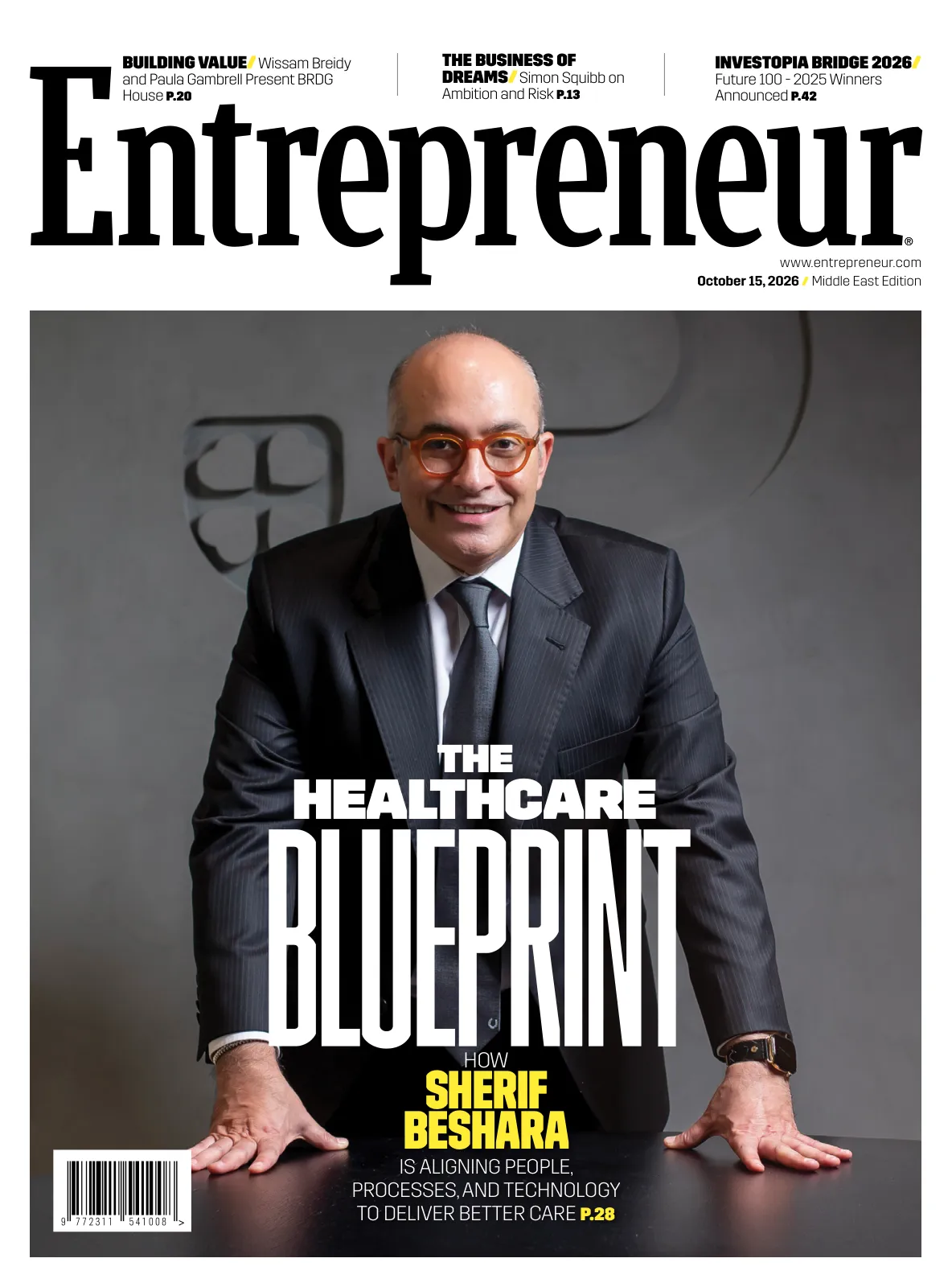
Entrepreneur Middle East, October 15, 2026
Page 1
INVESTOPIA BRIDGE 2026/
Future 100 - 2025 Winners
Announced P.42
BUILDING VALUE/ Wissam Breidy
and Paula Gambrell Present BRDG
House P.20
THE BUSINESS OF
DREAMS/ Simon Squibb on
Ambition and Risk P.13
www.entrepreneur.com
October 15, 2026 Middle East Edition
HOW
SHERIF
BESHARA
IS ALIGNING PEOPLE,
PROCESSES, AND TECHNOLOGY
TO DELIVER BETTER CARE P.28
HEALTHCARE
THE
BLUEPRINT
Page 2
Page 3
Eywa Way of Water is a state-of-the-art residential community with only
65 exceptional waterfront residences, with a holistic wellness ecosystem, curating
authentic experiences and best-in-class amenities few have dreamed of.
Contact us today:
+971 54 308 6000 I sales@byrevolution.com
E Y
W A
.
A E
E V E R Y T H I N G T H AT O N E C O U L D I M A G I N E
F O R E X T R A O R D I N A R Y L I F E
Page 4
The Mirra 2 Chair just keeps getting better. How?
We updated the chair so it’s 30 percent lighter
than the original Mirra - and the chair’s nylon base
and spine are now 100 percent recycled content.
We also gave it a fresh, inspired colour palette so it
can look professional, casual, or sporty. One thing
that hasn’t changed is the flexible yet supportive
design that allows your body to move naturally and
freely - the way it was meant to move.
The Mirra® 2
Chair is turning
heads again
hermanmiller.com
© 2026 Herman Miller
Page 5
P.28
The
Healthcare
Blueprint
How SHERIF BESHARA is
aligning people, processes,
and technology to deliver
better care
P.13
The
Business of
Dreams
SIMON SQUIBB on ambition
and risk
P.20
Building
Value
WISSAM BREIDY AND PAULA
GAMBRELL rethink real estate
with BRDG House
FEATURES
Contents/October 15, 2026
5
October 15, 2026 / ENTREPRENEUR.COM /
Page 6
Page 7
Page 8
8 / ENTREPRENEUR.COM / October 15, 2026
STARTUP
SPOTLIGHT
IN THE LOOP
TREPONOMICS
Contents/October 15, 2026
P.57 Create Apps
Championship 2026
Winners of third edition announced
in Dubai
P.60 Create AI Agents
Championship
H.H. SHEIKH HAMDAN launches global
competition with over AED2.5 million
in prizes
P.62 Mapping the Way Home
How AHLAN helps international
professionals settle in Saudi Arabia
P.64 Business-Ready Founders
ALI AL MEHAIRI on ADGM ACADEMY’S
approach to entrepreneurship
P. 74 CREATORS HQ and AMAZON Ads
unveil inaugural Amazon Creators
Foundry cohort
P. 76 Mistral AI’s ARTHUR MENSCH on
the divide between open and closed
AI
P. 78 UAE President Adviser
H.E. FAISAL AL BANNAI on why the UAE
has an edge in AI
P.49 Healthcare to Healthspan
Aster DM Healthcare’s ALISHA MOOPEN
on how longevity could reshape the
UAE’s healthcare economy
P.52 Beyond the Symptoms
In Good Wealth co-creator CHARIS
MARR explores the quiet costs of
menopause
P. 38 Betting on the UAE
H.E. MOHAMED H. ALSUWAIDI on AI, capital
and the UAE’s economic resilience at
Investopia Bridge 2026
P. 40 Bridges of Trust
NOURA AL KAABI on the UAE’s approach
to global partnerships at Investopia
Bridge 2026
P. 42 Backing Business Growth
‘FUTURE 100’ recognizes its third cohort
at Investopia Bridge 2026
P.44 Going Global
Trendyol Gulf CEO MOHAMAD ELANSARI
on expanding Gulf brands globally
INNOVATOR
8
CEO Wissam Younane
wissam@bncpublishing.net
MANAGING DIRECTOR Rabih Najm
rabih@bncpublishing.net
ART DIRECTOR Simona El Khoury
EDITOR IN CHIEF Tamara Pupic
tamara@bncpublishing.net
EDITOR AT LARGE Anil Bhoyrul
anil@bncpublishing.net
SENIOR FEATURES EDITOR Aalia Mehreen Ahmed
aalia@bncpublishing.net
JUNIOR EDITORIAL ASSISTANT Kristine Erika Agustin
kristine@bncpublishing.net
DIRECTOR OF INNOVATION
Sarah Saddouk sarah@bncpublishing.net
GROUP SALES DIRECTOR – B2B GROUP
Joaquim D’Costa jo@bncpublishing.net
HEAD OF PARTNERSHIPS
Samir Glor Samir@bncpublishing.net
BUSINESS DEVELOPMENT DIRECTOR
Andy Soulahian andy.soulahian@bncpublishing.net
COMMERCIAL LEAD
Anna Chipala anna@bncpublishing.net
COUNTRY MANAGER KSA
Amjad Fakhouri amjad@bncpublishing.net
COLUMNIST Tamara Clarke
CONTRIBUTING WRITERS
Alisha Moopen, Charis Marr
SUBSCRIBE
Contact subscriptions@bncpublishing.net to receive
Entrepreneur Middle East every issue
COMMERCIAL ENQUIRIES
sales@bncpublishing.net
ENTREPRENEUR.COM
Access fresh content daily on our website
All Rights Reserved 2026. Opinions expressed are solely those of the contributors.
Entrepreneur Middle East and all subsidiary publications in the MENA region
are officially licensed exclusively to BNC Publishing in the MENA region by
Entrepreneur Media Inc. No part of this magazine may be reproduced or
transmitted in any form or by any means without written permission of the publisher.
Images used in Entrepreneur Middle East are credited when necessary. Attributed
use of copyrighted images with permission. All images not credited otherwise
Shutterstock. Printed by United Printing and Publishing.
PO BOX 502511 DUBAI, UAE
P +971 4 4200 506
EntMagazineME
Entrepreneur-me
→ BNC Media Group CEO
Wissam Younane joined
fellow partners of Future
100 on stage alongside
H.E. Abdulla bin Touq Al
Marri, UAE Minister of
Economy and Chairman
of Investopia, at
Investopia Bridge 2026
in Abu Dhabi.
Page 9
100
THE
Influence.
In every
dimension.
The people
shaping
the region.
The stories
that
deserve to
be told.
w w w. t h e1 0 0 m e . c o m
Page 10
Editor’s Note/
Editor’s Note/
J
ust as we were getting used to generative artificial
intelligence (AI), a new term has entered the
conversation: agentic AI. But what exactly is it,
and why does it matter?
Traditional AI analyzes information, recognizes
patterns, and makes predictions. Generative AI,
popularized by tools such as ChatGPT, goes further
by creating text, images, and other content in response
to our instructions. Agentic AI represents the next step:
instead of simply telling us how to do something, it can
actually do it.
Imagine asking AI to organize a business trip.
Generative AI can recommend flights and hotels, while
agentic AI, with the necessary permissions, could make
reservations, coordinate your schedule, and manage the
entire process.
Now imagine applying that capability to healthcare,
transportation, public services, or entire cities.
This month, Mohammad Al Gergawi, UAE Minister of
Cabinet Affairs, announced the US$1 million Agentic
AI Award, developed by Dubai Municipality and the
World Economic Forum. The competition will bring
together more than 10,000 participants from 150
countries to develop AI solutions that improve urban
services and quality of life.
The initiative reflects the UAE’s broader ambitions.
Earlier this year, the government announced plans to
transition 50% of government sectors, services, and
operations to agentic AI within two years.
For entrepreneurs, this signals a significant opportunity.
As AI moves from generating information to executing
tasks, entirely new business models will emerge,
transforming how companies operate and services are
delivered.
Of course, greater autonomy demands stronger
safeguards, accountability, and human oversight.
But beyond the technological and economic
implications, there is a more personal question worth
considering. If agentic AI takes over many of the tasks
FROM GENERATIVE AI TO AGENTIC AI
Tamara Pupic
Editor in Chief | Entrepreneur Middle East
that currently fill our days, it could give us back
something increasingly precious: time.
And that leaves us with perhaps the most interesting
question of all: What will you do with that extra time?
10 / ENTREPRENEUR.COM / October 15, 2026
Page 11
Page 12
The World’s Largest
AI-First Expo & Summit
The New Intelligence
Order from Abu Dhabi,
the AI Capital of the World
SAVE
THE DATE
AIEverythingAbuDhabi.com
#AiEverythingAbuDhabi
GET INVOLVED
DESTINATION PARTNER
ORGANISED BY
GLOBAL PARTNER
HOST PARTNER
1113
MAY
2027
ADNEC CENTRE
Page 13
The Business of Dreams
British entrepreneur, investor, and HelpBnk founder Simon Squibb on turning dreams into reality,
building trust through personal branding, embracing risk, and why entrepreneurs in the UAE must be
willing to take more chances. by AALIA MEHREEN AHMED
→ Simon Squibb is a
British entrepreneur,
investor, author, and
founder of HelpBnk, a
platform dedicated to
helping people start
businesses and pursue
their entrepreneurial
ambitions.
13
October 15, 2026 / ENTREPRENEUR.COM /
IMAGE COURTESY SIMON SQUIBB OFFICIAL WEBSITE / WWW.SIMONSQUIBB.COM
Page 14
W
hat's Your Dream?" is a
question that has not
only become
synonymous with Simon
Squibb, it is, at times,
almost a prefix to his
actual name (just a
couple of weeks before
this interview, someone outside my job circle
spoke of Squibb as "the man on Instagram
who asks people on the streets what their
dreams are"). “I discovered something in the
last seven years that I didn't know about
myself: I get more satisfaction from giving
someone a present than receiving a present. I
get more satisfaction helping someone else
than just helping myself,” Squibb tells me,
when I ask him how repeatedly asking that
singular question has changed his own life.
“When I became a father, I chemically
changed as well. My son is now nine years
old. So in this process, I've realized he won't
do what I tell him to do; he'll only do what I do.
So the only way to really inspire young
people, including my own son, is to actually do
good in the world. Make a difference. Help
people. That's what I've discovered.”
B
ut within the first few moments of meeting
Squibb, the multi-millionaire entrepreneur and
investor does not ask me his trademark question.
Instead he asks me this: “Why don't you just ask
AI?”
“Chances are my audience will. You don't need me. If it's
just my knowledge, my audience will be thinking, ‘Well,
just ask AI,’” he further explains. As I proceed to explain
why AI will only be able to offer me snapshots of what
Squibb has said in the past, and not his present and
updated insights, Squibb adds: “Humans will always have
a place in the future… We want to know who the human is
to make sure we're not backing a fake human. AI doesn't
have a backstory; we have backstories. That's what makes
us interesting. At the same time, a lot of people are scared
[of AI], and I think they're unnecessarily scared. You need
14 / ENTREPRENEUR.COM / October 15, 2026
→ Having started his first
business at the age of 15
after experiencing
homelessness, Simon
Squibb has since founded
28 companies and
invested in over 78
startups. His
entrepreneurial journey
also includes the
successful sale of his
Hong Kong-based agency,
Fluid, to PwC.
B/Profile
Page 15
15
October 15, 2026 / ENTREPRENEUR.COM /
to tool up. You need to get ready. You need
to leverage these tools. You need to learn
how they work. But we are going to always
be servicing humans as humans.”
Earlier in the day —on Day 1 of the
Sharjah Investment Forum 2026, which is
where this interview takes place— Squibb
addressed a massive audience and
explained the three tenets he believes
make up the purpose of life: Commit,
Community, Change. “I'm not self-made.
It's impossible,” he told the packed hall.
“You need a community to make anything
work. Imagine if all of us in this room, all
of us, decided to help one person today.
Imagine the difference we could make to
that person's life. Between your network,
your contacts, we could change one
person's life.”
But despite the beaming optimism that
Squibb radiates, his mindset doesn’t stem
from idealism or what the Internet terms
as “toxic positivity.” “The key to making a
dream a reality is that it has to be
personal,” he says. “I often tell people your
purpose is hidden in your pain. If you can
leverage pain to do some good, you won't
stop. If there's a problem you're solving in
the world that has bothered you, you
won't stop. Now, if you don't have pain, I
wish it upon you a little bit because it
gives you motivation and purpose. And if
you don't have pain, go out with someone
that does. You'll see what it looks like. And
it's really powerful because good luck and
bad luck are both still luck. People need to
leverage luck, be it bad or good. And I
notice people that really, really do well,
they don't just want it, they need it.”
Squibb, of course, is no stranger to dealing
with life’s blows. Having lost his father at
the age of 15, he had to build what he calls
the “entrepreneur muscle” when he
decided to start a gardening company to
support himself and his family. In the
nearly four decades since that pivotal
decision, Squibb has gone on to build 28
different companies and has invested in
more than 80 startups. Then, in 2015, he
sold one of his Hong Kong-based
companies to global professional services
giant PwC — a move that would eventu-
ally bring him into “more money than he’ll
ever need,” as per his official website, and
birth the life mission that he continues to
work toward till today: to help 10 million
“The key to making a dream a reality is that it has to be
personal. I often tell people your purpose is hidden in your pain.
If you can leverage pain to do some good, you won't stop. If
there's a problem you're solving in the world that has bothered
you, you won't stop.”
↓ Simon Squibb with Aalia Mehreen Ahmed,
Senior Features Editor at Entrepreneur
Middle East
IMAGE COURTESY SIMON SQUIBB OFFICIAL WEBSITE / WWW.SIMONSQUIBB.COM
Page 16
B/Profile
people kickstart their businesses and
follow their dreams for free. And so, in
2023, he launched HelpBnk, a
London-headquartered online
platform that helps people start and
grow businesses by offering free
mentorship, resources, community
support, and access to accelerators
and funding. The concurrent #Give-
WithoutTake movement, which takes
place primarily through street
interviews where Squibb asks random
passersby “What’s your dream?” has
helped him amass over 27 million
social media followers.
And according to Squibb, social media
is now key for entrepreneurs and
founders to build their personal
brands - but only if it’s done with the
right intent. “I think people need to
take the concept of personal branding
and boil it down to something much
simpler. What do your colleagues say
about you? Do they respect you? Are
you managing from the top down or
the bottom up? I think bottom-up
management is more powerful. You're
in it with them, and respect is earned,
not taken,” he says.
“So I think personal branding starts
with your ecosystem. It doesn't
necessarily start with the public… I
think people aren't building their
personal brands in the right way. You
need to build trust with your col-
leagues, your customers, and within
your industry. I spent 20 years
building that trust before I ever went
to the public and asked them to trust
me, too. And then, never be anybody
but yourself. Don't create a character.
Be you. It doesn't matter who you are;
let people see the real you. If you do
that, you can sustain your personal
brand. If you don't, you'll eventually
drop off.”
But even before personal branding
comes into the picture, an ever-elusive
question for entrepreneurs is when to
launch. When asked what advice he
has to offer on the matter, Squibb says,
“I think it depends on the industry
you're in. I do like the idea of building
it and shipping it as quickly as
possible. But equally, there are some
industries where, let's say pharmaceu-
ticals, you have people's lives in your
I THINK PERSONAL BRANDING STARTS WITH YOUR ECOSYSTEM. IT DOESN'T NECESSARILY START WITH THE
PUBLIC… I THINK PEOPLE AREN'T BUILDING THEIR PERSONAL BRANDS IN THE RIGHT WAY. YOU NEED TO BUILD
TRUST WITH YOUR COLLEAGUES, YOUR CUSTOMERS, AND WITHIN YOUR INDUSTRY. I SPENT 20 YEARS
BUILDING THAT TRUST BEFORE I EVER WENT TO THE PUBLIC AND ASKED THEM TO TRUST ME, TOO.”
→ With a social media
following of over 22 million,
Simon Squibb is known for
his inspirational street
interviews and
#GiveWithoutTake
movement. The Sunday
Times bestselling author of
What's Your Dream? is now
on a mission to help 10
million people start
businesses and pursue
their dreams.
16 / ENTREPRENEUR.COM / October 15, 2026
Page 17
willing to live humbly for a while to
come back up. But you'll never lose
the lessons you learn from taking a
risk. That knowledge is yours forever.
Even if you lose all your money, you
still own those learnings. And that's
what people aren't realizing about
risk. It's a learning experience, and
that's how you succeed. People see
risk as a potential financial down-
side. I see not taking risks as a
knowledge downside. If you don't
take risks, you won't gain the
knowledge, and you won't be
successful.”
To cement Squibb’s advice, and to
conclude this story, I want to share a
quote from his talk earlier in the day,
where he elaborated on the afore-
mentioned story of how he became
an entrepreneur in the first place: “I
was walking past a beautiful big
house, and they had a messy garden.
And my brain spoke to me, this
‘entrepreneur muscle,’ for the first
time, said: “Simon, knock on that
door. Take a risk. Be brave. Ask them
if they will pay you to tidy up their
garden.” I swallowed my pride. I
swallowed my fear. And I knocked
on that door. And someone kind -I
didn't know they were kind at the
time- but someone kind came to the
door, looked me up and down and
said, “How can I help you?” I said: “I
notice your garden's messy. I'm
starting a gardening company.
Would you let me take care of your
garden?” And they said, okay, how
much? And I said, 200 pounds a
month.
“I felt alive. I had taken an idea in my
head and made it real! It was my
first experience with that. No one
ever told me this was possible. The
chairs that we're all sitting on, once
in someone's head, they made it real.
This stage, once inside someone's
head, they made it real. This
microphone, once in someone's
head, and they made it real. We
humans are incredible.”
hands. So you have to be very careful. I
think there's no general rule.”
As is typical of Squibb’s tips-sharing
approach, he offers two of his most
recent ventures as examples. “I have
launched 28 companies in my life, and
each of them had a different timeline
for when it was appropriate to launch,”
he shares.
“For example, I've just launched a new
coffee brand called Dream Brew. It
took me a year and a half to get the
product right. I needed that time to
create a product I truly believed in. I
could have launched it six months
earlier, but it didn't taste the way I
wanted it to. I could have shipped it,
but I think it was better to wait. On the
other hand, when I launched the
software product for HelpBnk nearly
four years ago, it was awful. People
couldn't even press the buttons
properly. But slowly, we improved it.
We found out what people really
needed by asking the market what they
wanted. We built a basic version. It
was rubbish, but people gave us
feedback, and we kept improving it.
So, ultimately, every business is
different.”
Squibb’s advice feels almost tailor-
made for a nation like the UAE, which
has become a premier launchpad for
companies across different stages of
growth and in a myriad of industries.
Indeed, in 2025 alone, it became home
to approximately 250,000 new
companies (as per information shared
by the Ministry of Economy and
Tourism), thus bringing the total
number of registered businesses in the
country to roughly 1.4 million by the
end of the year.
But while the UAE’s entrepreneurial
ambitions, spirit and growth have
certainly become the blueprint for
many, Squibb says there is one thing
founders in the country can do better
to unlock their full business potential:
“Take more risks! I think if you take
risks, you'll get more luck. More luck
leads to success. And if you don't take
risks, you reduce your chances of
success. Every day, I take a risk, and if
I don't, my chances of succeeding
drop. I think you fail if you don't take
risks.”
“That's what I love about business,” he
adds. “You can say, at worst, I lose all
my money and have to start again.
There's so much money in the world.
There's plenty of it. You just need to be
... Even if you lose all your money, you still own those
learnings. And that's what people aren't realizing
about risk.
17
October 15, 2026 / ENTREPRENEUR.COM /
Page 18
Standard Chartered Bank UAE is licensed
by the Central Bank of the UAE
Corporate & Investment Banking.
Global Markets. Global Banking. Transaction Services.
Now is your time
sc.com/cib
Make growth
your next stop
Dub
Johannesburg
New York
Page 19
London
Singapore
bai
Shanghai
Page 20
Bringing together complementary commercial and development
experience, the two founders introduce BRDG House as a
strategic development partner built on a simple philosophy: “We
Build Value Before We Build Projects.”
20 / ENTREPRENEUR.COM / October 15, 2026
WISSAM BREIDY AND PAULA GAMBRELL
LAUNCH BRDG HOUSE TO RETHINK
HOW REAL ESTATE VALUE IS BUILT
Page 21
21
October 15, 2026 / ENTREPRENEUR.COM /
W
issam Breidy and Paula
Gambrell are joining forces
to launch BRDG House, a
new strategic development
partner created to work
alongside real estate
developers from the earliest
stages of value creation
through development,
positioning and
commercialization.
For more than two decades,
Breidy has built his career
around communication,
reputation, brand building
and the power of public
trust. His experience has
extended from media and
communication into
advising businesses and
leadership teams on brand
transformation, strategic
positioning and reputation,
helping organizations
strengthen how they are
perceived, build relevance
and translate trust into
business value. Most
recently, as CEO of HRE
Development, he brought
that philosophy directly into
real estate, playing a central
role in transforming the
developer’s market
positioning and
strengthening its brand
presence in Dubai. His
experience reinforced a
belief that continues to
shape his commercial
thinking: strong brands
create trust, trust creates
demand, and sales are
ultimately the result of
many decisions made before
the transaction begins.
Gambrell brings a
complementary perspective
to that same belief, one
shaped by finance before
real estate. She began her
career at HSBC on the
product side of the business,
where mortgages gave her
an early, lender’s-eye view of
how property is bought,
financed and valued. She
went on to spend more than
15 years on the commercial
side of development across
the UAE and Saudi Arabia,
working with leading
developers including
DAMAC, Ellington
Properties and Dar Global
on sales strategy, joint
venture structuring,
development management
and international sales
channels reaching buyers in
China, India and the GCC.
That combination of
financial grounding and
commercial execution has
kept her focused on one
question: whether a
development decision will
ultimately turn into value.
Their professional journeys
were different, but their
conclusion was increasingly
the same.
Real estate developments
are often approached
through separate disciplines
-strategy, product,
architecture, development,
brand, marketing, sales and
operations- when the value
of a project ultimately
depends on how those
decisions work together.
That shared conviction led
them to establish BRDG
House.
Their philosophy is
captured in one sentence:
We Build Value Before We
Build Projects.
As BRDG House makes its
market debut, Breidy and
Gambrell explain why they
came together, what they
believe is missing from the
traditional development
model, why brand and trust
have commercial value, and
why the decisions that
ultimately determine a
project’s success begin long
before sales.
}You both had established
careers before BRDG House.
Why did you decide to build
something together?
WISSAM: What brought us
together wasn’t that we
were opposites. It was that
we were looking at the
industry through different
experiences and arriving at
many of the same
conclusions.
We both come from strong
commercial backgrounds.
My journey started long
before real estate. I spent
more than two decades in
media and communication,
where I learned how
reputation is built, how
“A PROJECT HAS A LIFECYCLE. A
DEVELOPER’S REPUTATION CARRIES FROM
ONE PROJECT TO THE NEXT.”
WISSAM BREIDY
Page 22
22 / ENTREPRENEUR.COM / October 15, 2026
people make decisions
and, most importantly,
how difficult trust is to
earn and how valuable it
becomes once you have
it. When I moved into
real estate and eventually
became CEO of HRE
Development, I had the
opportunity to apply that
thinking to a developer
brand. What interested
me wasn’t simply how to
market individual
projects. It was how you
build trust in the
developer itself.
How do you create a
reputation that gives
people confidence? How
do you build meaningful
relationships with the
brokerage community?
How do you create a
brand the market
recognizes before the
next project is even
announced? That
experience reinforced
something I strongly
believe today: Brand has
commercial value.
Paula reached the same
conclusions from finance
and the commercial side
of development.We were
bringing together two
commercially minded
people who understood
value creation from
different perspectives.
That became the
foundation of BRDG
House.
PAULA: I had seen the
same pattern for years. In
banking, I learned to look
at property the way a
lender does: what makes
an asset financeable and
what holds its value. On
the developer side, I saw
how often a project
reached the sales team
with its most important
commercial decisions
already locked in. You
cannot make the major
development decisions
first and then ask brand,
marketing and sales to
create value around them
at the end. By then, many
of the decisions
determining the
commercial outcome
have already been made.
WISSAM had reached the
same conclusion from the
brand side. He
understood how a
developer earns the
market’s trust. I
understood how a project
earns its numbers.That
complementarity is what
made building BRDG
together compelling.
}What did you believe
was missing in the
traditional development
model?
PAULA: Integration. Real
estate has extremely
capable specialists
-architects, development
managers, consultants,
designers, commercial
teams, branding
agencies, marketing
teams, brokers and sales
teams.The challenge isn’t
necessarily the quality of
those individual
disciplines. The challenge
is that they can operate
independently.
But the decisions are
interconnected. Product
affects pricing. Pricing
affects positioning.
Positioning affects
demand. Development
decisions affect customer
experience. Execution
affects reputation. And
all of them ultimately
affect commercial
performance. That is
where integration
becomes key between all
these disciplines. We saw
an opportunity to create
a model that connects
“BRAND CREATES TRUST. TRUST REDUCES FRICTION.
AND WHEN THE PROPOSITION IS RIGHT, TRUST HELPS
CREATE DEMAND.”
WISSAM BREIDY
B/Real Estate
Page 23
23
October 15, 2026 / ENTREPRENEUR.COM /
those decisions around one strategic
direction.
WISSAM: And the customer doesn’t see
those separate disciplines. They see one
development. They see one developer.
And ultimately they make one decision
about whether they believe in it, trust it
and see value in it.That’s why we believe:
Complexity doesn’t create value.
Alignment does.
}Is that why you describe BRDG House
as a strategic development partner?
WISSAM: Exactly. We’re very deliberate
about that definition. BRDG is not a
marketing agency. We’re not a branding
agency. We’re not simply a sales company.
And we’re not a traditional consultancy
that produces a strategy document and
leaves the developer to connect
everything afterwards. We work
alongside developers across the
development and commercial journey.
Our value isn’t one isolated service. Our
value is connecting the decisions that
create the outcome.
PAULA: The word partner matters and
like Wissam said, we are not here to build
a strategy document, we are here to work
alongside the developer to execute it with
them and make them stronger as a result
of it. To create meaningful value, you
need to understand the developer’s
business, objectives, projects and
organization. That requires involvement.
Strategy, commercial thinking,
development management, product,
“A DEVELOPMENT HAS
TO WORK AS A
PRODUCT, AS A
BUSINESS AND AS AN
ORGANIZATION.”
PAULA GAMBRELL
Page 24
24 / ENTREPRENEUR.COM / October 15, 2026
positioning, brand and
execution need to work
toward the same objective
rather than being treated as
independent scopes.
}Your philosophy is “We
Build Value Before We Build
Projects.” What does that
mean?
WISSAM: It means value
creation starts much earlier
than people often think.
Before construction, before
marketing and certainly
before sales, there are
fundamental questions that
need to be answered. Who
are we building for? What
does the market need? What
do people value? What is
missing? What should the
product be? How should it
be positioned? Why should
people trust it? Why should
they choose it? What gives it
pricing power? What will
make brokers believe in it?
Every one of those decisions
can create -or destroy- value
before the market ever sees
the development. That’s
what we mean when we say:
We Build Value Before We
Build Projects.
PAULA: That value has to be
embedded in the
development itself.
Feasibility, product,
development strategy,
commercial strategy, design
decisions, organizational
capability and execution all
influence the eventual
outcome. By the time you
physically build the project,
you should already
understand what value
you’re trying to create, for
whom you’re creating it and
how the development is
going to deliver it.
}Wissam, your experience as
CEO of HRE Development
appears to have shaped your
thinking about brand. What
did you take from that
experience?
WISSAM: One of the most
important lessons was
understanding the difference
between building a project
brand and building a
developer brand. A project
has a lifecycle. A developer’s
reputation carries from one
B/Real Estate
“BY THE TIME A PROJECT REACHES
THE SALES GALLERY, ITS PRICE
CEILING HAS ALREADY BEEN SET. OUR
JOB IS TO SET IT HIGHER.”
PAULA GAMBRELL
Page 25
25
October 15, 2026 / ENTREPRENEUR.COM /
project to the next.
My focus therefore wasn’t simply on
creating visibility around what we were
selling. It was about building trust
around who was behind it. How brokers
perceive you matters. How customers
experience you matters. How
consistently you communicate matters.
What you promise matters. And
whether you deliver against that
promise matters even more.
When those things start working
together, something changes. You’re no
longer introducing yourself from zero
every time you launch a project. The
reputation you’ve built begins creating
confidence before the commercial
conversation even starts. That’s when I
understood very clearly that brand isn’t
simply a marketing asset. It’s a business
asset. That thinking became an
important part of what Paula and I are
building at BRDG.
Why do you describe trust as having
commercial value?
WISSAM: Because in real estate, people
are often buying a promise. They may be
committing significant capital to
something they will not physically
receive for years. So before they buy the
property, they’re making another
decision: Do I trust the people and the
company behind it? That trust
influences the customer. It influences
the broker. It influences pricing power.
It influences how the market responds
to your next development. And over
time, it influences the value of the
developer brand itself.
That’s why I don’t separate brand from
commercial strategy. Brand creates
trust. Trust reduces friction. And when
the proposition is right, trust helps
create demand.
}Paula, how has your commercial
background shaped the way you think
about development?
PAULA: Banking taught me to look at a
project the way a lender or an investor
does. Before anyone asks whether it will
sell, they ask whether it holds together:
the land cost, the feasibility, the
structure, the exit. Working on the
developer side, with groups including
DAMAC, Ellington and Dar Global,
showed me the other half: how that
same project performs once it meets real
buyers, in the UAE, in Saudi Arabia and
across international markets. So my
questions start early. What are we
building, and for whom? Does the
feasibility work? How is the
development structured? And can the
organization execute the strategy? That’s
why I don’t see development and
commercial strategy as separate
conversations. A development has to
work as a product, as a business and as
an organization.
}So is BRDG ultimately a commercially
driven business?
WISSAM: Absolutely. But our definition
of commercial is broader than sales.
Commercial doesn’t simply mean sales.
Commercial means creating the
conditions that make sales possible.
Strategy. Product. Brand. Positioning.
Pricing. Experience. Trust.
Communication. Distribution.
Execution. When those elements work
together, you create demand. And when
genuine demand exists, sales become a
consequence rather than the entire
strategy.
PAULA: That’s something we
fundamentally agree on. Commercial
thinking should influence development
from the beginning. It shouldn’t arrive
at the end as a function expected to
monetize decisions that have already
been made.
}Why is the human element so
important to a business focused on
commercial value?
WISSAM: Because behind every
commercial number is a human
decision. Someone is choosing where to
live. Someone is deciding where to
invest. Someone is deciding whether a
home works for their family. Someone is
“THE STRONGEST
COMMERCIAL
DECISIONS ARE MADE
LONG BEFORE A
PROJECT REACHES THE
MARKET.”
WISSAM BREIDY
Page 26
26 / ENTREPRENEUR.COM / October 15, 2026
deciding whether they
trust a developer.
Someone is deciding
whether one development
is worth paying more for
than another. Data helps
us understand behavior,
but ultimately people
create demand. So
understanding what
matters to people should
influence what we build.
Better understanding
leads to better decisions.
Better decisions create
stronger products,
stronger demand and
stronger long-term value.
PAULA: That
understanding has to
translate into the
development. Customer
insight isn’t useful if it
remains in a
presentation.It needs to
influence product,
layouts, experience,
development decisions
and execution. That’s
where human
understanding becomes
development value and
ultimately commercial
value.
}Do developers
sometimes expect too
much from marketing
and sales?
WISSAM: Sometimes
marketing and sales are
asked to solve problems
that should have been
solved much earlier.
Marketing is important.
Sales are critical. Brand is
fundamental. But none of
them can permanently
compensate for a weak
proposition. If the
product is wrong, if the
positioning is unclear, if
pricing doesn’t make
sense or if the market
doesn’t trust the
developer, you can’t
simply increase the
marketing budget and
expect those issues to
disappear. You cannot
communicate your way
out of a weak proposition.
Marketing should
amplify value that already
exists. It shouldn’t be
expected to invent that
value at the end.
}Dubai is becoming an
increasingly competitive
development market.
What does that mean for
developers?
WISSAM: It raises the
standard. Customers have
enormous choice and
increasingly good access
to information.
Developers can’t rely
indefinitely on the same
language, amenities or
formulas to differentiate.
The question becomes:
Why should somebody
choose you?
Not simply: why this
apartment? But why this
developer? Why this
proposition? Why this
price? Why should I trust
you? That’s where
positioning, brand and
reputation become
increasingly important.
PAULA: It also means
developers need greater
discipline. As portfolios
grow, complexity
increases. You need
stronger decision-
making, clearer processes
and better alignment
between commercial
strategy and development
execution. A more
sophisticated market
requires more
sophisticated
development
organizations.
B/Real Estate
Page 27
27
October 15, 2026 / ENTREPRENEUR.COM /
}Where should commercial
thinking enter the
development process?
PAULA: As early as
possible. Some of the most
commercially important
decisions are made before
there is anything to sell.
Market opportunity.
Feasibility. Product. Unit
mix. Customer. Design
direction. Pricing
assumptions. Development
strategy. If commercial
intelligence is involved
early, those decisions can
reinforce one another.
WISSAM: By the time we
reach launch, we shouldn’t
be trying to discover why
the project matters. That
answer should already
exist. The strongest
commercial decisions are
made long before a project
reaches the market. At
launch, we’re
communicating the value
that has already been built
into the development.
}How do you define value
at BRDG?
PAULA: Value is when
better thinking translates
into better outcomes. A
strong product. Greater
clarity. Simpler processes
Better decisions. Better
execution. A stronger
organization. And
ultimately stronger
commercial performance.
WISSAM: And value isn’t
simply how many units you
sell. Did we create genuine
demand? Did we create
pricing power? Did we
build trust? Did we
strengthen the brand?
Does the market
understand why this
development deserves to be
chosen? Does what we’re
building today make the
next development
stronger? That’s the
difference between
completing transactions
and building long-term
value.
}Where do you want BRDG
House to go from here?
PAULA: I want BRDG to
become a trusted Strategic
Development Partner that
developers bring into
important conversations
early. Not because they
need another consultant,
but because they see the
value of connecting
commercial strategy,
development and execution
from the beginning. I want
to build a platform capable
of working alongside
ambitious developers
across multiple projects
and in multiple
geographies.
WISSAM: And I want
BRDG to have relevance
beyond the projects we’re
involved in. Projects create
proof.But a strong brand
has to contribute
something beyond its own
business. We want BRDG
to create conversations,
intelligence and initiatives
that bring developers,
investors, partners and
industry leaders together
around the issues shaping
the future of development.
We don’t want to appear
only when we have
something to launch or
sell. We want to remain
relevant because we’re
contributing something
valuable to the industry.
Projects create proof.
Relationships create
opportunity. Ideas create
relevance. That’s how
BRDG becomes more than
a service company. It
becomes a platform.
}Finally, if each of you had
to summarize BRDG’s
philosophy in one thought,
what would it be?
PAULA: By the time a
project reaches the sales
gallery, its price ceiling has
already been set. Our job is
to set it higher.
WISSAM: For me: Sales
are not the strategy. Sales
are the result. Before sales,
you need the right strategy.
The right product. The
right positioning. The
right brand. Trust.
Experience. Pricing.
Execution. When those
things are aligned, you
create demand. And that’s
ultimately the thinking
behind BRDG House:We
Build Value Before We
Build Projects.
“COMPLEXITY DOESN’T
CREATE VALUE.
ALIGNMENT DOES.”
BRDG HOUSE
Page 28
28 / ENTREPRENEUR.COM / October 15, 2026
28 / ENTREPRENEUR.COM / October 15, 2026
Page 29
29
October 15, 2026 / ENTREPRENEUR.COM /
BEYOND
MEDICAL
EXCELLENCE
29
October 15, 2026 / ENTREPRENEUR.COM /
HOW
SHERIF BESHARA
IS RETHINKING
HEALTHCARE
LEADERSHIP
Page 30
30 / ENTREPRENEUR.COM / October 15, 2026
A
s Group CEO of the
Mohamed & Obaid
AlMulla Group of
Companies, the
parent company of
American Hospital
Dubai, Sherif Beshara
is advancing a
leadership philosophy
built on a fundamental principle:
delivering world-class healthcare
requires more than exceptional
physicians and advanced
technology. It requires an
organization designed to make their
expertise work together for the
patient.
}}
F
or decades, the global healthcare industry has pursued
progress through greater medical specialization,
increasingly sophisticated technology and substantial
investments in clinical infrastructure. Hospitals have
competed to attract renowned physicians, establish specialized
departments and introduce the latest diagnostic and surgical
capabilities.
Yet, as healthcare becomes more advanced, it also becomes more
complex, raising a fundamental question for those responsible for
leading its institutions: How can hospitals ensure that
increasingly sophisticated medical expertise translates into better
experiences and outcomes for patients?
For Sherif Beshara, Group CEO of the Mohamed & Obaid AlMulla
Group of Companies, the parent company of American Hospital
Dubai, the answer lies as much in organizational excellence as it
does in clinical excellence.
A hospital may employ exceptional physicians and invest in the
most advanced medical technologies, but the value of those
Page 31
31
October 15, 2026 / ENTREPRENEUR.COM / 31
October 15, 2026 / ENTREPRENEUR.COM /
Page 32
32 / ENTREPRENEUR.COM / October 15, 2026
investments can be
diminished if patients
encounter fragmented
processes, poor
communication or
unnecessary delays in
accessing care. The
challenge, therefore, is
not simply to build an
institution capable of
delivering excellent
medicine, but to create
an organization in which
every component works
towards that objective.
It is a distinction that
places operational
performance,
organizational culture
and multidisciplinary
collaboration at the
centre of Beshara’s
approach to healthcare
leadership.
And it reflects a broader
shift taking place across
the international
healthcare industry: from
institutions organized
primarily around medical
specialities towards
integrated systems
designed around the
needs of individual
patients.
LEADING BEYOND
CLINICAL EXPERTISE
Beshara’s perspective on
healthcare leadership is
informed by an
unconventional
professional background.
With an Executive MBA
from Georgetown
University and a master’s
degree in international
law, his career spans
corporate governance,
legal counsel and
business management
rather than clinical
medicine.
In an industry
traditionally shaped by
medical expertise, that
background offers a
different way of
examining the structures
through which healthcare
is delivered.
Legal and corporate
governance disciplines
place considerable
emphasis on
accountability, risk
management, decision-
making and the
relationship between
institutional
responsibilities and
individual authority.
Business management,
meanwhile, introduces
questions about
organizational efficiency,
resource allocation and
the ability to translate
strategic ambitions into
measurable results.
Applied to healthcare,
these disciplines
encourage a systems-level
view of the organization.
Rather than considering
departments, services
and professional teams in
isolation, this approach
examines how their
decisions and activities
influence one another,
and, ultimately, the
patient.
The distinction is
particularly important in
an environment where
clinical decisions must
remain firmly in the
hands of qualified
medical professionals.
Beshara’s role is not to
substitute executive
authority for medical
judgement. It is to
establish the conditions
in which highly
specialized professionals
can exercise that
judgement effectively,
with the resources,
systems and
organizational support
Beshara’s role is not to substitute executive authority for
medical judgement. It is to establish the conditions in
which highly specialized professionals can exercise that
judgement effectively, with the resources, systems and
organizational support required to deliver excellent care.
“
”
Page 33
33
October 15, 2026 / ENTREPRENEUR.COM /
required to deliver
excellent care.
This requires a leadership
model that recognizes the
limits of individual
expertise. A hospital CEO
cannot possess the
combined knowledge of
surgeons, oncologists,
radiologists, nursing
leaders, researchers and
operational specialists.
What the position
demands instead is the
ability to bring those
disciplines together,
establish shared priorities
and ensure that
institutional structures
support rather than
obstruct their work.
The result is a different
understanding of
executive leadership: one
in which the ability to
connect expertise becomes
as important as the ability
to direct an organization.
WHEN OPERATIONAL
EXCELLENCE BECOMES
CLINICAL EXCELLENCE
Perhaps the clearest
illustration of this
philosophy lies in an area
of healthcare that rarely
receives the same
attention as medical
breakthroughs: the patient
journey.
Consider a patient
referred to a specialist for
a potentially serious
condition. The
consultation may be
conducted by an
outstanding physician,
supported by sophisticated
diagnostic equipment and
informed by the latest
clinical evidence.
Yet the patient’s
experience—and
potentially the continuity
of their care—can still be
compromised by
difficulties arranging
appointments, delays
obtaining insurance
approvals, poor
coordination between
departments or
inadequate follow-up.
None of these problems
necessarily reflects a failure
of medical expertise.
Nevertheless, each can
affect the effectiveness of
healthcare delivery.
For Beshara, this is where
operational excellence
assumes clinical
significance.}}
Page 34
34 / ENTREPRENEUR.COM / October 15, 2026
It is not simply a question of reducing
administrative costs, increasing
productivity or improving financial
performance. It is about building an
organization capable of delivering
reliable, coordinated and accountable
care.
At American Hospital Dubai, a
collaboration with Mayo Clinic to
improve the gastroenterology patient
journey offers a practical example.
The initiative examined challenges
including insurance-related delays,
scheduling difficulties and gaps in
patient follow-up. By reviewing existing
processes, strengthening coordination
and introducing operational
improvements, the hospital reduced
endoscopy turnaround time from
approximately 20 minutes to 12.4
minutes—a reduction of around 38%.
The hospital also reported improvements
in patient follow-up and satisfaction.
Although the turnaround-time
improvement is an operational measure
rather than a direct clinical outcome, it
illustrates how systematic changes can
make healthcare delivery more efficient
and improve the experience of patients
moving through complex services.
More importantly, the initiative
demonstrates the value of international
healthcare collaboration beyond the
exchange of clinical knowledge or the
prestige associated with institutional
partnerships.
Its significance lies in applying expertise
to identify specific problems, redesign
processes and measure improvements.
For healthcare executives confronting
rising demand, growing clinical
complexity and increasing pressure on
THE RELEVANT QUESTION FOR HEALTHCARE LEADERS IS THEREFORE
NOT WHETHER AN INSTITUTION POSSESSES THE NEWEST EQUIPMENT,
BUT WHETHER A PARTICULAR INVESTMENT CAN DEMONSTRATE
MEANINGFUL CLINICAL VALUE.
Page 35
resources, this presents an
important proposition:
some of the most
meaningful improvements
in healthcare may come
not from introducing
entirely new capabilities,
but from ensuring that
existing capabilities work
together more effectively.
TECHNOLOGY MUST
PROVE ITS VALUE
The same principle
informs the role of
technology in Beshara’s
vision for American
Hospital Dubai.
Across the global
healthcare industry,
artificial intelligence,
robotic-assisted surgery,
molecular diagnostics and
precision medicine are
transforming the
possibilities of clinical
practice.
Yet technological
sophistication does not
automatically translate
into better healthcare.
The value of innovation
depends on whether it
improves diagnostic
accuracy, enables more
effective treatment,
supports clinical decision-
making or makes care
more accessible and
coordinated.
Advances in imaging,
pathology and AI-assisted
analysis, for example, can
help physicians identify
certain conditions earlier
and interpret increasingly
complex clinical
information. Molecular
profiling and genetic
testing can support more
personalized treatment }}
35
October 15, 2026 / ENTREPRENEUR.COM /
Page 36
36 / ENTREPRENEUR.COM / October 15, 2026
Page 37
37
October 15, 2026 / ENTREPRENEUR.COM /
decisions, particularly in areas such as oncology.
Similarly, robotic-assisted surgery and
minimally invasive techniques can provide
surgeons with enhanced visualization and
precision. For appropriately selected patients
and procedures, these approaches may offer
benefits including reduced postoperative pain,
shorter hospital stays and faster recovery.
However, these benefits depend on clinical
evidence, patient suitability and the expertise of
the professionals using the technology.
The relevant question for healthcare leaders is
therefore not whether an institution possesses
the newest equipment, but whether a particular
investment can demonstrate meaningful clinical
value.
This distinction becomes increasingly
important as hospitals navigate the growing
number of technological solutions entering the
market.
37
Page 38
38 / ENTREPRENEUR.COM / October 15, 2026
H
.E. Mohamed H. Alsuwaidi, UAE Minister of
Investment and Co-Chair of Investopia,
opened Investopia Bridge 2026 Abu Dhabi
with a message to investors. “Someone
looking at the UAE now, despite everything that has been
happening, can only ask, ‘If I were to make a bet on an
economy like the UAE is today, why wouldn’t I?’”
Being held at Park Hyatt Abu Dhabi Hotel and Villas on
Saadiyat Island under the theme “Investing in a More
Resilient World,” Investopia Bridge 2026 brings together
ministers, policymakers, investors, business leaders and
BRIDGE 2026
UAE Minister of
Investment
Mohamed H. Alsuwaidi:
“Why Wouldn’t You Bet
on the UAE?”
38 / ENTREPRENEUR.COM / October 15, 2026
Page 39
39
October 15, 2026 / ENTREPRENEUR.COM /
“
entrepreneurs to discuss the shifts
shaping the global economy and
investment landscape.
H.E. Alsuwaidi added, “We’re a
nation of about 12 million people
that is punching above its weight.
But productivity has always been
our strong suit. That is why the UAE
is one of the leading nations when it
comes to AI, both at an educational
level and an investment level. We
see AI technology continuing to be
our strongest advantage and
muscle to leverage in the future.
“All of that attracts capital- local
capital and third-party capital. We
have a very strong backbone for the
AI infrastructure, and our
infrastructure in general is one of
the most modern in the world.
“We have very deep pool of talent.
We have not seen a negative flow of
talent as a result of this conflict.
We’ve only seen a positive inflow of
talent and wealth. Ultra-high-net-
worth individuals have stayed here.
Yes, there have been some exits, but
there’s been a net positive in
general. Capital is deep and
available.
Alsuwaidi said the UAE had
managed the security situation of
recent months effectively, keeping
its institutions working and its
economy open, and had emerged
stronger.
When asked what building an AI
company and economy in the UAE
means in practical terms, Alsuwaidi
pointed to the UAE’s technology
adoption across sectors including
transportation, healthcare,
construction, defense and energy.
He said the UAE’s ability to test and
deploy emerging technologies
quickly would remain central to its
AI ambitions. “Our ability to get
things done and test them within
the ecosystem is relatively easy,” he
said. “We’re going to be a first
adopter, fast adopter, an innovator, a
leader in this space, and just see
more of it.”
All of that
attracts capital-
local capital
and third-party
capital. We have
a very strong
backbone for the
AI infrastructure,
and our
infrastructure in
general is one of
the most modern
in the world.
”
39
October 15, 2026 / ENTREPRENEUR.COM /
Page 40
40 / ENTREPRENEUR.COM / October 15, 2026
H
.E. Noura Al Kaabi, UAE
Minister of State at the
Ministry of Foreign
Affairs, placed trust,
reliability and reputation at the heart
of the UAE’s approach to
international partnerships during
Investopia Bridge 2026 Abu Dhabi.
Speaking during the session
“Bridges of Trust: Diplomacy, Capital
and Culture in the UAE–UK
Partnership,” Al Kaabi highlighted
the importance of building
relationships that extend beyond
formal agreements and withstand
periods of geopolitical and economic
uncertainty.
“The connection starts with people,
with seeds, with ideas. And I believe
that consistency, especially in
uncertain times, and being reliable is
the hardest reputation to carry.
“The work that we do is outside the
negotiation room. Negotiations can
happen in a day or two. Signing an
MOU can take a day, maybe even
minutes. But what lasts is the trust
and the partnership. It’s based on
that: How can I build economic ties,
people-to-people ties and political
ties?
BRIDGE 2026
UAE Minister of
State Noura Al
Kaabi:
“Our Reputation Is
Our Capital”
“
What I love
about the City of
London and the
partnership with
the UAE is that
we have those
hundreds of
years of history.
We have English
common law,
which is used in
40% of contracts
worldwide.
”
Page 41
41
October 15, 2026 / ENTREPRENEUR.COM /
“I’m in a strategic
partnership. It doesn’t
mean that if I sign that
agreement with a certain
geography, I am against
another geography.
Therefore, we always have
to be alert and resilient,
based on technological
changes, changing times,
political structures and,
unfortunately, the unrest
happening around us. But I
think the only consistent
element is the trust that
you build. And that trust
takes time.”
Al Kaabi concluded with a
message that connected
the UAE’s international
standing directly with its
approach to capital and
long-term partnerships.
“We want to be sustainable
in our capital,” she said.
“And our reputation is our
capital.”
Joining Al Kaabi in the
conversation, Dame Susan
Langley, The Rt. Hon. the
Lady Mayor of the City of
London Corporation,
echoed the importance of
trust in translating
diplomatic relationships
into economic
opportunities.
“Relationships take years
to build. So when we talk
about turning diplomacy
into economic reality, that
relationship gives you
permission to do so, but it
doesn’t happen overnight,”
Langley said.
“The City of London, or the
UK as a whole, and the
UAE have a really deep
and rich history. And I think
specifically now, we are
focusing on many of the
same things. In this
increasingly uncertain
geopolitical world, we’re
looking at diversification,
we’re looking at risk, we’re
looking at resilience.”
Langley pointed to the
UK’s legal and financial
infrastructure, as well as its
innovation ecosystem, as
areas underpinning its
relationship with the UAE.
“I have never, in my entire
life, used the words
stability, trust, history and
‘our word is our bond’ as
much about the UK. But
that’s true, and what I love
about the City of London
and the partnership with
the UAE is that we have
those hundreds of years of
history. We have English
common law, which is
used in 40% of contracts
worldwide.”
“So we have that depth of
knowledge and we have
the ecosystem that’s built
up. But on top of that,
we’re layering innovation.
We have the highest
number of fintechs in
Europe. We have the
highest number of fintech
unicorns. We have an
Oxford-Cambridge corridor
with life sciences booming
and now moving into
Canary Wharf.”
She added that the two
markets increasingly share
priorities around
technology and
investment.
“So in terms of the
relationship with the UAE,
you are also focusing on
AI, on technology, not just
investment. And that’s the
mirror image of where we
are in the City of London.
And I think, based on the
history we have of trust, it
allows us to move forward,
to share initiatives.
Investment is both ways as
well.”
“
Relationships
take years
to build. So
when we talk
about turning
diplomacy
into economic
reality, that
relationship
gives you
permission
to do so, but
it doesn’t
happen
overnight
”
Page 42
42 / ENTREPRENEUR.COM / October 15, 2026
BRIDGE 2026
I
n the presence of H.E. Abdulla bin
Touq Al Marri, Minister of Economy
and Tourism and Co-Chair of
Investopia, ‘Future 100’ – the joint
initiative between the Ministry of
Economy and Tourismm and the
Government Development and the
Future Office – honored its third cohort
of 100 companies. The ceremony took
place during the Investopia Bridge
2026 event in Abu Dhabi.
H.E. Bin Touq said, “The UAE is keen to
support startups and companies
operating in the new economy sectors
and help them develop their
businesses and expand into markets
through an integrated ecosystem of
enablers, legislation, incentives, and
programmes that grant them access to
funding, expertise, and markets, while
enhancing their ability to innovate and
forge new partnerships. The ‘Future
100’ initiative embodies this approach
by highlighting promising companies
every year and supporting their growth
and expansion.”
He added, “Since its launch, the
initiative has succeeded in attracting
investments worth US$100 million
through its partners, benefiting more
than 53 companies enrolled in the
initiative. It has contributed to
enhancing their access to investments
and partnerships and supporting their
ability to transform promising
opportunities into projects and
companies with high growth potential.
This aligns with the objectives of the
‘We the UAE 2031’ vision to consolidate
the country’s position as a global hub
for the new economy over the next
decade.”
Over the past three editions/cycles
since the initiative’s launch, 300
companies have been recognized from
3,395 applications received, including
1,282 applications in the third cycle,
reflecting growing interest in promising
companies within the new economy
sectors.
The selection process evaluates
applications across four main pillars:
creative capability, market potential,
business model sustainability and
scalability, and environmental, social,
and governance (ESG) impact.
The Future 100 list covers 17 sectors,
including space, biotechnology,
sustainability and environment, health
technology, HR technology, renewable
energy, creative industries, sharing
economy, agri tech, ed tech,
cybersecurity, advanced manufacturing,
food technology, fintech, smart mobility,
legal technology, and proptech. The
initiative also encompasses a range of
modern technologies and business
models, including e-commerce, sharing
economy, 3D printing, Internet of
Things, Web 3.0, robotics, metaverse, AI
‘Future 100’
Honors Its 2025 Edition
DOWNLOAD
THE
FUTURE 100
2025
REPORT.
Page 43
43
October 15, 2026 / ENTREPRENEUR.COM /
companies strengthen their ability
to attract funding, support
valuation, compliance, and
ownership management processes,
and offer training and mentorship
programs, plus a 25 per cent
discount on the annual subscription
to the Carta platform during the first
year.
The ‘Future 100’ initiative has been
expanding its partnership network
that includes government entities,
innovation funds, tech companies,
financial and banking institutions,
business accelerators and
incubators, and venture capital
funds, bringing the total number of
partners to 42 key partners include
the strategic partner Majra –
National CSR Fund, acceleration
partners Abu Dhabi Department of
Economic Development, Dubai
Future District Fund, Emirates NBD,
Mohammed bin Rashid Innovation
Fund, Investopia, Microsoft, MEVP,
Careem, EY, Eurasia Capital, In5,
Mohamed bin Zayed University of
Artificial Intelligence, FTI
Consulting, Nuwa Capital Ltd, EGF,
Carta, and DIFC Innovation Hub,
along with several community
partners from both the public and
private sectors.
enabled service enhancement, and
blockchain technology.
On the sidelines of Investopia Bridge
2026, the ‘Future 100’ initiative signed
three memoranda of understanding. The
first was with Nuwa Capital Ltd, aimed at
supporting the growth and expansion of
listed companies.
The second memorandum was signed
with Global Ventures to enhance
business development and partnership
opportunities for the listed companies,
support their growth, and participate in
evaluating applications. The company
also committed to investing at least US$1
million in one or more companies joining
the initiative.
The third memorandum with Carta will
provide specialized services that help
→ BNC Media Group CEO
Wissam Younane joined
fellow partners of Future
100 on stage alongside
H.E. Abdulla bin Touq Al
Marri, UAE Minister of
Economy and Chairman
of Investopia, at
Investopia Bridge 2026
in Abu Dhabi.
Page 44
Trendyol Gulf CEO Mohamad
ElAnsari
Trendyol Gulf CEO Mohamad ElAnsari is pursuing a two-part ambition: to make the e-commerce
platform part of daily life across the Gulf, while enabling local sellers and brands to reach customers
around the world.
M
ohamad
ElAnsari has a
simple measure
of success for
Trendyol in the Gulf: how
often customers open the
app. In less than three
years, the platform has
onboarded 15,500 regional
sellers, from large retail
groups to smaller SMEs,
and built a customer base
of over 4 million across the
region. The next step, says
the CEO of Trendyol Gulf,
is making it as much a part
of the daily routine as a trip
to the local mall.
He has a substantial
platform to build from.
Founded in Istanbul in
2010, Trendyol is one of the
world’s leading e-commerce
platforms with a multi-
category offering that
includes its own private
label brand, Trendyol
Collection. It connects
more than 250,000 Turkish
sellers and global brands
with over 40 million
customers across dedicated
local-language apps in
Türkiye, Saudi Arabia,
UAE, Qatar, Kuwait,
Bahrain, Oman, Germany,
Azerbaijan, Bulgaria,
Poland, Czech Republic,
Slovakia, Hungary,
Romania and Greece.
Yet, as ambitious as that
may sound, ElAnsari is
aiming higher still: to help
turn local brands into
global ones. At the heart of
that ambition is what he
describes as “two-way
commerce”, aiming not only
to not bring international
products into Gulf markets,
but also to give local
merchants a platform
through which they can
reach customers around
the world.
“Just as we import, we
have to have the ability to
also export,” ElAnsari
explains. “Eventually, our
marketplace should be the
right vehicle or channel for
local sellers to be able to
not only sell to other cities
or other countries in the
Gulf, but eventually be able
to sell to Romania or to
Istanbul, or to whatever
city they need.”
The two-fold ambition is
increasingly significant
given the speed at which
Trendyol has built its Gulf
marketplace. Within days
of launching in Saudi
Arabia and the UAE in late
2023, the Trendyol app
reached the top of KSA’s
commerce app rankings. By
November that year, the
platform had expanded
across all six GCC markets,
and by early 2025, its Gulf
customer base had
surpassed four million.
ElAnsari comes across as
the kind of friendly,
articulate CEO who brings
both intellect and genuine
passion to the pursuit of
results. His track record
reveals a distinctly
results-focused mindset:
prior to joining Trendyol,
he held leadership
positions at Cenomi,
Careem and Strategy&. At
Trendyol, that drive is also
fueled by a strong
emotional investment in
what he is building in the
Gulf.
OUR MARKETPLACE SHOULD
BE THE RIGHT VEHICLE
OR CHANNEL FOR LOCAL
SELLERS TO BE ABLE TO NOT
ONLY SELL TO OTHER CITIES
OR OTHER COUNTRIES IN THE
GULF, BUT EVENTUALLY BE
ABLE TO SELL TO ROMANIA
OR TO ISTANBUL, OR TO
WHATEVER CITY THEY NEED.”
“
From Winning The Gulf To Taking Gulf Brands Global
by TAMARA PUPIC
44 / ENTREPRENEUR.COM / October 15, 2026
Page 45
→ Mohamad
ElAnsari is the
CEO of
Trendyol Gulf.
Page 46
46 / ENTREPRENEUR.COM / October 15, 2026
“We have the right to
win because, inherently,
we don’t compete with
our sellers. We empower
them. We provide
incremental business,”
he says. "We do have our
own brand, but it’s a
small part of the
business. That was part
of our DNA, but today,
95% of our business
comes from sellers. So
sellers don’t see us as a
competitor; they see us
as an incremental
channel.”
One example of how
Trendyol is empowering
local sellers is its August
2026 partnership with
Dubai Chambers of
Commerce, designed to
help Dubai-based SMEs
join and grow on the
platform. Under the
initiative, Trendyol
doubled its standard
introductory
commission discount
from 20% to 40% for
eligible SMEs referred
by Dubai Chambers of
Commerce and extended
it from two to three
months. Participating
businesses also receive
homepage and
campaign visibility, free
advertising credit,
priority account
management and
onboarding support,
alongside training
through Trendyol
IN A MARKETPLACE WITH
MILLIONS OF PRODUCTS,
SELLERS ALSO NEED THE
RIGHT TOOLS TO STAND
OUT. THAT'S WHERE WE
COME IN, PROVIDING THEM
WITH INSIGHTS, BEST
PRACTICES, MARKETING
SUPPORT AND THE TOOLS
THEY NEED TO GROW THEIR
BUSINESSES."
“
Page 47
47
October 15, 2026 / ENTREPRENEUR.COM /
Academy covering product
listings, stock
management, pricing,
advertising and
performance analysis. In
Saudi Arabia, Trendyol
introduced similar
incentives and launched a
dedicated “Local Sellers”
page, making it easier for
customers to discover and
shop from Saudi
businesses, while helping
local sellers increase their
visibility and reach.
"What we do is bring
traffic to the platform,
much like a mall attracts
footfall,” ElAnsari says.
“But in a marketplace with
millions of products,
sellers also need the right
tools to stand out. That's
where we come in,
providing them with
insights, best practices,
marketing support and the
tools they need to grow
their businesses
Before going further into
how Trendyol is helping
individual sellers stand
out, ElAnsari points to a
more fundamental
advantage: the sheer scale
of a marketplace and the
discovery it enables. “One
of our success stories is a
large retailer with a big
portfolio of brands, and
the surprise, for them and
for us, was that in no time,
they started selling more
products on our platform
than on their own
website,” he says. "On a
marketplace, you
automatically have more
people coming simply to
browse and discover, often
with no intention of
buying anything until
something inspires them.
“And then you have small
SMEs, some even
operating from home and
designing abayas, that
might initially be selling
only a few thousand riyals’
worth of products. Once
they join our platform,
their sales can go through
the roof. Suddenly, they’re
talking about hundreds of
thousands of riyals every
single month.”
With the scale of the
opportunity established,
ElAnsari returns to the
question of how individual
sellers can actually stand
out within such a vast
marketplace. “My advice is
to focus on content.
Content is the starting
point,” he says. "The
images, the product
descriptions, the
composition, whether
something is cotton or
wool. These may seem like
small details, but they
matter more than ever,
especially with AI and
advanced technology.
For example, we now have
an AI-powered shopping
assistant. We’re reaching a
stage where consumers
don’t necessarily want to
browse anymore; they
want to state their intent:
‘I’m looking for an
AED300 outfit for a casual
evening.’ That’s it. But in
the background, if there
isn’t proper content, the
AI won’t understand what
to recommend.“If the
customer says, ‘I want an
AED300 shirt from a
specific brand,’ then it
becomes much easier. But
if they don’t specify the
brand, you need to make
sure that, as a seller, you
have great content and
item descriptions so your
products can be
discovered.”
Trendyol itself is equally
specific and detailed in its
own approach. ElAnsari
explains that, as the
platform operates across
36 countries worldwide,
its strategy is tailored not
only to individual markets,
but sometimes even to
individual cities. “For
example, here in the UAE,
consumers tend to be
more drawn to
international brands,
whereas in Saudi Arabia,
there is a stronger
preference for local sellers
and local brands,” he says.
“Because of that
preference for local
brands, we created, within
this massive digital mall, a
mini digital mall dedicated
to Saudi sellers. And
people love it. You click on
it and immediately
discover Saudi brands of
every size, from the biggest
names to medium-sized
businesses and small
brands."
Trendyol’s Ramadan
campaigns reflect its
commitment to
understanding and
catering to Gulf
consumers. From modest
fashion collections
tailored to local
preferences to
collaborations with
regional talent, the
platform has continued to
strengthen its local
relevance. Most recently,
Trendyol partnered with
Saudi designer Nasiba
Hafiz on a limited-edition
collection made available
across the Gulf and its
international markets.
“This reflects our mission
to enable commerce
wherever we operate,
creating opportunities for
local talent to grow and
reach new markets,” says
ElAnsari.
He adds, “When we first
launched, we operated as
an international platform,
with all our products
coming from Türkiye.
Fast-forward nearly three
years, and today, local
sellers account for almost
two-thirds of our sales.
We’ve evolved into a truly
local, and in some cases
even hyper-local,
marketplace.”
And that is how, city by
city, neighbourhood by
neighbourhood, Trendyol
intends to become part of
daily life across the
region.
“WE’VE EVOLVED INTO
A TRULY LOCAL, AND IN
SOME CASES EVEN HYPER-
LOCAL, MARKETPLACE.”
Page 48
PROPERTIES
solproperties.ae
800-765-1
Learn More
Page 49
49
October 15, 2026 / ENTREPRENEUR.COM /
From Healthcare to Healthspan
Why longevity will reshape the UAE’s healthcare
economy. by ALISHA MOOPEN
Page 50
‘T/Healthcare
F
or generations, health-
care has largely been
built around treating
illness: diagnosing a
condition, providing
treatment and help-
ing patients recover.
That model will always
remain essential. But as people
live longer, healthcare conver-
sation is evolving. The ques-
tion is no longer simply how
long we live, but how long do
we remain healthy, active and
independent.
T
his is where healthspan becomes
critical.
Lifespan tells us how long we
live. Healthspan asks how long
we remain healthy enough to
enjoy those additional years. According to
the latest available WHO estimates, life
expectancy at birth in the UAE is 78.3
years, while healthy life expectancy at
birth is 67.3 years. That represents an
11-year difference between lifespan and
healthy life expectancy. It should not be
interpreted as 11 years spent living with
chronic disease, but it offers an important
perspective on the opportunity to improve
the quality of the years we gain.
This shift from lifespan to healthspan
has significant implications for healthcare
and for the wider economy.
The future of healthcare will
increasingly move towards prevention,
earlier intervention and continuous health
management. Instead of waiting for
symptoms to appear, healthcare providers
will need to help individuals understand
their health risks earlier and take action
before conditions become more complex.
The case for starting early is particularly
important. A study of young adults in the
UAE found that both males and females
spent around 80% of their waking hours
sedentary. Based on daily step counts,
50% of male participants and 76.6% of
female participants were classified as
sedentary or low active. The study
involved university students and is not
representative of the wider UAE
population, but it provides a useful
reminder that the foundations of healthy
ageing are established much earlier in life.
This is where technology can help
transform healthcare.
Advances in diagnostics, biomarkers,
artificial intelligence and digital health
are creating new opportunities to
understand health beyond individual
symptoms. Increasingly, health
information can be brought together to
provide a more comprehensive view of an
individual’s risks and needs, supporting
earlier and more personalized
interventions.
For healthcare providers, this means
moving from an episodic model of care
towards a more continuous relationship
with individuals. A health check should
not simply identify a problem; it should
help inform what an individual can do
next. Diagnostics should lead to
meaningful action. Digital tools should
complement clinical expertise. And
personalized assessments should help
people make better-informed decisions
about their health.
Personalization will be particularly
important because there is no single
formula for healthy ageing. People of the
same age can have very different lifestyles,
health risks, genetic backgrounds and
nutritional needs. Healthcare therefore
needs to move beyond a one-size-fits-all
approach towards models that recognize
the individual.
This evolution also creates an important
economic opportunity for the UAE.
Longevity sits at the intersection of
healthcare, technology, wellness, research
and business. As the focus shifts towards
prevention and healthspan, demand will
increasingly extend beyond traditional
hospital-based services to include
diagnostics, digital health, personalized
healthcare, rehabilitation, nutrition,
physical activity and other preventive
services.
ACCORDING TO THE LATEST AVAILABLE WHO ESTIMATES, LIFE
EXPECTANCY AT BIRTH IN THE UAE IS 78.3 YEARS, WHILE HEALTHY LIFE
EXPECTANCY AT BIRTH IS 67.3 YEARS. THAT REPRESENTS AN 11-YEAR
DIFFERENCE BETWEEN LIFESPAN AND HEALTHY LIFE EXPECTANCY.”
50 / ENTREPRENEUR.COM / October 15, 2026
Page 51
This opportunity is part of a
broader global shift. The
global longevity market is
estimated at $27.6 billion,
reflecting growing interest in
technologies, services and
healthcare models focused on
extending healthy years of
life. For the UAE, this
presents an opportunity to
position itself within an
emerging global longevity
economy while building on its
existing strengths in
healthcare, technology and
innovation.
The impact can extend into
workplaces as well. Healthier
populations can potentially
remain active and productive
for longer, creating
opportunities for employers
to think differently about
employee wellbeing,
preventive health and
long-term workforce
resilience.
The UAE is already taking
steps towards building a
broader longevity ecosystem.
Dubai’s ambitions are
supported by an established
healthcare ecosystem, with
approximately 5,800 licensed
healthcare facilities across the
emirate. This provides a
strong foundation for the
development of specialized
services spanning preventive
health, diagnostics,
personalized medicine,
rehabilitation and other areas
of the emerging longevity
ecosystem.
The approval of the Dubai
Longevity Authority’s strategy
and operating budget marks a
move towards
implementation, with a focus
on healthspan, research,
clinical trials, innovation and
responsible regulation. The
strategy targets annual
growth of around 31% and
aims to contribute more than
AED35 billion to Dubai’s
economy over the next
decade. Against the backdrop
of a growing global longevity
market, these ambitions
demonstrate Dubai’s intent to
build longevity not only as a
healthcare priority, but also as
a significant economic and
innovation opportunity.
These ambitions
demonstrate that longevity is
not simply a healthcare
conversation. It is
increasingly an economic and
innovation opportunity that
brings together science,
technology, investment,
regulation and healthcare
delivery.
For this ecosystem to
succeed, however, integration
will be essential. Data must
connect with clinical
expertise. Innovation must
translate into meaningful
health outcomes. Technology
must support, rather than
replace, the relationship
between people and their
healthcare professionals. And
wellness must remain
grounded in evidence.
Perhaps most importantly,
longevity should not be
viewed as a conversation
reserved for older people. It is
a lifelong project. The choices
made in our twenties and
thirties can influence our
health trajectory decades
later, while prevention and
early detection become
increasingly important
through midlife and beyond.
For healthcare
organizations, this means
rethinking the patient
journey. For technology
companies, it means
developing solutions that are
clinically meaningful and
accessible. For businesses, it
means recognizing the
connection between healthier
employees and sustainable
productivity. And for
individuals, it means taking a
more proactive role in
understanding and managing
their health.
The next chapter of
healthcare will therefore not
be defined simply by how
effectively we treat disease. It
will also be defined by how
successfully we help people
avoid preventable illness,
maintain independence and
remain healthier for longer.
The opportunity for the
UAE is to build an integrated
longevity ecosystem where
healthcare, technology,
science and prevention work
together.
Because the economic value
of longevity will ultimately
depend not only on the
number of years we add to
life, but on the health,
productivity, independence
and quality of those years.
The goal is not simply to live
longer.
It is to live better for longer.
Alisha
Moopen
Managing
Director and
Group CEO,
Aster DM Healthcare
Alisha Moopen joined
Aster DM Healthcare in
2013, initially serving as a
director for GCC operations
before being promoted to
Managing Director for the
region. In 2023, she played
a pivotal role in a US$1
billion transaction, which
ultimately led to her
appointment as the Group
CEO. In this capacity,
Moopen is responsible for
steering the company’s
strategic direction and
driving its expansion into
new markets. Aster DM
Healthcare is one of the
region’s largest integrated
healthcare providers,
operating a vast network of
15 hospitals, 117 clinics, and
285 pharmacies across the
GCC. With a workforce of
over 13,000 employees,
including 1,673 doctors and
3,692 nurses, the company
serves millions of patients
annually, reinforcing its
position as a leader in the
healthcare sector.
51
October 15, 2026 / ENTREPRENEUR.COM /
Page 52
52 / ENTREPRENEUR.COM / October 15, 2026
W
ith October dedicated to Menopause
Awareness, and World Menopause
Day on October 18th, much is said
about the physical and emotional
changes women experience. But
there is a financial impact that often
goes unnoticed, from shifts in
income and career progression to
confidence, planning and long-term security.
Menopause and perimenopause tends to arrive in the
last 10 to 15 years of a woman’s career, coinciding with
a period of changes to family structures, aging parents,
possible loss of loved ones and essentially more
responsibility. But it is also a crucial time when your
pension and investments need to grow.
Saying this, midlife and menopause deserves the same
financial attention as any other major stage like changing
careers or moving countries. What makes this stage
financially different is that the pressure rarely comes from
one place. And often, it is not the obvious costs that catch
women out, but the quieter ones that build in the
background. As it does not affect every woman financially
the same way, understanding where the pressure points
Menopause is a Financial
Phase Too
The hit to career, income, and confidence.
by CHARIS MARR
‘T/Menopause
Page 53
53
October 15, 2026 / ENTREPRENEUR.COM /
could be, makes it easier to
plan with confidence.
The Quiet Costs Of
Menopause
The financial impact of
midlife is often less about
one dramatic expense and
more about the multitude
of circumstances that can
quietly shift around you.
You might be supporting
ageing parents while your
children still need you,
taking time away from
work to care for someone,
or trying to make major
decisions while your own
health, sleep and
confidence are changing at
the same time. It is also
when you might be
reflecting on long-term
decisions around
retirement that suddenly
feel much closer. None of
these things are caused by
menopause, but when they
collide at the same point in
life, the financial impact
can be significant.
Most money advice is
written for people just
starting out their career.
But midlife is where the
decisions get bigger and
the support gets thinner. A
divorce, serious illness or
loss can expose hidden
costs with the need to
understand pensions,
insurance and paperwork
that someone else might
have normally managed.
For women living in the
UAE, there can be an
additional layer of
complexity as many are
managing assets and
responsibilities across
countries. Speaking from
experience, a sudden loss
to a family member can
also quickly turn finances
into a complicated and
difficult phase to navigate
alone.
When these life-changing
decisions tend to be made
in the same years you
experience menopause, it
can make it harder to
think clearly about money
when stakes are so high
and everyone is relying on
you. Knowing your
numbers early gives you
the ability to choose,
rather than simply react
out of panic. Doing a
financial check-in does not
need to be complicated.
Some useful places to start
include writing down your
essential expenses, so you
know the total you’d need
to cover if your income
changed, create an
emergency fund that could
cover a few months if
required, cover for
unexpected health
changes, and have an
honest conversation with a
partner or family about
what changes in income
would mean for the
household.
Career Impacts
Menopause can affect
some women’s confidence,
stopping them from
putting themselves
forward for a promotion or
a pay rise, which comes at
a growth cost. Considering
a step back from work at
50 can also have a bigger
impact than a career break
at 30, as there is less time
for your income to recover
or for money to compound.
Research by Canadian
Employment Hero found
that 41% of workers aged
between 35 - 54 felt their
age made them less
attractive to employers.
That pressure can show up
in the job search too. If you
are in the job market, ask
yourself, “Am I adjusting
my CV just to fit the box?”
Often referred to as CV
botoxing, adjustments
made to timelines or
senior titles to bypass the
age or salary filters may
work in the short term, but
it often means accepting
lower pay, which reduces
your personal pensions
and eventually your
savings.
Health Costs
Money stress and
menopause symptoms
often feed each other and
having clarity around your
finances can ease one side
of that loop. In the
workplace, the stress of
midlife and
perimenopause can also
MIDLIFE AND MENOPAUSE
DESERVES THE SAME FINANCIAL
ATTENTION AS ANY OTHER MAJOR
STAGE LIKE CHANGING CAREERS
OR MOVING COUNTRIES."
“
Page 54
54 / ENTREPRENEUR.COM / October 15, 2026
coincide with periods of burnout,
anxiety, or reduced confidence at work,
which can influence decisions around
reducing hours, taking a career break or
stepping away altogether. AJ Bell
Money Matters found that one in 20
women stopped working due to
menopause, one in 25 reduced their
hours, and a fifth said it affected their
confidence at work.
In the UAE, this can come with an extra
financial impact as health cover is often
linked to employment. Stepping back
from work may mean arranging your
own cover in your 50s, potentially at a
higher cost than before. There also
appears to be a gap in workplace
support. According to Deloitte Women
@ Work 2025 (UAE), 18% of women
globally reported accessing menopause
support through workplace benefits,
compared with none of the UAE
respondents. That matters because
when support is not readily available
through the workplace, women may be
left to manage symptoms, seek
specialist care or fund additional
support themselves. People are also
living longer, which means healthcare
may need to be funded over a much
longer period, including the possibility
of needing care later in life. By thinking
of your healthcare costs earlier and
including them in the wider financial
picture, you can create more choices
and protection for the future.
Looking ahead
On the upside, midlife can also be a
financial second wind for many.
Earnings are often at their peak, the
cost of raising young children has
usually eased, and most women have a
clearer sense of what they want from
their money and their work. That can
make it a particularly useful time to
step back and look at the full financial
picture, rather than focusing on one
area in isolation. At In Good Wealth, we
look at five connected parts of financial
wellbeing: what you earn, save, grow,
spend and protect, starting with a
Prosperity Pulse Quiz. Considering the
numbers together makes it easier to
identify where attention is most needed
without creating a long, overwhelming
list of things to focus on.
Career gaps, health costs and life
changes will not apply to everyone in
the same way and many women may go
through this stage with barely a ripple
in their finances. For those who do feel
it, a good plan can change what the next
decade looks like. With clearer
information and the right choices, you
can move through this phase without
setting back the progress you have
made.
Charis Marr is the Co-
Creator of In Good Wealth,
a UAE-based financial
wellbeing brand helping
people understand their money in a way
that feels clear, human and connected to
real life. Created by Charis Marr and
Shana Doherty, the brand supports
individuals, businesses and
communities through practical
education, coaching, workshops and
digital tools designed to build financial
confidence without jargon or judgement.
In Good Wealth is a brand operated by
Louma Studio FZ-LLC, registered in Ras
Al Khaimah, United Arab Emirates. All
content provided by In Good Wealth is
intended for general informational and
educational purposes only.
‘T/Menopause
“MOST MONEY ADVICE IS
WRITTEN FOR PEOPLE JUST
STARTING OUT THEIR
CAREER. BUT MIDLIFE IS
WHERE THE DECISIONS GET
BIGGER AND THE SUPPORT
GETS THINNER.”
Page 55
> Nominate now <
| Entrepreneur.com
| Entrepreneuralarabiya.com
www.ent-awards.com
LEADERSHIP
A W A R D S2026
I N P A R T N E R S H I P W I T H
Pa r t n e r s
| 16 DECEMBER 2026
| SOFITEL DUBAI THE PALM
Page 56
FIND HOMES,
SECURE INVESTMENTS.
CITYSCAPE GLOBAL 2026
Page 57
57
October 15, 2026 / ENTREPRENEUR.COM /
Create
Apps
Championship
2026
Page 58
H
.H. Sheikh
Moham-
med bin
Rashid
bin
Moham-
med bin
Rashid Al Maktoum honored
the winners of the third
edition of the Create Apps
Championship at Emirates
Towers Boulevard.
The winners were Ettan
Ehsan, named Best
Youth-made App; RUSH,
winner of Most Impactful
App; LiaPay, named Most
Innovative App; and POP by
Kwelio, winner of Longevity
App of the Year. POP by
Kwelio also received the
championship’s top honor,
Dubai’s App of the Year.
The awards ceremony for
the third edition of the
Create Apps Championship
was attended by Omar
Sultan Al Olama, Minister of
State for Artificial Intelli-
gence, Digital Economy, and
Remote Work Applications
and Chairman of Dubai
Chamber of Digital
Economy; Mohammad Ali
Rashed Lootah, President
and CEO of Dubai Cham-
bers; and Saeed Al Gergawi,
Vice President of Dubai
Chamber of Digital
Economy.
Ettan Ehsan is a gamified
learning platform that
transforms school subjects
into short, visual and engag-
ing challenges. RUSH is a
marketplace offering
curated group travel
experiences built around
shared interests and
connections.
LiaPay is an AI-powered
financial wellness assistant
that analyzes financial and
employment data to provide
personalized insights and
guidance. POP by Kwelio is
a smart medication-adher-
ence app that uses
behavioral science,
gamification and predictive
analytics to encourage
consistent medication use.
T H E C H A M P I O N S H I P I S PA R T O F T H E C R E AT E A P P S I N D U B A I
I N I T I AT I V E , L E D B Y T H E D U B A I C H A M B E R O F D I G I TA L E C O N O M Y
TO S U P P O R T A P P D E V E LO P M E N T, D I G I TA L S K I L L S A N D
T E C H N O LO G Y E N T R E P R E N E U R S H I P I N T H E E M I R AT E .
Winners of Third
Edition Announced
in Dubai
Create
Apps
Championship
2026
58 / ENTREPRENEUR.COM / October 15, 2026
Page 59
T
he championship is
part of the Create
Apps in Dubai
initiative, led by the Dubai
Chamber of Digital
Economy to support app
development, digital skills
and technology entrepre-
neurship in the emirate.
Across its three editions,
the championship has
attracted 15,564 applica-
tions from 153 countries,
contributed to the
development of 1,700
prototypes and supported
the launch of more than
140 applications. The third
edition alone received
9,754 entries from around
the world.
H.H. Sheikh Hamdan bin
Mohammed bin Rashid Al
Maktoum, Crown Prince of
Dubai, Deputy Prime
Minister and Minister of
Defence of the UAE, and
Chairman of The Executive
Council of Dubai, said
Dubai would continue to
serve as a platform for
creativity that benefits
communities globally, with
innovative initiatives and
applications contributing
to government perfor-
mance, the development
of new services and
improvements in quality of
life.
He also affirmed that the
forward-looking vision of
H.H. Sheikh Mohammed
bin Rashid Al Maktoum,
Vice President and Prime
Minister of the UAE and
Ruler of Dubai, has
enabled Dubai to shape
the future by remaining at
the forefront of adopting
advanced technologies.
Finalists and semifinalists
of the championship will
receive direct entry to
Oraseya Capital’s
Launchpad, a six-month,
in-person program
supporting early-stage
startups before they are
investment-ready. The
program provides
structured guidance,
access to expertise, and
connections to networks
and resources to help
founders develop their
products, refine their
business models and build
early traction.
Oraseya Capital is the
venture capital arm of the
Dubai Integrated Econom-
ic Zones Authority (DIEZ),
investing in startups from
pre-seed to Series B.
Launched in 2023, the
Create Apps Champion-
ship has developed from
an app development
competition into a global
platform supporting
founders and innovators
in the digital economy,
with a focus on turning
technology ideas into
scalable applications and
ventures.
↑ Mohammed bin
Rashid bin
Mohammed (center)
with the winners of
the Create Apps
Championship 2026.
Image courtesy
Dubai Media Office
Create
Apps
Championship
2026
59
October 15, 2026 / ENTREPRENEUR.COM /
Page 60
60 / ENTREPRENEUR.COM / October 15, 2026
H
.H. Sheikh
Hamdan
bin
Moham-
med bin
Rashid Al
Maktoum, Crown Prince of
Dubai, Deputy Prime
Minister and Minister of
Defence of the UAE, and
Chairman of The Executive
Council of Dubai, has
launched the Create AI
Agents Championship,
marking the next evolution
of the Create Apps
Championship and shifting
its focus from digital
applications to autono-
mous AI-agent systems.
The global competition will
feature four categories:
Best Societal AI Agent,
Best Personal AI Agent,
Best Business AI Agent,
and Best Youth AI Agent.
Each category winner will
T H E G LO B A L C O M P E T I T I O N W I L L F E AT U R E F O U R
C AT E G O R I E S : B E S T S O C I E TA L A I A G E N T, B E S T P E R S O N A L
A I A G E N T, B E S T B US I N E S S A I A G E N T, A N D B E S T YO U T H
A I A G E N T.
IMAGE COURTESY DUBAI MEDIA OFFICE
Sheikh Hamdan
Launches Create AI
Agents Championship
With AED2.5 Million-Plus
Prize Pool
Create
Apps
Championship
2026
Page 61
receive an AED550,000
grant, while one of the four
winners will also be named
AI Agent of the Year and
receive AED1 million. The
championship’s total prize
pool exceeds AED2.5
million.
The competition is
designed to encourage
participants to develop
AI-agent systems inte-
grated into practical
applications that address
real user needs and
market requirements.
Participants will identify
priority challenges, design
AI agents to address them,
test their impact, and
explore their potential to
become scalable products,
services, and commercial
ventures.
The launch forms part of
Dubai’s efforts to accelerate
the adoption of Agentic AI
and prepare its business
ecosystem to harness the
technology, with a focus on
expanding its economic and
commercial applications
and creating new opportu-
nities for innovation and
growth.
The championship is open
to innovators worldwide
from both technical and
non-technical backgrounds,
with no minimum age
requirement. Individuals
and teams can enter with
an idea, prototype, or
early-stage minimum viable
product (MVP), while
existing businesses can
submit a new AI-agent
solution or capability. Fully
commercialized solutions
are not eligible.
The Best Societal AI Agent
category will recognize
solutions designed to
generate positive social
impact across areas
including social cohesion,
inclusion, education,
sustainability, and resilience.
Best Personal AI Agent will
focus on solutions that
improve daily life, productiv-
ity, health, well-being, and
personal decision-making.
Best Business AI Agent will
recognize solutions that
help public- and private-
sector organizations
improve workflows,
services, decision-making,
and customer experience.
Best Youth AI Agent is open
to participants under the
age of 21 at the time of
registration. Team entries in
the youth category must be
led by a participant who
meets the same age
requirement.
Registration is now open to
innovators, entrepreneurs,
students, and technology
developers from around the
world.
Three introductory
workshops on Agentic AI
will follow the launch. In
November, the Digital
Academy will open with
four advanced training
courses, four practical
workshops, and mentorship
sessions. Participants will
also have access to
self-paced learning content
and specialized sessions to
help develop their solutions
and prepare their pitches.
Registration will close in
December 2026, with
entrants required to submit
an AI-agent prototype,
pitch deck, and demo video.
Sheikh Hamdan said the
initiative builds on the
vision of H.H. Sheikh
Mohammed bin Rashid Al
Maktoum, Vice President
and Prime Minister of the
UAE and Ruler of Dubai, to
strengthen human
capabilities and enable
people to benefit from
advanced technologies
such as artificial intelli-
gence, while reinforcing
Dubai’s position across
technology-driven sectors.
61
October 15, 2026 / ENTREPRENEUR.COM /
Create
Apps
Championship
2026
Page 62
62 / ENTREPRENEUR.COM / October 15, 2026
Mapping the
Way Home
S
audi Arabia’s career opportunities are drawing international
professionals and their families to the Kingdom, especially as
it moves to diversify its economy beyond oil. In fact, according
to the latest estimates of the General Authority for Statistics
(GASTAT), the country’s non-Saudi population reached
approximately 15.7 million in mid-2024, up from 14.5 million in 2023,
accounting for 44.4% of the population.
Its appeal as a place to work is also reflected in InterNations’ Expat
Insider 2026 survey, in which 70% of respondents in Saudi Arabia said
they had relocated for work-related reasons, compared with 33% globally,
while 72% said the move had improved their career prospects.
However, employment is only one part of moving to another country,
and settling into everyday life is a different conversation. It is within this
How Ahlan, an AI-powered mobility platform founded by Abiel
Ghezae, is helping international professionals and their families
navigate the move to Saudi Arabia. by KRISTINE ERIKA AGUSTIN
S/Mobility
→ Nadim Zidan is
the founder of
Celebrity Bee FZ, a
social media
marketing and
branding agency
that today serves
celebrities, VIPs,
public figures, and
leading businesses
across the region.
space that Abiel Ghezae developed Ahlan, an
AI-powered global mobility platform.
Through personalized guidance and planning
tools, Ahlan aims to support professionals
and families before and after their move to
Saudi Arabia, connecting them with
organizations and service providers in one
place.
“Attracting talent is only part of the
challenge. Professionals still have to navigate
housing, schools, documentation, finances
and everyday life across disconnected sources
and providers,” Ghezae, founder and CEO of
Ahlan, explains. “That is the gap Ahlan is
being built to address: helping international
professionals not only move to Saudi Arabia,
but settle and thrive here.”
The idea took shape as Ghezae prepared to
return to Saudi Arabia in early 2026.
Although he had previously lived and worked
in Riyadh, finding the information he needed
still meant searching government websites,
property platforms, Facebook and WhatsApp
groups, and reaching out to personal contacts.
“Saudi Arabia today is very different from
the country I previously lived in. The scale of
transformation is attracting international
companies, investment and talent, creating a
growing need to make moving to and living in
the Kingdom as seamless as possible,” he says,
explaining why he sees Ahlan as particularly
relevant now.
Born in Saudi Arabia and raised in the UK,
Ghezae has spent more than 20 years working
across both countries in entrepreneurship,
business development, marketing, events and
community building. His experience includes
two and a half years as marketing director for
an international retail franchise in Saudi
Arabia. He now draws on that background to
lead Ahlan’s business strategy and growth in
the Saudi market.
“I realized the problem wasn’t necessarily a
lack of information,” he says. “It was bringing
the right information together, making it
personal and providing a clear route from a
question to actually getting something done.”
Founded in May 2026 and currently
operating in beta, Ahlan begins with a
questionnaire to assess each member’s needs
and priorities. Its AI assistant, Ask Ahlan,
uses this information to answer their
relocation questions with guidance relevant to
their situation. This is the starting point for
the company’s model: Ask → Plan → Do. The
→ Abiel Ghezae is
the founder and
CEO of Ahlan.
Page 63
63
October 15, 2026 / ENTREPRENEUR.COM /
aim is to help members turn
the guidance into a
personalized plan, then take
the next step or find a
service provider who can
help.
“Trust is equally
important,” Ghezae
emphasizes. “After Ask
Ahlan provides an answer,
members can select ‘Verify
Sources’ to check the
sources behind the
information provided. We
are continuing to
strengthen this layer as the
platform develops,
supported by two PhDs
(Doctor of Philosophy) in
AI within our core team.”
Individuals can also use
relocation checklists to
organize their move and a
savings calculator to help
with financial planning, two
of its popular tools,
according to Ghezae. Ahlan
also includes Discover and
Community features, where
members can explore and
review restaurants, cafes,
events, and local
experiences. The team is
currently developing
booking capabilities so
members can arrange
services through the
platform.
Five months into the
business, Ahlan has already
reached 500 members and
secured 12 organizational
pilots, according to Ghezae.
The pilots span education,
events, media, and health
and beauty, including an
international school that
has backing from Saudi
Arabia’s Public Investment
Fund. The names of the
participating organizations
remain undisclosed while
the pilots are underway.
“Organizations can
support their international
professionals through one
connected ecosystem while
gaining greater visibility
into their needs and
progress,” Ghezae says.
“Ultimately, we are
connecting three sides of
the ecosystem: the
professional, the
organization supporting
them, and trusted providers
capable of fulfilling their
needs.”
Ahlan has been founder-
funded to date, and is now
raising US$750,000 in
pre-seed financing.
“Relocation is our entry
point because it creates a
series of high intent needs,
from housing and
education to careers, events
and everyday services,”
Ghezae explains. “The
opportunity is to connect
that intent with the
organisations supporting
internationally mobile
professionals and trusted
providers capable of
serving them. Saudi Arabia
gives us a compelling
market in which to prove
that model before
expanding further.”
Ahlan aims to attract
approximately 3,000
members by the end of
October through paid
acquisition, giving the team
a larger user base to test the
service, Ghezae says.
Looking ahead, the
company plans to add more
trusted Saudi service
providers to the platform,
reducing the need for
members to navigate
disconnected websites and
social media platforms.
Saudi Arabia will remain
Ahlan’s focus as it seeks to
develop its local knowledge
before expanding across the
GCC and other
international relocation
routes.
“I want Ahlan to become a
key part of the
infrastructure that makes
international mobility
significantly less
fragmented,” he says. “In
Saudi Arabia, that means
creating one connected
ecosystem where a
professional can ask a
question, understand their
options, make a plan and
take the next action, while
organisations and trusted
providers participate in
that same journey.”
THAT IS THE GAP AHLAN IS BEING BUILT TO ADDRESS: HELPING
INTERNATIONAL PROFESSIONALS NOT ONLY MOVE TO SAUDI
ARABIA, BUT SETTLE AND THRIVE HERE.”
“
Page 64
64 / ENTREPRENEUR.COM / October 15, 2026
S/Abu Dhabi
ADGM Academy’s Approach
to Entrepreneurship
Ali Al Mehairi, Senior Executive Director for Business Enablement, shares how practical
training, mentorship, and locally tailored support will guide the academy’s planned expansion of
entrepreneurship programs across Abu Dhabi. by KRISTINE ERIKA AGUSTIN
Page 65
65
October 15, 2026 / ENTREPRENEUR.COM /
T
he UAE is
moving
beyond
encourag-
ing startup
formation
toward
building a more connected
entrepreneurship ecosys-
tem, linking founders with
talent, funding, markets
and global opportunities.
That is the shift Ali Al
Mehairi, Senior Executive
Director for Business
Enablement at ADGM
Academy, the knowledge
arm of ADGM, has
observed in the country’s
entrepreneurship land-
scape, adding that the
strongest opportunities for
the next generation of
founders are emerging in
artificial intelligence,
advanced industries,
sustainability, and the
digital economy.
“UAE National entrepre-
neurs are particularly well
placed to create locally
relevant solutions with
global potential, while
generating skilled employ-
ment, intellectual property
and new sources of econom-
ic value,” Al Mehairi told
Entrepreneur Middle East.
“ADGM Academy’s role is to
help translate that national
ambition into a stronger
pipeline of commercially
capable, investment-ready
founders.”
Emirati entrepreneurship,
specifically, is expanding
rapidly, with the number of
SMEs owned by UAE
nationals increasing 63%
over five years, according to
the Ministry of Economy
and Tourism in January
2026.
With a mission to develop
future-ready talent across
industries, ADGM Academy
offers training and
mentorship for aspiring
founders and business
owners at different stages.
Its initiatives include the
Entrepreneurship Program,
delivered with Khalifa Fund
to support startups and
small and medium-sized
enterprises; the Future
Entrepreneurs Program, a
hands-on program aimed at
supporting Emiratis, job
seekers, and the youth; and
the five-day Ruwad Al Ain
Bootcamp, which helps
participants develop the
skills and networks to build
a business. The academy
said it trained more than
500 entrepreneurs across
the UAE in 2025.
Alongside its entrepreneur-
ship programs, ADGM
Academy supports Abu
Dhabi’s broader national
talent agenda. Its 2025
Annual Report shows it
trained 2,244 Emiratis
during the year, bringing
the total since 2019 to
10,779.
These programs reflect Al
Mehairi’s view that
entrepreneurship education
should go beyond just
teaching business concepts.
“Effective entrepreneurship
education is applied,
iterative and connected to
the market,” he said. “It
combines rigorous business
fundamentals with live
challenges, customer
discovery, practitioner
insight and repeated
opportunities to test
decisions.”
As technology reshapes
industries, Al Mehairi
emphasized the need for
founders to understand how
emerging tools can solve
customer problems while
developing the financial
discipline, commercial
judgment, and adaptability
needed to run a business.
“The founders who define
the UAE’s next phase will be
those who combine
innovation with disciplined
execution and build
companies capable of
competing beyond their
home market.”
In his work with first-time
founders in Al Ain, Al
Mehairi has observed that
many bring technical
knowledge or a strong
commitment to solving a
problem, but need more
experience in assessing
customer demand, reaching
the right market, forecast-
ing finances, and evaluating
funding options.
THE FOUNDERS
WHO DEFINE
THE UAE’S
NEXT PHASE
WILL BE THOSE
WHO COMBINE
INNOVATION
WITH
DISCIPLINED
EXECUTION
AND BUILD
COMPANIES
CAPABLE OF
COMPETING
BEYOND
THEIR HOME
MARKET.”
“
Page 66
66 / ENTREPRENEUR.COM / October 15, 2026
S/Abu Dhabi
“The response must therefore
be practical and staged,
helping founders validate the
problem, define the customer,
test the economics and
establish measurable mile-
stones before scaling,” he
continued. “Mentorship,
market access, and expert
guidance are most valuable
when embedded throughout
that journey.”
At ADGM Academy, mentor-
ship is structured around
specific business priorities and
practical next steps, according
to Al Mehairi. “An effective
mentor-founder relationship
combines candor, relevance
and accountability. The mentor
should challenge assumptions,
bring pattern recognition from
real experience and help the
founder focus on the decisions
that materially affect the
venture,” he said.
Indeed, PwC Middle East’s
August 2025 report, “Why
Entrepreneurial Capabilities
Are Key to Empowering
MENA’s Youth,” identifies
mentorship and structured
entrepreneurship education as
two priorities for helping
young people in the region
build viable businesses. It notes
that entrepreneurship in
MENA has grown substantially
over the past five years, with
46% of employees ready to
start a business. Yet only 35%
of small businesses without
mentors survive more than five
years, half the rate of those
with mentors.
With UAE-based entrepre-
neurs interviewed stressing the
need to normalize mentorship,
PwC recommends that
governments and businesses
facilitate programs connecting
young founders with experi-
→ Ali Al Mehairi,
Senior
Executive
Director for
Business
Enablement,
ADGM Academy
Page 67
67
October 15, 2026 / ENTREPRENEUR.COM /
enced mentors. According to the report,
these programs can encourage learning
and collaboration while helping
aspiring entrepreneurs navigate
real-world challenges and avoid
common pitfalls.
As ADGM Academy now looks to
expand its work across Abu Dhabi,
including in Al Dhafra, Al Mehairi said
it will maintain consistent training
standards while tailoring delivery to
each community’s needs through
relevant industry focus areas, practical
case studies, mentor networks, and
market access opportunities.
“Our experience in Al Ain reinforced a
fundamental lesson: entrepreneurial
talent exists across every community,
but impact is greatest when support
reflects local economic opportunities
and aspirations,” he shared.
For Al Mehairi, the next step is stronger
coordination to help founders outside
established business hubs move from
education to incubation, market access,
funding and growth.
“Closing this gap requires coordinated
contributions from across the ecosys-
tem,” he explained. “Universities can
develop early entrepreneurial capabil-
ity; government entities can align
support with regional and national
priorities; private-sector companies can
provide real problems, customers and
supply-chain opportunities; and
investors can introduce commercial
discipline and growth capital.”
Al Mehairi concluded that ADGM
Academy could play a broader role in
strengthening the entrepreneurship
ecosystem and supporting Emirati
founders as they build and grow their
businesses.
“By connecting UAE National talent
with expertise, networks and opportu-
nity, we can help create a more inclusive
pipeline from entrepreneurial potential
to productive enterprise,” he said.
TREP
TALK
BY CONNECTING
UAE NATIONAL
TALENT WITH
EXPERTISE,
NETWORKS AND
OPPORTUNITY, WE
CAN HELP CREATE
A MORE INCLUSIVE
PIPELINE FROM
ENTREPRENEURIAL
POTENTIAL TO
PRODUCTIVE
ENTERPRISE.”
“
Page 68
Page 69
69
October 15, 2026 / ENTREPRENEUR.COM /
B/Gear
From better goods to better wardrobe bests, every issue, we choose a few items that make the
approved executive selection list. In this edition, our picks are from Dyson, Cassina and Victoire
The Executive Selection
JAMES DYSON AWARD 2026 ↓
Two UAE inventions selected for the James
Dyson Award 2026 Global Top 20.
Two UAE student inventions have been selected among
the global Top 20 finalists for the 2026 James Dyson
Award, an international design award that celebrates,
encourages and inspires the next generation of design
engineers.
The National winner of the UAE award, VenaLume,
developed by Middlesex University Dubai student Umer
Farhan, combines AI-based assessment with near-
infrared imaging to help healthcare professionals identify
difficult venous access and visualize veins during
intravenous catheter insertion. Meanwhile, Curtin
University Dubai student Erdzean Nathaniel Sybico’s
VocaBuddy is a wearable communication device that
uses familiar images, voices, and tactile buttons to help
non-verbal children express everyday needs.
www.jamesdysonaward.org/home/
Page 70
70 / ENTREPRENEUR.COM / October 15, 2026
B/Gear
CASSINA: ME FROM
OUTSIDE ↓
Cassina turns reflection into a
statement with Me From Outside,
Italian artist Pietro Terzini’s first design
product for the brand. Limited to 100
pieces, the mirror features the screen-
printed message “NO RISK NO
STORY,” offering a prompt to consider
courage, perception and identity. A
numbered plaque bearing a
handwritten signature sits on the back
of the mirror, giving it the feel of a
signed artwork. The piece is available
at the Cassina showroom on Jumeirah
Street in Dubai.
www.cassina.com
Page 71
100
THE
Influence.
In every
dimension.
T h e p e op l e sh a p i n g th e reg i on .
T h e sto ri e s th a t d eser ve to b e tol d .
w w w. t h e1 0 0 m e . c o m
Page 72
72 / ENTREPRENEUR.COM / October 15, 2026
IMAGES COURTESYDYSON | CASSINA | VICTOIRE
VICTOIRE: LE ROUGE AND LE
KISS ↓
Dubai-based jewelry brand Victoire brings
lipstick-inspired forms and an unexpected
diamond cut to its Le Rouge and Le Kiss
collections. Founded by French-Canadian
creative director and former fashion
photographer Fanny Turcotte, the brand
works predominantly with lab-grown
diamonds, with each piece named after a
real woman and carrying a personal story.
The Phoebe necklace from Le Rouge takes
inspiration from the shape of a lipstick,
with clean lines and balanced proportions.
Le Kiss takes a more playful approach with
a pinky solitaire ring crafted in 18-karat
white gold and crowned with the brand’s
original kiss-shaped lab-grown diamond.
www.victoire.ae
B/Gear
Page 73
100
THE
Influence.
In every
dimension.
The people
shaping
the region.
The stories
that
deserve to
be told.
w w w. t h e1 0 0 m e . c o m
Page 74
74 / ENTREPRENEUR.COM / October 15, 2026
C
reators HQ
and
Amazon
Ads have
unveiled
the first cohort of the
Amazon Creators Foundry,
bringing together UAE-
based creators and
entrepreneurs, including
some of the region’s
best-known digital
personalities, for a
six-month program
designed to help scale their
products and brands on
Amazon.ae. The program
will also support their
international expansion
through the Global Selling
program which offers
reach to over 20 Amazon
stores globally.
First announced in
January 2026 during the 1
Billion Followers Summit,
Amazon Creators Foundry
by Creators HQ and
Amazon Ads supports the
next stage of growth for
creators who have built
recognised public profiles,
engaged communities, and
product brands of their
own.
Participants bring their
experience in content
creation, audience
engagement, and entrepre-
neurship, with Amazon
providing business
support, e-commerce
infrastructure, and
advertising tools to help
them reach more custom-
ers.
The first cohort com-
prises Anas Bukhash, Noor
Stars, Rayan Shaded,
Shamsa Al Dhaheri, Azza
Zarour, Saoud Alkaabi,
Sara Monika Rewienska,
Anthony Omenya, Yara
Aziz, Saeed Al Nuaimi,
Adel Nassar, Bana Idriss,
Jules Trass, Kris Fade, and
Mohanad AlHattab. Their
businesses span fragrance,
skincare, haircare, fashion
and accessories, food and
beverages, and card games.
Throughout the six-
month program, partici-
pants will receive dedi-
cated business support to
develop their presence on
Amazon.ae, with eligible
creators preparing for
global expansion. The
announced support
package includes
US$10,000 in Amazon
In the Loop/
The Wait Is Over: Creators HQ and
Amazon Ads Unveil Inaugural Amazon Creators
Foundry Cohort and Its Benefits
Page 75
75
October 15, 2026 / ENTREPRENEUR.COM /
Sponsored Ads cashback and up to US$100,000 in Amazon
Demand-Side Platform (DSP) advertising incentives to help
increase brand visibility, reach new customers, and support
sales.
Participants will also receive a nomination for the UAE
Golden Visa and membership in Creators HQ, connecting
them with the UAE’s growing creator economy ecosystem,
and a booth at the 1 Billion followers Summit.
Her Excellency Alia Al Hammadi, Vice Chairperson of the
UAE Government Media Office and Deputy CEO of the 1
Billion Followers Summit, said, “The Amazon Creators
Foundry, launched by Creators HQ in strategic partnership
with Amazon, reflects the UAE’s strategic transformation in
the content creator economy and e-commerce sectors.”
Her Excellency noted that transforming content creators’
talents into successful commercial ventures with global reach
reinforces the UAE’s leadership in digital media and its
position as a global hub for nurturing talent and investing in
young potential.
Al Hammadi added, “Through its strategic partnerships
with major global companies and platforms, Creators HQ
continues to deliver a practical model that equips creators
with the tools and support to reach global markets and turn
their talent into sustainable businesses. Empowering the
selected creator entrepreneurs within the Amazon Creators
Foundry and other Creators HQ initiatives contributes to the
national economy with innovative projects led by qualified
digital talent, aligned with the future economy."
Rayan Karaky, Managing Director of Amazon Ads, EMEA
and Southeast Asia, said, “The caliber of projects and talent
selected for the Amazon Creators Foundry reflects the
strength of the UAE's creator economy and the entrepreneur-
ial ambition we see across the nation. The chosen creators
have a clear vision as well as the ability to understand and
serve their communities through impactful ventures."
He added, "Amazon is committed to providing the full
technical infrastructure, advertising solutions, and advanced
logistics support to all accepted participants, from product
listing and fulfillment activation to cross-border expansion
through the Global Selling Program, from the UAE. The
Amazon Creators Foundry provides an integrated growth
environment that enables new brands to reach hundreds of
millions of shoppers, driving the creator economy forward."
The initiative builds on Amazon’s existing tools for
independent brand owners, including customized online
storefronts, brand protection through Amazon Brand
Registry, advertising solutions, fulfillment by Amazon (FBA)
activation for end-to-end logistics, and performance
analytics.
By combining the creators’ brand-building experience
Creators HQ’s network and Amazon.ae’s commercial
capabilities, the partnership aims to accelerate the growth of
their businesses in the UAE and beyond.
Page 76
76 / ENTREPRENEUR.COM / October 15, 2026
I
n a fireside chat titled
“Sovereign, Open, Safe
— Pick Two?”, CNN’s
Becky Anderson opened
the conversation with
Arthur Mensch, founder
and CEO of Mistral AI, by
addressing the debate over
AI safety and increasingly
capable AI agents.
She pointed to a global
market increasingly
divided between open and
closed AI systems,
particularly across the US
and China, before asking
Mensch about Mistral AI’s
position in that race and
his assertion that its next
model will “very signifi-
cantly” close the perfor-
mance gap.
“If you look at the
end-to-end solution, there
is no reason why you
should pay the API
markup for closed models,”
Mensch said. “99% of the
use cases that we deal with
today can be addressed
with open models. So there
is really a change in the
way the market views the
business model of artificial
intelligence.
“I think it’s very important
for enterprises because
they gain more control,
more deployment options,
and they can keep their IP
and utilize it effectively.
The shift is actually pretty
brutal, and what we see in
the open market is that
we’re driving our growth
pretty quickly. What we
expect is that this will
effectively challenge many
of the closed models that
are out there.”
Turning to Europe’s
position in the global AI
race, Anderson asked
whether the continent can
demonstrate that sover-
eign, open and safe AI is
possible—or risk falling
further behind the US and
China. Mensch rejected the
idea that Europe cannot
compete, pointing to its
existing technology leaders
and arguing that AI
sovereignty is becoming
increasingly important
worldwide. “The narrative
that Europe cannot
compete is simply not true.
There are a lot of techno-
logical champions in
Europe,” he said.
Comparing AI to electric-
ity, Mensch argued that
countries and companies
need their own technology
supply-chain strategies
rather than becoming
overly dependent on a
single source. “That means
hedging. Of course, you’re
going to be using US
technology when it works,
but having uncorrelated
suppliers in a world where
you have a lot of uncer-
tainty is actually very
valuable.”
Mensch also pointed to
growing alignment
between Europe and the
GCC as both regions seek
alternatives to dependence
on US and Chinese AI
technology.
“Europe and the GCC
region are very aligned in
that respect as they need to
secure AI supply on the
human side and the IP side
to produce their own
models. Being able to have
models that actually
In the Loop/
AI Everything Abu Dhabi 2026
Mistral AI’s Arthur Mensch on the Divide Between
Open and Closed AI
Page 77
77
October 15, 2026 / ENTREPRENEUR.COM /
understand languages that are not
English. And, of course, models that
have strategic capabilities in defense
and cybersecurity. And they need to be
able to source those models in a way
that is not dependent on the US
administration’s manpower in
particular,” he said.
“So, what that means is that on this
specific technology, as well as on other
strategic parts like defense, there’s a
divergence of interest between these
two regions that have been friends for
centuries. Overall, there’s a common
interest in building IT that is acces-
sible outside of the US and Chinese
borders.”
When asked whether the AI infrastruc-
ture boom can withstand a higher cost
of capital, Mensch argued that
financing costs are not the biggest
challenge facing the sector. “The total
cost of ownership for the cluster that
you build spans over five years.
Roughly, the capital cost is between
10% and 15%. So that means that the
sensitivity to the rate is not that high.
The biggest chunk of the total cost of
ownership is in the CAPEX. I would
not say that the cost of capital is very
problematic in the CAPEX that we see
on artificial intelligence. The truth is,
which is still a little bit of a no-no, is
the rate of adoption by enterprises. At
the end of the day, the kind of
deployment we are making depends on
enterprises adopting the technology
and creating growth. If it does not
create growth, if it only replaces jobs,
there is not going to be this abundance
that we are building. And that drive of
adoption is, for us, the only way in
which we can make the infrastructure
investments we have all the while
actually be justified.”
Mensch positioned sovereign AI as
Mistral AI’s core focus, arguing that
enterprises increasingly need technol-
ogy that gives them control over their
deployments, intellectual property and
costs rather than creating dependence
on centralized AI providers. “It’s quite
simple. We lead on sovereign AI. We
bring technology that makes our
customers sovereign. We empower our
customers instead of making them
dependent on us. It turns out that for
an enterprise, most of the use cases
showing a return on investment will
involve core processes where you
change an entire organization based on
agents. Because this touches core
processes, data, and IP, you’re not
going to build it on public AI; you’re
going to build it on sovereign AI
technology. Therefore, we expect that
the market is going to increase very
significantly in that category of
sovereign AI that we are building
today to increase very significantly.”
Closing the conversation, Anderson
asked what an organization must
actually control before it can genuinely
call its AI sovereign. Mensch pointed
first to portability (the ability to move
between infrastructure providers)
before highlighting business continu-
ity, affordability, IP control and what
he described as “cultural sovereignty.”
“Models built in the U.S. are very
English-centric, and they miss certain
nuances found in many different parts
of the world,” he said. “In the language
space, in particular, we are finding that
there’s always an effort to be made to
make the model specifically good at a
specific kind of Arabic, for instance.
That aspect around interfaces, around
understanding the cultural nuances of
the country, is also super important,
for states, of course, because they serve
their citizens, but also for companies,
because when they are building
customer services, they need to
understand the cultural nuances of
their own customers.”
THE SHIFT IS ACTUALLY PRETTY BRUTAL, AND WHAT WE SEE IN THE
OPEN MARKET IS THAT WE’RE DRIVING OUR GROWTH PRETTY
QUICKLY. WHAT WE EXPECT IS THAT THIS WILL EFFECTIVELY
CHALLENGE MANY OF THE CLOSED MODELS THAT ARE OUT THERE.”
Page 78
78 / ENTREPRENEUR.COM / October 15, 2026
In the Loop/
AI Everything Abu Dhabi 2026
UAE President Adviser H.E. Faisal Al Bannai on
Why the UAE Has an Edge in AI
K
icking off AI Everything Abu
Dhabi 2026, Becky Anderson,
journalist, anchor and
Managing Editor of CNN’s
Abu Dhabi bureau, recalled a point
previously made by H.E. Faisal Al
Bannai, Adviser to the UAE President
and Secretary General of the Advanced
Technology Research Council: true
sovereignty means mastering and
evolving the underlying technology,
rather than simply owning a product.
Opening the fireside chat, “AI as a State
Capability – A New Architecture of
Sovereign AI”, Anderson asked Al Bannai
what it actually means for a country to
own its AI future rather than borrow or
rent it from somebody else.
“Being sovereign is not necessarily only
about owning the IP, or owning the
economics of the IP. I think a critical part
of being sovereign means you control the
destiny of how that technology you’re
able to modify,” Al Bannai said. “One,
you’re able to understand what’s in it.
Two, you’re able to modify it yourself.
You’re able to evolve it yourself.
“Even if you choose to use partners to
help you, if you don’t have control over
evolving it, testing it, modifying it, and
really driving the destiny of that
technology, it’s not sovereign. These are
very critical aspects when it comes to
sovereignty across the board.”
When asked whether the UAE should
slow the development of advanced AI
systems or continue pushing ahead while
strengthening safeguards, Al Bannai
said, “At the end of the day, everyone’s
pushing ahead at full speed. What needs
to happen is very conscious thinking
around security measures and the tests
we want frontier models, whether closed
source or open source, to go through.
Closing the conversation, Anderson asked
where the UAE, and Abu Dhabi
specifically, has a genuine competitive
advantage in AI, particularly as the US and
China continue to lead the race to develop
frontier models. “The UAE’s main
advantage is the agility to make decisions,
move fast, and be very practical in what it
does,” Al Bannai said.
“The key advantage of the UAE is having
a regulator bold enough to understand the
risks and move with agility, clients bold
enough to experiment with new use
cases, and, at the same time, a practical
mindset.
“Frontier large models are great, but 70%
to 80% of what we all need, and what
enterprises need, is not an extremely large
model. They need very specific, small and
medium models tailored to the use case.
So we focus now on using very small,
specialized models that really address
multiple use cases, including transport
and multiple other areas.
“I think the competitive edge we have is
that we will be much more focused on
deploying practical use cases that can
really propel the city going forward, rather
than just talking about the large model
that you can chit-chat with.”
“You can build the model you want
to build, but it can’t be the person
building it who is also stamping it
and saying, trust me. I think, more
and more, we need independent
reviews and standards. Will they be
perfect? No. Should you wait until
you build the perfect model? You
will not build the perfect model.
“We need clear, independent
reviews that say, here’s where we
think the risks are and here’s what
we should be testing against. And
that should evolve daily, monthly.
This is something that is extremely
iterative.
“In the UAE, we’re adopting the
best-in-class closed models, and
we are building our own open-
source models, because frankly,
nobody has an answer.
“So, the UAE’s approach is, let’s
adopt what’s best out there.
Meanwhile, let’s build our sovereign
capabilities. Meanwhile, let’s think in
a practical way about putting some
circuit breakers and measures in
place, knowing that they will not be
perfect, but knowing that you’ll be
agile enough to fix them as we go.”
Page 79
The voice of
entrepreneurship
around the world
Access fresh content daily on our website
Page 80