Page 1
LEADERS REAL ESTATE O c t o b e r 2 0 2 6 | M i d d l e E a s t E d i t i o n Haider Ali Khan is changing how Dubai decides who to trust EARNED, GIVEN NOT
Entrepreneur Middle East
Page 1 / 132
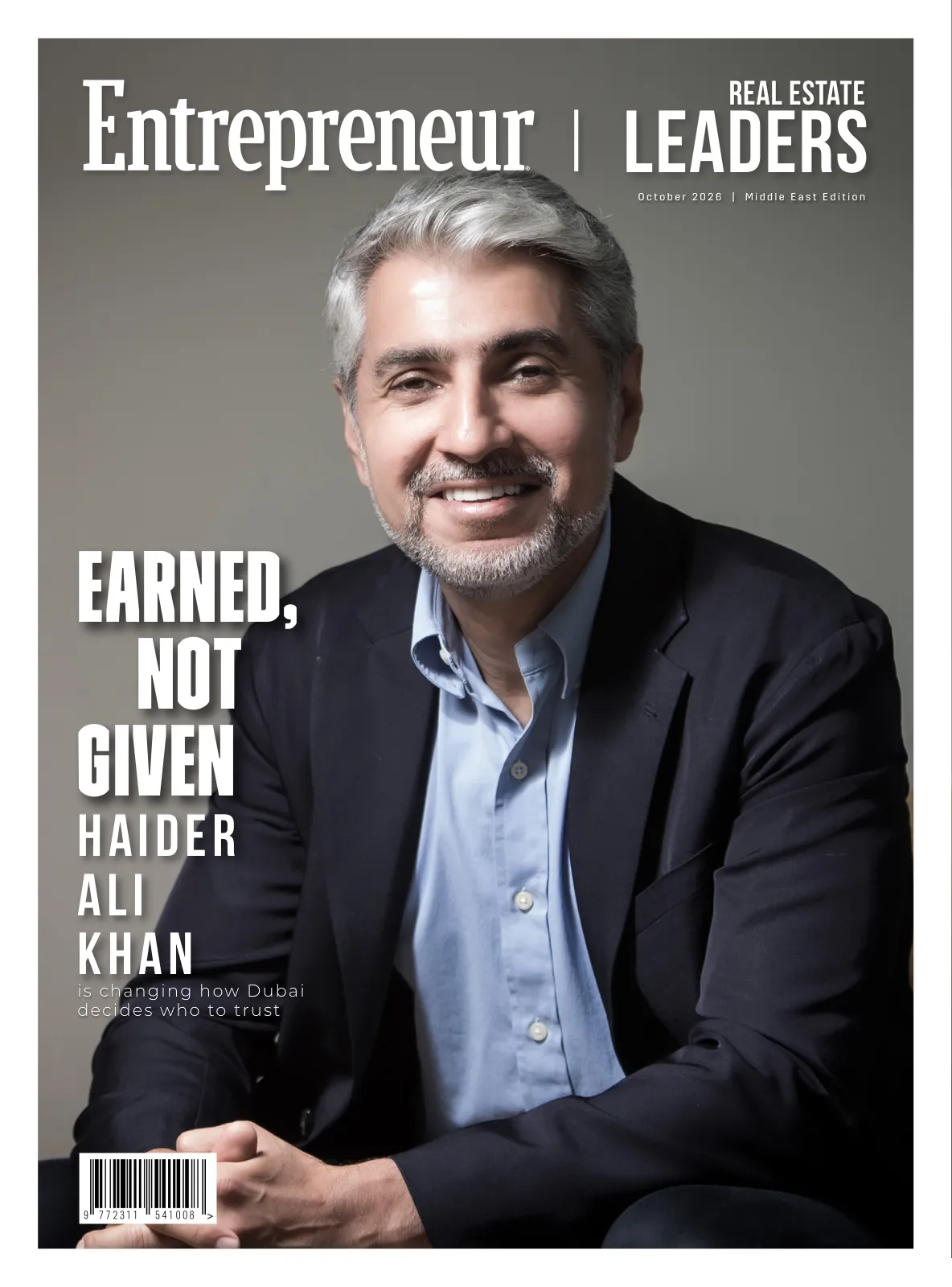
LEADERS REAL ESTATE O c t o b e r 2 0 2 6 | M i d d l e E a s t E d i t i o n Haider Ali Khan is changing how Dubai decides who to trust EARNED, GIVEN NOT
Standard Chartered Bank UAE is licensed by the Central Bank of the UAE Corporate & Investment Banking. Global Markets. Global Banking. Transaction Services. Now is your time sc.com/cib Make growth your next stop Dub Johannesburg New York
b London Singapore bai Shanghai
Eywa Way of Water is a state-of-the-art residential community with only 65 exceptional waterfront residences, with a holistic wellness ecosystem, curating authentic experiences and best-in-class amenities few have dreamed of. Contact us today: +971 54 308 6000 I sales@byrevolution.com E Y W A . A E E V E R Y T H I N G T H AT O N E C O U L D I M A G I N E F O R E X T R A O R D I N A R Y L I F E
Entrepreneur Middle East Real Estate Leaders Entrepreneur.com | October 2026 6 The Gulf Finds Its Own Voice Warm sand palettes, sculpted curves, modern Arabic craft and homes designed around wellbeing Earned, Not Given Haider Ali Khan is changing how Dubai decides who to trust TruBroker™ TruBroker™ is Bayut’s performance-led programme designed to promote agent credibility, accountability and excellence across the UAE’s real estate market Op Ed The best agents are no longer the best-kept secret Intelligent Living Shaping Spaces That Think, Adapt and Inspire The Gulf’s Green Blueprint The region that built its fortune on oil is now building some of the world’s most ambitious clean energy and green building programmes The Gulf’s Property Technology Boom Mortgages approved in days, homes bought from AED 500, rent paid in instalments and AI agents answering buyers at midnight The Intelligent Gulf Home From air conditioning that learns your routine to locks that open with a glance, the products inside Gulf homes are getting smarter every year Singapore, the Lion City’s Smart Blueprint Nine in ten households own their home, the government plans housing decades ahead and the whole city is mapped as a digital twin News Editor’s Note 10 18 32 48 54 86 94 102 110 120 128
100 THE Influence. In every dimension. The people shaping the region. The stories that deserve to be told. w w w. t h e1 0 0 m e . c o m
Entrepreneur.com | October 2026 9 In the race for excellence, there is no finish line. His Highness Sheikh Mohammed bin Rashid Al Maktoum, Ruler of Dubai
Entrepreneur Middle East Real Estate Leaders Entrepreneur.com | October 2026 10 Gulf VOICE Finds Its Own Warm sand palettes, sculpted curves, modern Arabic craft and homes designed around wellbeing. The Gulf’s interiors have stopped borrowing from elsewhere and started setting the pace. The
Entrepreneur.com | October 2026 11 Interiors | The Gulf Finds Its Own Voice
Entrepreneur Middle East Real Estate Leaders Entrepreneur.com | October 2026 12 Walk into a newly finished villa in Dubai Hills or a penthouse on Palm Jumeirah today and the first thing you notice is what is missing. The glare of high-gloss marble has softened. The chrome has given way to brushed brass and bronze. The stark white walls that once defined a certain idea of Gulf luxury have warmed into sand, cream, camel and clay. Light falls across textured plaster and travertine rather than bouncing off mirrored surfaces. It is a quiet revolution, and it says something important about the region. For decades, the Gulf imported its idea of a luxurious home from Milan, Paris and London, often in the most literal sense. Now it is developing an interior language of its own: confident, comfortable, rooted in place and increasingly admired far beyond the region’s borders. The numbers behind the shift are as impressive as the rooms. The UAE is the largest interior design market in the GCC, followed by Saudi Arabia and Qatar. Research from Ken Research values the UAE interior fit-out market at around $3.02 billion in 2025 and projects it to reach $4.59 billion by 2031, growth of more than 7 per cent a year. The drivers are easy to see. Dubai’s record property transactions have created a vast pipeline of newly handed-over homes, each one a blank canvas. Hospitality projects across the region demand interiors that compete with the best hotels in the world. And Saudi Arabia’s giga-projects are commissioning interiors on a scale few markets have ever seen. The region’s design calendar reflects that growing confidence. Downtown Design, the Middle East’s leading fair for contemporary design, returns to Dubai Design District from 4 to 8 November 2026. INDEX, the long-running interiors and fit-out exhibition, held its Saudi Arabia edition in September and returns to Dubai in June 2027. Each has become a fixture on the international calendar, drawing global brands to meet Gulf designers, developers and buyers. If one idea defines the Gulf interior in 2026, it is warmth. Designers across the UAE describe a decisive move away from the cool greys and stark whites that dominated the last decade towards earthy, natural tones: warm white, sand, terracotta, olive and dusty rose. The change is not only aesthetic. As designers point out, the golden-amber quality of Gulf afternoon light flatters warm tones in a way it never flattered cold ones. Warm neutrals are also more forgiving of desert dust. It is design that responds to climate and context, which is precisely what makes it feel authentic. Warm minimalism, as many studios now call it, keeps the clean lines and calm of modern design but adds texture and tactility. Natural stone, timber, limewash, bouclé and linen give rooms depth without clutter.
Entrepreneur.com | October 2026 13 Travertine has become something close to a signature material, prized for its warmth and its quiet, timeless character. The second big theme is form. Straight lines and sharp corners are giving way to curves: arched doorways, rounded sofas, sculptural lighting and organic shapes that soften a room and encourage people to gather. In the Gulf, where homes are built around hospitality and the majlis tradition of welcoming guests, the appeal is natural. Curved seating invites conversation. Arches echo the region’s architectural heritage. Sculptural pieces turn a living room into something closer to a gallery, without sacrificing comfort. Perhaps the most exciting development is the confident integration of regional culture. Designers are reinterpreting mashrabiya screens as laser-cut panels, translating geometric motifs into carved feature walls and using warm, low lighting to bring out texture in the way traditional architecture always has. Interiors | The Gulf Finds Its Own Voice
Entrepreneur Middle East Real Estate Leaders Entrepreneur.com | October 2026 14 This is not pastiche. The best work treats heritage as a living design language rather than a decorative layer. A contemporary villa might pair a minimal kitchen with a hand-carved timber screen, or a sleek living space with a ceiling inspired by traditional patterns. The result is a home that feels unmistakably of the Gulf while remaining utterly contemporary. The region’s own talent is driving much of this. Downtown Design’s UAE Designer Exhibition this year explores the materials, rituals, industries and ways of making that shape design practice in the country. Tashkeel’s Tanween Design Programme, now in its 13th edition, has selected seven designers whose work will culminate in a sustainable design showcase at the fair. Programmes like these are building a generation of Emirati and Gulf-based designers with a distinctive voice and a growing international following. The third theme is wellness, and it has moved from a luxury add-on to a design principle. High-end homes across the region increasingly include dedicated spaces for spa treatments, meditation, fitness and recovery. Bathrooms are designed to feel like hotel suites. Bedrooms are planned around sleep, with layered lighting, blackout solutions and acoustic comfort. Biophilic design, bringing nature indoors, is part of the same story. Indoor planting, natural materials, courtyards and seamless connections between interior and terrace create homes that feel calmer and healthier. In a climate where people spend much of the summer indoors, the ability to feel connected to nature inside the home is genuinely valuable. The fourth theme reflects how people now live. Homes must support work, family life, entertaining and rest, often in the same day and sometimes in the same room. Designers are responding with multi- functional layouts: built-in home offices, furniture that moves or changes use, and rooms that can shift purpose without losing their character. Technology is increasingly woven into the fabric of the home rather than bolted on afterwards. Lighting scenes, climate control, motorised shading and integrated audio are planned from the first drawings, hidden in joinery and ceilings so that the home feels effortless rather than technical. It is the interior expression of Intelligent Living: a house that quietly adapts to the people in it.
15 For investors and developers, the new Gulf interior is not only beautiful but commercially smart. Designers working with landlords report that durable, easy-care finishes, UV-resistant fabrics, layered lighting and neutral palettes with bold accents help homes let faster, photograph better and command stronger reviews. That matters in a market where listings compete for attention on screens before anyone walks through the door. A well- designed, well-lit interior generates more enquiries and spends less time on the market. For short-term rental investors in particular, design has become a measurable driver of returns. Developers have noticed too. Branded residences and premium projects now compete as much on interior quality and designer partnerships as on location and views. A recognised design name can define a project’s identity and support its pricing long after launch. What ties these themes together is confidence. The Gulf no longer needs to prove that it can afford luxury. Instead, it is defining what luxury should feel like in this part of the world: warm, calm, crafted, connected to place and designed around the way families actually live. That confidence is drawing attention globally. International brands now launch collections at Gulf design weeks. Regional designers are winning commissions abroad. And buyers relocating to the region from London, Mumbai or Sydney often find that the homes they move into are more thoughtfully designed than the ones they left behind. The next decade promises even more. With a deep pipeline of new homes, hotels and cultural projects across the UAE and Saudi Arabia, and a growing generation of homegrown talent, the Gulf interior is set to become one of the most influential design movements in the world. The region has found its voice. Now it is being heard. Interiors | The Gulf Finds Its Own Voice
Entrepreneur.com | October 2026 17 The best way to predict the future is to invent it. Alan Kay, computer scientist
Entrepreneur Middle East Real Estate Leaders Entrepreneur.com | October 2026 18 In the world’s most dynamic property market, Bayut has spent almost two decades turning information into confidence. Now, with TruBroker™, CEO Haider Ali Khan is changing how Dubai decides who to trust. EARNED, GIVEN NOT
Entrepreneur.com | October 2026 19 Earned, Not Given | Haider Ali Khan
Entrepreneur Middle East Real Estate Leaders Entrepreneur.com | October 2026 20 Every day in Dubai, somebody makes the biggest financial decision of their life. A family relocating from London signs a lease on a villa in Arabian Ranches. A first-time buyer puts down a deposit on an off-plan apartment in Jumeirah Village Circle. An investor from Riyadh adds a third unit on Palm Jumeirah to a growing portfolio. Behind almost every one of those decisions sits a broker. And behind a remarkable number of those brokers sits Bayut. For Haider Ali Khan, CEO of Bayut and dubizzle, that is both a privilege and a responsibility. “We can all agree that buying a home is a big decision,” he says. “You can have all the information in front of you and still want to speak to someone who understands your situation, guides you with more insights and helps you make one of life’s most important financial decisions.” “When I think about what Bayut is really for, it always comes back to that moment,” he adds. “Someone is about to trust a person they may never have met with their savings, their family’s next chapter, sometimes their whole reason for moving to this country. Our job is to make sure the person they trust has earned it.” That idea, simple to say and fiendishly difficult to deliver at scale, is the thinking behind TruBroker™, the performance-led programme that has become one of the most significant shifts in how property is bought, sold
Earned, Not Given | Haider Ali Khan Earned, Not Given | Haider Ali Khan and rented in the UAE. Since September 2024, the number of agents enrolled has grown almost tenfold, from around 1,100 to more than 11,000. More than 36,000 recognition badges have been awarded. In an industry long defined by who you know, Bayut has built a system that rewards what you actually do. To understand why TruBroker™ matters, start with the scale of the market it serves. Dubai’s real estate sector closed 2025 with more than 270,000 transactions worth AED 917 billion, up 20 per cent on the previous year, according to the Government of Dubai. It was the latest in a run of record-breaking years, and the emirate’s Real Estate Strategy 2033 sets an even bolder ambition: AED 1 trillion in annual transactions. Those numbers represent something more than investment flows. They represent people: new residents arriving from every corner of the world, first-time buyers stepping onto the ladder, global investors who may be choosing a home in a city they have visited only a handful of times. Each of them needs reliable information and a professional they can rely on. “Growth on this scale is a wonderful thing, but it brings a responsibility with it,” says Khan. “When the market moves this quickly and so many new residents arrive every year, the consumer needs a reliable way to separate the signal from the noise. That is where a platform has to earn its place. Not by being the loudest voice in the room, but by being the most trusted one.” 21
Entrepreneur Middle East Real Estate Leaders Entrepreneur.com | October 2026 22 It is a responsibility Bayut has been preparing for since long before Dubai’s current boom. Bayut began in 2008 as an online property portal connecting buyers and tenants with properties across the UAE. In its early years, the platform focused on bringing property listings into one accessible place, helping people explore their options while giving agencies another way to reach prospective clients. These foundations would shape its broader ambition: to make the property journey simpler and more useful for both consumers and real estate professionals. A significant turning point came in 2014, when Haider moved from the US to the UAE to take over as CEO. Bringing extensive experience in technology, he helped steer Bayut into its next phase of growth, with a stronger focus on product development, the search experience and relationships with the brokerage community. Over the following years, that approach extended beyond listings: the launch of Bayut Academy in 2017 introduced professional training for agents, while TruCheck™ in 2019 addressed the need for greater confidence in listing availability. Together, these developments helped establish Bayut’s focus on technology, trust and industry support. An electrical engineering graduate of the University of Texas at Austin, Khan spent well over a decade building a formidable career in the United States with some of the most respected names in technology and finance, including Goldman Sachs, Silicon Labs and National Instruments, where he led global teams spanning the US, Europe, India and China. In 2014, he made the decision that would define the next chapter of the company: he left the comfort of corporate America, moved to Dubai and took the helm as CEO full time. “I had a very good career in the US, and I learned an enormous amount there,” he says. “But I had a desire for more; to build something of value that outlived me. That’s what brought me to Dubai and Bayut. When you live in a city that is so full of drive and ambition, you are naturally inspired to do more and give more. I wanted to be part of that story, not watch it from a distance.” What followed was a period of extraordinary growth. Under Khan’s leadership, Bayut scaled its technology, its team and its audience to become the UAE’s largest dedicated property portal. As Bayut grew, its strength in technology became central to its efforts to raise industry standards. It developed tools that addressed practical challenges. This approach took centre stage at the inaugural Bayut Big Broker Event, B3DXB, in April 2019, where various innovations were unveiled alongside discussions involving brokerage leaders, Google and regulatory representatives. By bringing technology and the industry together, Bayut encouraged a more transparent, accountable and service-focused approach to real estate, with better information for consumers and better tools for the professionals guiding them. In 2020, Bayut’s parent company joined forces with OLX Group’s regional operations, bringing dubizzle, the UAE’s best-known classifieds platform, into the same family and creating what was widely recognised as the Arab world’s first homegrown unicorn. Today, Dubizzle Group, whose largest shareholder is the global technology investor Prosus, reaches around 18 million monthly active users, and Khan leads both Bayut and dubizzle. Colleagues describe a leader who combines an engineer’s rigour with an unusual degree of patience: someone who would rather get a product right than get it out first. It is a philosophy he is happy to articulate. “Size can make a company slow if you let it,” he says. “I
23 Earned, Not Given | Haider Ali Khan Earned, Not Given | Haider Ali Khan tell our teams that we should still behave like the start-up: curious, a little restless and completely focused on the customer. The day we stop asking how something could be better is the day someone else starts answering that question for us.” If there is a single thread that runs through Bayut’s rise, it is data. The company has built one of the largest data science teams in the region, with more than 80 data scientists working on everything from lead scoring and market forecasting to personalised search. In 2022, the Dubai Land Department signed a memorandum of understanding with Bayut to provide the market with interactive data and reports, giving consumers access to official transaction information in a way that simply did not exist when the brothers first launched. The product pipeline that followed has repeatedly set the pace for the industry. TruEstimate™ offers instant property valuations. BayutGPT, an AI-powered real estate assistant, lets home seekers search in natural language rather than through endless filters. In 2025, the Group acquired Property Monitor, the real estate intelligence provider, deepening the market insight available to agents, developers and investors. “Data on its own is just numbers,” says Khan. “The value comes when it helps a real person make a better decision. A tenant who can see what similar homes actually rented for. A seller who understands what their property is genuinely worth. A broker who walks into a meeting better prepared than ever before. That is what we build for, every single day.” For all the sophistication of modern property search, one question has always been stubbornly difficult to answer: which agent should I actually trust? It is a question that has long frustrated the industry. Every agent promises great service, yet for most buyers and tenants there has been no reliable way to check. Good agents and indifferent ones could look much the same on a listing page, and the professionals who answered every call, kept every listing accurate and knew their communities inside out rarely received the credit they deserved. TRUBROKER™ AT A GLANCE What it is: Bayut’s performance-led programme promoting agent credibility, accountability and excellence across the UAE. How agents qualify: Key performance indicators including responsiveness, listing quality and authentic listings. Enrolled agents: around 1,100 (September 2024) to more than 11,000 today. Recognition badges awarded: more than 36,000. > > > >
Entrepreneur Middle East Real Estate Leaders Entrepreneur.com | October 2026 24 “When I think about what Bayut is really for, it always comes back to that moment. Someone is about to trust a person they may never have met with their savings, their family’s next chapter, sometimes their whole reason for moving to this country. Our job is to make sure the person they trust has earned it.
25 Earned, Not Given | Haider Ali Khan Bayut had already tackled one half of the trust equation with TruCheck™, its authentication programme that confirms listings are genuine and accurately represented. TruBroker™ took on the other half: the professional behind the listing. “That is the thinking behind TruBroker™,” says Khan. “We wanted to make it easier for consumers to find agents who consistently do good work, and to give those agents the recognition they have earned. TruBroker™ looks at meaningful measures, including responsiveness, listing quality, market expertise and professionalism. It gives consumers a clearer picture of the person they may be trusting with an important decision.” Crucially, the badge cannot be bought. “The badge means something because it has to be earned,” Khan says. “It’s not something that’s just handed to you. It actually reflects the effort an agent puts in day after day: keeping listings accurate, following through with clients and holding themselves to a high standard.” “We chose to build something that rewards behaviour. If you answer your clients, keep your listings accurate and know your community, the platform should notice, and it should say so publicly. That distinction is the whole point. It is what gives the badge its value, for the agent and for the consumer.” Khan said TruBroker™ is Bayut’s performance-led programme designed to promote agent credibility, accountability and excellence across the UAE’s real estate market. Rather than relying on self- description or seniority, it recognises agents against key performance indicators that matter to the people they serve: how quickly and reliably they respond, the quality of their listings, and whether those listings are authentic. Agents who meet the standard earn recognition badges that appear on their profiles. The most accomplished feature on area-specific leaderboards, which highlight the top performers community by community, from Dubai Marina and Downtown to Al Furjan, Majan and Jumeirah Golf Estates. Khan is particularly proud of the local dimension. “Dubai is not one market, it is dozens of micro- markets,” he says. “The agent who knows every building in Al Furjan or every street in Jumeirah Golf Estates brings something a general search can never replace. The leaderboards make that local mastery visible, and that is enormously valuable to a family deciding where to live.” The response from the market has been emphatic. A programme that counted around 1,100 enrolled agents in September 2024 now has more than 11,000, a nearly tenfold increase in less than two years. In a market of this size, that represents a genuine shift in professional culture. “I find that incredibly encouraging,” says Khan. “Thousands of professionals chose to be measured, because they believe in the quality of their work and want the market to see it. That says a great deal about where this industry is heading.” That willingness to be measured has brought a healthy competitive edge. Agents can now see exactly where they stand in their community and what it takes to climb, and consumers feel the effect in quicker replies, sharper listings and better-informed advice. “Competition is good when it is about the right things,” Khan says. “We are asking them to compete on how well they serve people. When that becomes the race, everybody wins, the client most of all.” It also reflects a changing consumer. Today’s home seekers arrive better informed and more demanding than ever, often comparing dozens of properties, and the agents behind them, before making a single call. “People do their homework now,” says Khan. “By the time they pick up the phone, they have already studied the listings, the prices and the agent. We want an agent’s track record to speak for them before they have even said hello.”
Entrepreneur Middle East Real Estate Leaders Entrepreneur.com | October 2026 26
Entrepreneur.com | October 2026 27 Earned, Not Given | Haider Ali Khan For the agents featured in this edition, the impact is tangible: more qualified enquiries, more direct approaches from sellers and landlords, and conversations that begin from a position of confidence rather than suspicion. TruBroker™ rewards the agents who do the unglamorous things well, day after day, and makes sure the market notices. “Every time an agent raises their standard, the whole market moves up a notch,” Khan adds. “Agencies benefit, the industry’s reputation grows and the consumer is better protected. That is the kind of progress we want Bayut to stand for.” It would be easy to assume that a company built by engineers would see the future of property as purely digital. Khan sees it differently. “Technology has changed a great deal about real estate,” he says. “But that human connection, that need for reassurance and support, has stayed remarkably consistent. I truly believe a good agent brings more than a property to the table. They know when to listen, when to challenge an assumption and when a property that looks perfect on paper is simply wrong for their client. As technology becomes more capable, I believe that judgement will become even more valuable.” That conviction shapes how Bayut approaches artificial intelligence. “There is understandable excitement around what these technologies can do, and we see enormous potential,” he says. “But their value comes down to how useful they are in someone’s day to day. A more intuitive search can help a home seeker explain what they need. Better market information can help a broker have a more informed conversation. Tools that reduce routine work can give both sides more time to focus on the decision itself.” “There is a fear in some quarters that AI will replace the broker,” he continues. “I see the opposite. The more routine work technology takes away, the more the human qualities matter: judgement, honesty, local knowledge. In many ways, TruBroker™ is our bet on those qualities. We are using technology to make the best human professionals easier to find.” It is also why Bayut describes agencies as partners rather than simply customers. “At Bayut, this shapes how we work with our agency partners,” Khan says. “We have a shared interest in helping people make better property decisions. When our partners succeed in doing that, we succeed too.” Bayut’s influence extends well beyond its own platform. Its work with government entities, including the Dubai Land Department and the Abu Dhabi Real Estate Centre (ADREC), reflects a belief that the quality of the property experience depends on the whole ecosystem. “Our work with government entities like DLD and ADREC matters because the quality of the property experience depends on the infrastructure around it: reliable information, clear processes and services that work well together,” Khan explains. “The UAE has shown how much can be achieved when the public and private sectors work towards a shared ambition. Each brings something valuable to the table. The government provides direction and oversight, while businesses contribute technology, expertise and a close understanding of customer needs.” THE BAYUT STORY 2008: Bayut launches in the UAE. 2014: Haider Ali Khan moves from the US to Dubai to lead Bayut as CEO full time. 2019: Bayut launches B3DXB, a first-of-its kind broker summit, bringing together 800+ brokers from across the UAE. Bayut also unveils Chris Hemsworth as the face of the brand with a heartfelt campaign celebrating life in the UAE. 2020: Bayut’s parent company joins forces with OLX Group’s regional operations, including dubizzle, creating the Arab world’s first homegrown unicorn. 2022: Dubai Land Department signs MoU with Bayut to bring interactive market data to consumers. 2024: Bayut launches TruEstimateTM and TruBrokerTM, revolutionising the PropTech ecosystem in the UAE. 2025: Dubizzle Group acquires Property Monitor, the UAE’s biggest repository of property market intelligence. Today: Bayut’s TruBroker™ programme sees strong adoption across the real estate community, with over 11,000 TruBrokers™ and more than 36,000 recognition badges awarded. > > > > > > > >
Entrepreneur Middle East Real Estate Leaders Entrepreneur.com | October 2026 28 “The ambition behind the Dubai Real Estate Strategy 2033 is extraordinary, and it is exactly the kind of ambition this country has a habit of meeting,” he adds. “Our role is to make sure the experience keeps pace with the scale: transparent, data-backed and trustworthy at every step.” That spirit, he believes, will be just as important in the next phase of PropTech. “AI will continue to change how people discover property, and data will help us anticipate their needs more effectively. We should use those capabilities to help professionals offer better advice and give consumers greater clarity.” Bayut now sits at the centre of one of the most watched real estate markets on earth. Its success has never rested on a single product. It rests on a habit of asking what consumers and agents genuinely need, and then building it properly. TruBroker™ may be the clearest expression yet of that habit. It addresses the oldest question in property, who can I trust, with the newest tools available, and it hands the answer to the agents who earn it. “As Dubai continues to grow and welcome people from around the world, trusted agents will remain essential to the strength
Entrepreneur.com | October 2026 29 Earned, Not Given | Haider Ali Khan of its property market,” Khan says. “Every well-informed recommendation and every positive client experience helps build confidence in the industry. For an agent, a reputation takes time to earn. We want our platform to help them build it and get recognised for it.” Asked what success looks like a decade from now, he answers without hesitation. “If buyers and tenants across this region expect their agent to be authentic, responsive and offer genuine guidance—and can take that for granted because it has become the norm—then we will have done our job.” For now, his message is reserved for the professionals who are already setting that standard. “People may find their next home through a screen, but the decision is still deeply personal,” he says. “The future of real estate should make that journey easier while giving the people guiding it every opportunity to do their best work and be recognised while doing it.” And to the agents celebrated in these pages, a final word. “To the TruBrokers™ recognised in this edition: congratulations. Your hard work has brought you here, and I hope you take pride in that. Keep doing right by your clients, sharing what you know and setting an example for the industry.”
Entrepreneur.com | October 2026 31 It takes 20 years to build a reputation and five minutes to ruin it. If you think about that, you’ll do things differently. Warren Buffett, chairman of Berkshire Hathaway
Entrepreneur Middle East Real Estate Leaders Entrepreneur.com | October 2026 32
Entrepreneur.com | October 2026 33 What is TruBroker™? TruBroker™ is Bayut’s performance-led programme designed to promote agent credibility, accountability and excellence across the UAE’s real estate market. It recognises agents based on key performance indicators, including responsiveness, listing quality and authentic listings, while providing recognition badges and area-specific leaderboards to highlight top-performing professionals. Brought to you by
Entrepreneur Middle East Real Estate Leaders Entrepreneur.com | October 2026 34 TruBroker™ Agent Testimonials READY SALES HADY YASSIEN TruBroker™ | Business Bay Specialist | Ready Property Sales “TruBroker™ changed how clients see me. Before we even speak, they know I’m responsive, reliable and serious about my work. In Dubai, trust is everything, and the TruBroker™ badge builds it from day one. It helped me stand out, close deals faster and keep my clients for the long term. For me, TruBroker™ isn’t just a badge. It’s proof that consistency pays off.” MYLES LENNON RAE TruBroker™ | The Valley by Emaar Specialist | Ready Property Sales “Working in one of the most competitive industries in the world, this job is all about marginal gains. Committing to being a TruBroker™ has paid me back many times over by putting me in front of the right buyers and sellers before my competitors. Clients trust my listings from the very first click.”
Entrepreneur.com | October 2026 35 JAMIE NEEP TruBroker™ | Dubai Marina Specialist | Ready Property Sales “Being a Bayut TruBroker™ is a recognised mark of credibility, professionalism and proven market performance. It shows buyers and sellers that I’m a registered broker operating successfully and in line with authorised guidelines. It also gives my listings greater visibility to genuine, active buyers, helping me generate stronger enquiries and giving my clients the best possible opportunity to sell quickly and effectively.” SHROUQ MOUSA TruBroker™ | Al Furjan Specialist | Ready Property Sales “TruBroker™ has added another level of trust and transparency to the way I work with my clients. By personally verifying properties through TruCheck™, I can offer buyers greater confidence that the listings they see are genuine and accurately represented. As an Al Furjan specialist, I believe that credibility starts with providing clients with reliable information and a professional experience they can trust from the very beginning.” TruBroker™ Agent Testimonials | Brought to you by
Entrepreneur Middle East Real Estate Leaders Entrepreneur.com | October 2026 36 SERGHEI GOTCO TruBroker™ | Palm Jumeirah Specialist | Ready Property Sales “To me, TruBroker™ is mainly about trust. On Palm Jumeirah, clients have a lot of choice, not only in properties but also in agents. TruBroker™ gives clients that extra bit of confidence before the first call. It won’t close the deal for you (that would be too easy), but it definitely helps you get started.” HEFIN JONES TruBroker™ | JVC Specialist | Ready Property Sales “TruBroker™ has really helped strengthen my credibility in the market by giving clients clear evidence of my experience and results. It makes conversations much easier, as sellers can feel confident trusting me with their property, while buyers have the reassurance that they’re working with someone who knows the market, understands property values and can negotiate on their behalf to achieve the best possible price.” TruBroker™ Agent Testimonials READY SALES
Entrepreneur.com | October 2026 37 PARMIDA AZIZI TruBroker™ | Downtown Dubai Specialist | Ready Property Sales “Being ranked as the number one TruBroker™ in my area has strengthened my visibility among serious sellers and genuine buyers, allowing them to find and connect with me directly. With hundreds of direct properties in my inventory across Dubai, I’m constantly working with genuine listings and motivated clients. TruBroker™ helps me connect with the right people, while Bayut continues to strengthen the trust between clients and high- performing sales executives in the market.” CHLOE CROMAR TruBroker™ | Dubai Hills Estate Specialist | Ready Property Sales “TruBroker™ has made a real difference in my business by helping me generate more leads, connect with more sellers, and attract direct buyers. One of the biggest advantages is being able to showcase my profile and transaction history, which gives clients confidence in my experience and track record. It builds trust from the start and helps me stand out as an agent in a competitive market.” TruBroker™ Agent Testimonials | Brought to you by
Entrepreneur Middle East Real Estate Leaders Entrepreneur.com | October 2026 38 DARREN MURPHY TruBroker™ | Jumeirah Golf Estates Specialist | Ready Property Sales “TruBroker™ identifies the top agents in each community through a points system based on sales and listing activity. For buyers especially, that’s invaluable: they can quickly and clearly see who the area experts are, and know they’re dealing with the best. After 13 years specialising in Jumeirah Golf Estates, I’m grateful to be recognised this way, and to Bayut for a tool that puts clients and true area specialists first.” TALIA BESSER TruBroker™ | Arabian Ranches Specialist | Ready Property Sales “Being a TruBroker™ has strengthened my position in an increasingly competitive market. Because my business depends on credibility, trust, and a strong reputation, the added recognition on Bayut has made an incredible difference. It gives buyers and sellers greater confidence in choosing me, rein forces my credibility as a trusted agent, and increases my visibility among serious clients. Since becoming a TruBroker™, I’ve connected with more qualified clients and built stronger relationships with clients who value professionalism and trust. Overall it has helped me stand out and establish an even stronger presence in the market.” TruBroker™ Agent Testimonials READY SALES
Entrepreneur.com | October 2026 39 MOHAMMAD SHAMMAA TruBroker™ | Downtown Dubai Specialist | Rentals “Being a TruBroker™ on Bayut has really helped me build trust with my clients, especially new clients, owners, and landlords who are new to the country or working with me for the first time. It gives them the confidence and reassurance they need when dealing with a broker. At the same time, it’s a great tool that helps brokers showcase their professionalism and take their service to the next level.” ZAFAR ALAM KHAN TruBroker™ | JLT Specialist | Rentals “As a broker, I focus on understanding my clients, creating the right opportunities and delivering a service they can genuinely trust. With TruBroker™ supporting me, I’ve been able to expand my network, strengthen my presence in the market, and build my identity as a real estate professional that every property seeker can trust.” RENTALS TruBroker™ Agent Testimonials | Brought to you by
Entrepreneur Middle East Real Estate Leaders Entrepreneur.com | October 2026 40 SAMI ULLAH MUHAMMAD HUSSAIN TruBroker™ | Al Furjan Specialist | Rentals “Being recognised as a TruBroker™ and a market expert in Al Furjan means a lot to me. I spend a lot of time getting to know the area, its properties and what renters are looking for. That local knowledge helps me give clients honest advice and find homes that suit their needs. TruBroker™ has also helped me become more confident and efficient as a real estate agent. It has made connecting with clients and managing opportunities much easier. I am grateful to Bayut for giving me this opportunity and to help me stand out from competition.” TruBroker™ Agent Testimonials RENTALS EVIN DAVIS TruBroker™ | Deira Specialist | Rentals “As a real estate agent, I’ve found that while Bayut already provides valuable leads, TruBroker™ takes it a step further by delivering more tailored leads that significantly enhance my closing rates. In today’s competitive market, this advantage is crucial. TruBroker™ allows me to focus on my role as an area specialist, helping me understand the unique needs of my clients and the specific dynamics of my market. This tailored approach not only streamlines my efforts but also positions me to serve my clients more effectively, ultimately leading to greater success.”
Entrepreneur.com | October 2026 41 ANAM HAFEEZ TruBroker™ | Business Bay Specialist | Rentals “Being a TruBroker™ on Bayut has genuinely made a big difference in my work. I’m not only getting calls from serious buyers and better quality clients, but I’m also receiving calls directly from property owners looking to sell and list their properties. I’m getting new listings almost every day, which has created more opportunities and helped me grow my business and build stronger client relationships.” TruBroker™ Agent Testimonials | Brought to you by CHARLIE OLIVE TruBroker™ | Springs Specialist | Rentals “TruBroker™ has made a real difference to my work. When I speak with landlords and tenants, the recognition helps build trust and gives them more confidence in the service I provide. The added visibility for my profile and listings also helps me reach more potential clients and create new opportunities. It’s encouraging to have the work I put in every day recognised in a way that helps me grow as an agent.”
Entrepreneur Middle East Real Estate Leaders Entrepreneur.com | October 2026 42 TruBroker™ Agent Testimonials RENTALS FELICIA ELORM TruBroker™ | JVC Specialist | Rentals “Seeing myself on the Bayut billboard was a proud moment. It’s brought me more visibility, and I’ve noticed that people recognise me and feel more confident reaching out. Being a TruBroker™ has helped me stand out in a competitive market and reflects the effort I put into supporting my clients. I’m grateful to Bayut for the recognition and for their continued support.” OLIVER BANKS TruBroker™ | Dubai Marina Specialist | Rentals, Betterhomes “TruBroker™ has helped me stand out by giving me more visibility and credibility with clients. It’s made it easier to showcase my listings and connect with serious buyers, which has helped me grow my business. In such a competitive market like Dubai, having the right tools makes a big difference, and TruBroker™ has definitely helped me become more recognised and successful as an agent.” CAMERON CRESSWELL TruBroker™ | Dubai Hills Estate Specialist | Rentals “TruBroker™ has definitely helped me stand out in a competitive market. It gives clients confidence that they’re dealing with an active agent and helps build trust with both owners and tenants. I think it’s also a good way of being recognised for the work you’re putting in and the results you’re achieving, and it’s been a really useful part of my business.”
Entrepreneur.com | October 2026 43 TruBroker™ Agent Testimonials | Brought to you by PRIYANKA DEV TruBroker™ | Majan Specialist | Off-Plan Sales “Bayut’s TruBroker™ has been a game-changer for me in my specialist area, Majan. The strong listing visibility, quality leads and real-time market insights have helped me connect with serious buyers and tenants, respond faster and convert more opportunities into successful deals. I highly recommend gaining Bayut’s TruBroker™ status to any agent looking to grow their business and achieve better results.” DEEPAK DAHIYA TruBroker™ | Arjan Specialist | Off-Plan Sales “ TruBroker™ has been instrumental in strengthening my credibility and visibility in Dubai’s highly competitive property market. By helping me showcase authentic listings, genuine expertise and a consistent record of client service, it gives buyers and sellers greater confidence when choosing to work with me. The platform’s transparency and recognition have helped me differentiate myself, build stronger relationships, and convert trust into lasting success.” OFF-PLAN SALES
Entrepreneur Middle East Real Estate Leaders Entrepreneur.com | October 2026 44 TruBroker™ Agent Testimonials OFF-PLAN SALES MITHUN KANDY TruBroker™ | JVC Specialist | Off-Plan Sales “Being recognised as a TruBroker™ by Bayut has helped me stand out in a competitive real estate market by giving my listings greater visibility and building stronger trust with potential clients. The TruBroker™ badge adds credibility to my professional profile, helping me attract more genuine enquiries and connect with serious buyers and tenants. It reflects my commitment to quality, transparency, and exceptional service.” SAM PAYNE TruBroker™ | DAMAC Lagoons Specialist | Off-Plan Sales “Bayut and the TruBroker™ recognition in particular has played a big part in my growth as a real estate agent. In a competitive market like Dubai, having this badge helps me get my listings in front of the right people and gives clients a better sense of who I am and how I work. That visibility has helped me build trust, make meaningful connections and turn more conversations into opportunities.”
Entrepreneur.com | October 2026 45 EGOR LARIN TruBroker™ | Business Bay Specialist | Off-Plan Sales “TruBroker™ has become an incredibly useful part of my daily work as a real estate agent. It helps give my listings more visibility, attract interested buyers and connect with other professionals in the market. I also appreciate how simple and convenient the platform is to use. For me, TruBroker™ helps build credibility with clients, work more efficiently and ultimately support the growth of my business.” ANIRUDH ASAWA TruBroker™ | Dubai South Specialist | Off-Plan Sales “For me, Bayut is all about getting the right visibility and the right enquiries. In real estate, trust is very important, and when clients see the TruBroker™ badge, it gives them that extra confidence that they’re dealing with a genuine and active broker. Better visibility means more enquiries, more conversations, and eventually more deals. It’s simple, if you’re serious about this business, you need to make sure your listings stand out. You need to be a TruBroker™.” TruBroker™ Agent Testimonials | Brought to you by
Entrepreneur Middle East Real Estate Leaders Entrepreneur.com | October 2026 46 MUHAMMAD MANZOOR TruBroker™ | Dubai Islands Specialist | Off-Plan Sales “The Bayut TruBroker™ badge has played a major role in elevating my visibility and positioning me at the forefront of Dubai’s real estate market. It has strengthened the trust clients place in my advice, helped me stand out in a highly competitive market, and given me greater access to a strong pool of qualified buyers. Today, sellers actively seek me out because they recognise the visibility, reach, and buyer network that come with my presence on Bayut. For me, the TruBroker™ badge isn’t just recognition. It’s credibility, visibility, and another level of market authority.” TruBroker™ Agent Testimonials OFF-PLAN SALES KUNAL KUKREJA TruBroker™ | Town Square Specialist | Off-Plan Sales “I started out focused on becoming a Town Square specialist. Once I was recognised as a TruBroker™, I began hearing from clients interested in properties in other developments too. I think the recognition helps buyers and sellers feel more confident reaching out, because they can see that I take my work seriously. It’s opened up opportunities I hadn’t expected and motivated me to keep raising my standards with every client.”
Entrepreneur.com | October 2026 47 NADEEM KHAN TruBroker™ | IMPZ Specialist | Off-Plan Sales “Bayut’s TruBroker™ recognition has really helped me stand out as an agent in Dubai’s competitive real estate market. For me, the biggest benefit has been the trust it creates with clients from the very first interaction. They can see that they’re dealing with an agent who is active, knowledgeable and committed to delivering a high level of service. It’s also pushed me to stay consistent with accurate listings, quick response times and strong market knowledge. TruBroker™ has helped strengthen my personal brand and motivates me to keep raising my standards as an agent.” TruBroker™ Agent Testimonials | Brought to you by
Entrepreneur Middle East Real Estate Leaders Entrepreneur.com | October 2026 48
49 The best agents are the best-kept secret NO LONGER Op Ed | The best agents are no longer the best-kept secret In real estate, everyone says they deliver great service. The question is: how can a consumer tell? For years, it has been difficult for buyers and tenants to see which agents consistently follow through. It has been just as difficult for excellent agents to get credit for the work they put in. The solution to that? TruBroker™. Today’s property seekers have more information, more choice and higher expectations. They want an agent who knows the market, responds when they need help and gives them the confidence to make a decision. A strong sales pitch might start the conversation, but consistent performance is what earns their trust. TruBroker™ makes that performance visible. It recognises agents through measures that matter to consumers, including responsiveness, listing quality and listing authenticity. Experience and relationships will always count in this business. TruBroker™ adds a clearer way to show what an agent is delivering today. And agents have responded. In less than two years, TruBroker™ has grown ninefold, from around 1,100 enrolled agents in September 2024 to more than 10,800 today. More than 34,000 recognition badges have been awarded, and over 15,000 agents have appeared on area-specific leaderboards. Those numbers tell me that agents want their work to be seen and are willing to compete on the quality of that work. The area-specific leaderboards are particularly valuable. Knowing Dubai real estate is one thing; knowing the buildings, prices and buyer expectations in a particular community is another. They help consumers find agents with relevant local expertise and give agents a clear reason to keep sharpening it. I like a bit of healthy competition. When agents can see where they stand and what it takes to improve, everyone has a reason to raise their game. Better listings, faster responses and stronger advice are all things consumers can feel in the experience. The best agents have always worked hard to earn their reputation. TruBroker™ helps make that hard work easier to see. That is a powerful change. It rewards professionals who combine market knowledge with responsiveness, relationships with results and ambition with accountability. That is not good just for the agents. It’s good for agencies, it’s good for the industry and, most importantly, good for every consumer navigating Dubai’s property market. By Fibha Ahmed, Vice President of Sales, Bayut
BUILT FOR MOMENTS THAT MATTER EXTRAORDINARY Escape to a home where urban sophistication meets resort tranquility. PRIVATE POOLS | 30+ AMENITIES | PRIME LOCATIONS 800-SAMANA | WWW.SAMANADEVELOPERS.COM
DISCOVER REFINED living *Ranking as per the H2025 1 sales volume data of property monitor for Dubai
Entrepreneur.com | October 2026 53 Management is doing things right; leadership is doing the right things. Peter Drucker, management thinker
Entrepreneur Middle East Real Estate Leaders Entrepreneur.com | October 2026 54 SHAPING SPACES THAT THINK, ADAPT AND INSPIRE 54 L I V I N G INTELLIGENT
Entrepreneur.com | October 2026 55 Intelligent Living | Shaping Spaces That Think, Adapt and Inspire
Entrepreneur Middle East Real Estate Leaders 56 FUTURE: DUBAI 2030, THE WORLD’S SMARTEST PROPERTY MARKET? Artificial intelligence in the land registry, title deeds on the blockchain, new metro lines and the world’s largest airport under construction. By the end of this decade, Dubai intends to be the benchmark for how a property market should work. How close is it?
Entrepreneur.com | October 2026 57 Every great property market is shaped by a handful of decisions that look obvious only in hindsight. London’s came with the railways. New York’s came with the grid. Dubai’s came in 2002, when freehold ownership was opened to foreign buyers and a desert emirate decided to compete for the world’s capital. The next set of decisions is being made now, and most of them are not about buildings at all. They are about data, digital infrastructure and the rules that govern how property is owned and traded. If they work, Dubai will enter the 2030s not just as one of the world’s busiest property markets but as its most intelligent. If they do not, it will still be a remarkable city with a very large amount of real estate. The smart money is on the former. But the case is worth examining properly. Strictly speaking, Dubai’s deadline is not 2030 but 2033. The Dubai Economic Agenda, known as D33, aims to double the size of the emirate’s economy over the decade. The Real Estate Strategy 2033, approved by His Highness Sheikh Hamdan bin Mohammed bin Rashid Al Maktoum, Crown Prince of Dubai, sets out the property sector’s part in that plan. Its headline ambition is AED 1 trillion in annual real estate transactions by 2033. Alongside it sit targets to increase the number of transactions by 70 per cent, to multiply the value of real estate portfolios twentyfold to AED 20 billion and to contribute AED 73 billion to the emirate’s GDP. The strategy also commits to promoting home ownership and family stability, and to strengthening Emirati competitiveness in the sector. On the government’s own measure, 2025 closed with more than 270,000 transactions worth AED 917 billion. That puts the trillion-dirham target within sight years ahead of schedule. A softer 2026, shaped by regional conflict and a second quarter in which deal volumes fell sharply, is a reminder that targets are not reached in a straight line. But the direction is not in doubt. So 2030 becomes the natural halfway test. By then, the question will be less about volume and more about quality: whether the market is not just bigger, but smarter. A smart property market is, first of all, a measurable one. On this test, Dubai has already moved into the global top tier. The 2026 Global Real Estate Transparency Index from JLL and LaSalle ranks Dubai 17th in the world and first in the Arab world, up from 28th two years ago. JLL credits the Dubai Land Department with leading the way in real-time, publicly accessible property data, supported by platforms such as Mollak and the Dubai REST app. Intelligent Living | Future: Dubai 2030
Entrepreneur Middle East Real Estate Leaders Entrepreneur.com | October 2026 58 The private sector has built on that foundation. Portals now track search behaviour across millions of users, valuation tools draw on official transaction records, and performance programmes measure broker quality against verifiable indicators. By 2030, the realistic ambition is a market in which every listing is verified, every price can be checked against evidence, and every professional’s track record is visible. The second test is speed and simplicity. In many of the world’s most established markets, buying a home still involves weeks of paperwork, multiple intermediaries and a surprising amount of paper. Dubai is pushing hard in the opposite direction. In September 2026, the DLD launched its AI-powered Initial Registration platform, which reads identity documents and contracts, populates applications and can approve eligible standard transactions automatically. It brings project registration, transaction registration and escrow management into one system. Reports at launch suggested data entry could fall by up to 80 per cent. The platform sits within a far larger ambition. His Highness Sheikh Mohammed bin Rashid Al Maktoum has announced a framework for half of UAE government sectors, services and operations to run on autonomous, agentic AI within two years. Real estate, one of the most document-heavy sectors in any economy, is an obvious early beneficiary. By 2030, the test will be whether a buyer, seller and lender can move from agreed price to registered title in days rather than weeks, with every step verified and visible. Few markets anywhere are attempting that at Dubai’s scale. The third test is the boldest. A smart market does not just digitise the old model of ownership; it creates new ones. In March 2025, the DLD launched the pilot phase of its Real Estate Tokenisation Project, working with the Virtual Assets Regulatory Authority and the Dubai Future Foundation. Through the Prypco Mint platform, UAE ID holders can buy a share of a property for as little as AED 2,000, with ownership recorded by the Land Department itself rather than through an intermediary structure. The DLD projects that tokenised real estate could reach AED 60 billion by 2033, around 7 per cent of the emirate’s property transactions. A second phase has reportedly introduced regulated secondary trading. The potential is significant. Tokenisation could open Dubai property to investors who would never buy a whole apartment, allow owners to release value without selling outright and create a more liquid market in an asset class famous for its illiquidity. The challenges are just as real: investor protection, fees, valuation and
the need for robust regulation. The fact that Dubai is linking tokens directly to its official title registry, under licensed and supervised platforms, is what sets its approach apart. No amount of software matters if the physical city cannot keep up. Here the numbers are striking. Dubai’s population passed 4.5 million by the end of 2025, according to official figures released this summer. The Dubai 2040 Urban Master Plan anticipates continued growth over the coming decades, and the infrastructure pipeline is being built accordingly. The Dubai Metro Blue Line, a 30-kilometre route with 14 stations, is due to open on 9 September 2029, the network’s 20th anniversary. It will link communities including Mirdif, International City, Dubai Silicon Oasis, Dubai Creek Harbour and Dubai Festival City. In April 2026, plans were announced for a further AED 34 billion Gold Line. To the south, the AED 128 billion expansion of Al Maktoum International Airport is designed for an eventual capacity of 260 million passengers a year, with an entire urban district expected to grow around it. For the property market, infrastructure is destiny. Every new station and every new terminal reshapes which communities are accessible, which are desirable and which are about to be discovered. A smart market is one that sees those shifts coming, and Dubai’s data infrastructure increasingly allows it to. It would be a poor feature that ended in unqualified celebration. Dubai’s path to 2030 has real obstacles. “For the property market, infrastructure is destiny. Every new station and every new terminal reshapes which communities are accessible, which are desirable and which are about to be discovered. Intelligent Living | Future: Dubai 2030
Entrepreneur Middle East Real Estate Leaders 60 The first is supply. A record pipeline of new homes is due for completion over the next few years, and analysts have warned that some mid-market communities could see pressure on prices as it arrives. A smart market will need the data to match supply to genuine demand, and developers disciplined enough to use it. The second is affordability. Rents rose sharply over recent years, and while the market has cooled, keeping Dubai accessible to the teachers, nurses and young professionals who make a city work is essential to its long-term appeal. The strategy’s emphasis on home ownership is a welcome signal. The third is resilience. This year has shown that external shocks can still move sentiment quickly. Transparency helped: buyers could see what was really happening rather than relying on rumour. But the true test of a smart market is how calmly it behaves when the news is bad. The fourth is people. Technology can verify a listing, value a home and register a sale. It cannot replace the judgement
Entrepreneur.com | October 2026 61 of a skilled professional. A smart market needs smarter brokers, better-trained valuers and regulators fluent in AI, blockchain and data privacy. The industry’s investment in skills will matter as much as its investment in software. Will Dubai be the world’s smartest property market by 2030? The honest answer is that no single market will ever hold that title uncontested. London has depth of history and law. Singapore has rigour. New York has scale. But no other major market is attempting what Dubai is attempting all at once: real-time public data, AI-driven registration, tokenised ownership linked to an official registry, performance-measured brokers and a multi- billion-dirham infrastructure programme, all aligned to a single strategy with a clear deadline. That combination is genuinely unusual. If the next four years go broadly to plan, the question at the end of the decade may not be whether Dubai is the world’s smartest property market. It may be which markets are trying to copy it. Intelligent Living | Future: Dubai 2030
Entrepreneur Middle East Real Estate Leaders Entrepreneur.com | October 2026 62
Entrepreneur.com | October 2026 63 Intelligent Living | Luxury: Can Data Predict the Next Luxury Hotspot? LUXURY: CAN DATA PREDICT THE NEXT LUXURY HOTSPOT? Dubai now sells more $10 million homes than almost anywhere on earth. The numbers show where the wealthiest buyers are going. The harder question is whether they can show where they will go next. For years, the answer to “where is Dubai’s most expensive address?” was easy. Palm Jumeirah, with its frond villas and waterfront penthouses, was the shorthand for the city’s ultra-prime market, and for good reason. It was where the record sales happened, where international buyers looked first and where agents earned their reputations. Then, in the first half of 2026, something quietly changed. According to Knight Frank, Dubai Hills Estate recorded 51 home sales above $10 million, edging past Palm Jumeirah’s 50. An inland, golf-course community built around schools, parks and a central location had become the busiest super-prime address in one of the world’s most competitive luxury markets. Could anyone have seen that coming? The honest answer is that the data was there. The question is whether anyone was reading it. Dubai’s luxury market has become a global phenomenon. In 2025, sales of homes priced above $10 million rose 27.7 per cent to a record $9.05 billion, according to Knight Frank. In the final quarter of that year, the emirate logged 143 super-prime sales worth $2.5 billion, more than any other city the consultancy tracks, as London slipped to seventh. The first half of 2026 kept the run going. Dubai recorded 296 home sales above $10 million, worth $5.1 billion, a 14 per cent rise in value year on year. There were 165 such sales in the first quarter and 131 in the second, including a record 26 above $25 million. A six- bedroom villa on Jumeirah Bay Island sold for $76.3 million, and an 80,000 square foot plot on Naia Island changed hands for $152.5 million. That resilience came despite the regional conflict that unsettled the Gulf in the spring. Knight Frank’s Faisal Durrani noted that first-half figures largely reflected deals agreed before the conflict, given the typical four- to-six-week gap between a sale and its registration. Subsequent data has been more mixed. Betterhomes reported that luxury homes saw the sharpest decline in second-quarter volumes, and UBS has warned that uncertainty over the inflow of high earners could weigh on the premium segment. Even so, a report covering January to August counted 335 sales above $10 million, still a formidable total by any global standard.
The Dubai Land Department’s own figures tell a similar story. Investment in luxury real estate reached AED 87.71 billion in the first quarter of 2026, up 26 per cent. Predicting a luxury hotspot is not a matter of a single number. It is about reading several signals together and noticing when they start to point the same way. Search before sales. The first signal is attention. Bayut’s H1 2026 data shows Palm Jumeirah still topping searches for ultra-luxury apartments and villas, but with sustained interest in Bluewaters Island, Emirates Hills, District One, Jumeirah Bay Island and Al Barari. Searches are cheap; transactions are not. When search interest in a community persists over several quarters and begins to show up in enquiries, it is often an early sign that demand is moving. The off-plan pipeline. The second signal is what buyers are willing to commit to before a building exists. Palm Jebel Ali, where completion is scheduled for 2028, recorded 40 sales above $10 million in the first half of 2026, third behind Dubai Hills and Palm Jumeirah. In the final quarter of 2025 it had already been second only to Palm Jumeirah. Buyers paying super-prime prices for homes they cannot yet walk through are making a strong statement about where they think the future lies. Entrepreneur Middle East Real Estate Leaders
Entrepreneur.com | October 2026 65 Intelligent Living | Luxury: Can Data Predict the Next Luxury Hotspot? Land and trophy plots. The third signal comes from the ground up. When a plot on Naia Island commands $152.5 million, it tells you that some of the world’s wealthiest buyers believe in the long-term scarcity of that location enough to build from scratch. Breadth of transactions. The fourth signal is depth. A single headline sale can be a one-off. Dozens of sales above $10 million in one community, across different buildings and sellers, point to a market that has genuinely repriced. That is what distinguished Dubai Hills in 2026: not one trophy deal but a steady flow of them. Rental premiums. The fifth signal is how much people will pay simply to live somewhere. Strong luxury rents in a community show that its appeal is not only speculative. They also support values when sales slow. Look closely at the communities that have broken through and a pattern emerges. Dubai Hills Estate combined three things the data could measure and one thing it could not. It had family infrastructure, with schools, a hospital and a major mall. It had centrality, sitting between Downtown and the Marina. It had a golf course and parkland that created a sense of space rare in a dense city. The thing the data could not measure was taste: the emergence of a buyer, often a relocating family rather than a holiday-home investor, who wanted a primary residence with room to breathe rather than a postcard view. The Jumeirah coastline tells a different story. A report on the first eight months of 2026 found Jumeirah Second leading $10 million-plus apartment sales by value, with 31 transactions worth AED 2.77 billion and an average of nearly AED 90 million. Palm Jumeirah followed with 35 apartment sales worth AED 2.18 billion. Here the driver is the oldest one in luxury property: genuine scarcity of beachfront land in established neighbourhoods. Knight Frank’s 2025 data highlighted La Mer, Jumeirah 2 and Tilal Al Ghaf as among the most active neighbourhoods at the top of the market. Each represents a different luxury proposition: a beachfront lifestyle district, a low-rise heritage neighbourhood and a lagoon-led master community. The common thread is not a type of property but a type of experience that is hard to replicate. If data could reliably predict the next luxury hotspot, every developer would already own it. There are good reasons it cannot. The first is that luxury buyers are a small group making large, personal decisions. A few dozen transactions can change a community’s ranking, which means the signal is often noisy. One family office deciding to build a compound can look like a trend. The second is design. Some of the most significant shifts in Dubai’s luxury market have come from a single exceptional project: an architect with a following, a hotel brand lending its name to residences, a developer with a reputation for delivery. Data can track the effect after the fact. It struggles to forecast the impact of a building that does not yet exist.
Entrepreneur Middle East Real Estate Leaders Entrepreneur.com | October 2026 66 The third is sentiment. The first half of 2026 showed how quickly external events can change the mood of a global buyer base. Luxury buyers are mobile by definition. They can pause, wait or redirect their capital elsewhere in a way that end users in the mid-market often cannot. The fourth is that the best hotspots create their own demand. Dubai Hills did not simply attract the luxury buyers who already existed. It helped define a new kind of luxury buyer. That is the hardest thing of all to model. So, where next? The responsible answer is not a single name but a short list of signals worth watching. Watch communities where search interest is rising faster than listings. Watch off-plan launches that sell through quickly at prices above their neighbours. Watch land sales, especially waterfront and island plots, where buyers are committing to build. Watch infrastructure announcements that change how long it takes to reach the airport, the financial district or the beach. And watch where relocating families, not just investors, choose to put down roots. On current data, Palm Jebel Ali has moved from promise to proof, with buyers paying super-prime prices years ahead of completion. The island and coastal plots of Jumeirah continue to set records. Communities such as Al Barari and District One are drawing persistent search interest. And Dubai Hills Estate has shown that the next luxury address does not have to be on the water at all. Knight Frank has suggested that prime values, which nearly tripled from late 2020, will grow more modestly from here. That makes the ability to read the data more important, not less. In a rising market, almost every prime location wins. In a maturing one, the winners are the buyers and advisers who spot the shift early. Data will not hand anyone the next Palm Jumeirah on a plate. But in a market as well measured as Dubai’s, it can tell you where to start looking, and it can tell you, sooner than ever before, when the wealthiest buyers in the world have started to look there too.
Entrepreneur.com | October 2026 67 Intelligent Living | Luxury: Can Data Predict the Next Luxury Hotspot? “In a rising market, almost every prime location wins. In a maturing one, the winners are the buyers and advisers who spot the shift early.
Entrepreneur Middle East Real Estate Leaders Entrepreneur.com | October 2026 68 TRANSPARENCY: TRUST IS THE NEW CURRENCY Dubai has just climbed eleven places in the world’s leading real estate transparency index. Verified listings, open transaction data and measurable broker performance are turning trust from a feeling into a fact.
69 Intelligent Living | Transparency: Trust is the New Currency There was a time when the most important question in Dubai property was not “how much?” but “is it real?” Was the apartment in the photographs still available? Had it ever been available? Was the price a genuine asking price or a lure to get a phone call? Was the person on the other end of the line licensed, experienced, or simply persuasive? Those questions have not disappeared, but the tools to answer them have changed beyond recognition. Last month, the 2026 Global Real Estate Transparency Index, published by JLL and LaSalle, placed Dubai 17th in the world and first in the Arab world. Two years earlier it stood 28th. An eleven-place climb in a single edition is rare for any market. For one that was widely described as opaque little more than a decade ago, it is remarkable. The ranking matters for a simple reason. Capital follows confidence. JLL’s research found that transaction volumes in the world’s most transparent markets rose 64 per cent over the past two years, and that markets classed as highly transparent attract more than 80 per cent of global direct real estate investment. Transparency is not a compliance exercise. It is an economic advantage. The Global Real Estate Transparency Index has been published every two years since 1999. The 2026 edition covers 88 countries and 146 city markets, scored across 260 individual measures grouped into areas including market data, governance, the legal and regulatory framework, transaction processes and sustainability. Scores run from 1 to 5, with 1 the most transparent. Dubai scored 1.98, placing it ahead of Switzerland, Poland, Italy, Denmark, Norway and South Korea. The United Kingdom kept the top spot. Abu Dhabi was named the world’s most improved market, rising eight places to 33rd. Together with Saudi Arabia and Qatar, the Gulf’s leading markets are now among the most improved anywhere over the past decade, a striking result in a year marked by regional disruption. JLL singled out the Dubai Land Department as a leader in providing real-time, publicly accessible property data, and pointed to digital platforms including Mollak, the service charge management system, and the Dubai REST app. Trust in real estate rests on four things. Dubai has been working on all of them at once. The foundation is the listing itself. In Dubai, every property advertisement legally requires a Trakheesi permit, issued by the Dubai Land Department and tied to a specific property and advert. The permit number must appear on the advertisement, and the advert must match the permit. Since April 2023, the DLD’s Madmoun service has added a QR code to real estate advertisements. Anyone can scan it with a phone and check the advert against the Land Department’s own records, confirming that the listing is approved and that the details match. Advertising without a valid permit is a RERA violation, with fines reported to start at AED 50,000 and rising for repeat offences, alongside the risk of listings being removed and licences suspended. The portals have built their own layers on top. Bayut’s TruCheck programme verifies that listings are genuine and accurately represented, and verified listings are clearly marked so that consumers can see the difference at a glance. The practical effect is easy to underestimate. Fake and duplicate listings do more than waste a buyer’s time. They distort the market’s sense of supply and price, make genuine properties harder to find and erode confidence in the whole industry. Every verified listing removes a little of that noise.
Entrepreneur Middle East Real Estate Leaders Entrepreneur.com | October 2026 70 The second pillar is the past. Ask an agent in many global cities what a neighbouring apartment sold for and you may get an educated guess. In Dubai, you can increasingly see the answer yourself. The Dubai Land Department publishes transaction data that was once the preserve of insiders, and it has worked with private platforms to put that information in front of consumers. In 2022 the DLD signed a memorandum of understanding with Bayut to provide the market with interactive data and reports drawn from official transaction records. Specialist intelligence providers, including Property Monitor, which Bayut’s parent Dubizzle Group acquired in 2025, have deepened the analysis available to agents, developers and investors. For a buyer, transaction history is the ultimate reality check. A listing price is an aspiration. A registered sale is evidence. When both are visible side by side, negotiation becomes a conversation about facts rather than a contest of nerve. The third pillar is pricing, and it is where transparency is still a work in progress. Open data has made pricing far more rational. Instant valuation tools give sellers and buyers a starting point grounded in recent transactions. Rental indices help tenants understand whether a renewal increase is fair. Price-per-square-foot comparisons across buildings and communities are now a few taps away. But pricing in a market this dynamic will never be perfectly transparent. Off-plan resales, where a buyer sells a contract before completion, can be harder to benchmark. Unique villas and super-prime homes have few comparable sales. Service charges vary widely from building to building, which is precisely why Mollak, the DLD system that governs how they are set and collected, has become such an important part of the picture. The honest position is that Dubai has moved from a market where price information was scarce to one where it is abundant. The challenge now is helping consumers interpret it correctly, which brings us to the people who do that for a living. The final pillar, and perhaps the most important, is the professional in the middle of the transaction. Every broker operating in Dubai must be registered with RERA, and consumers can check a broker’s registration number and their brokerage’s office number through the DLD website or the Dubai REST app. That establishes legitimacy. It does not, on its own, tell you whether a broker is any good. This is the gap that performance-led programmes are now filling. As this edition’s cover story describes, Bayut’s TruBroker programme recognises agents against measurable indicators, including responsiveness, listing quality and the authenticity of their listings. Enrolment has grown from around 1,100 agents in September 2024 to more than 10,800, with more than 34,000 recognition badges awarded and over 15,000 agents featured on area-specific leaderboards. The badge cannot be bought; it has to be earned. The significance goes beyond any single platform. For the first time, a broker’s reputation in Dubai can be built on visible, verifiable performance rather than on marketing spend or word of mouth alone. That raises the bar for the whole profession, and it gives consumers a way to choose with confidence.
71 Intelligent Living | Transparency: Trust is the New Currency It is tempting to see transparency as a cost: more permits, more checks, more rules. The evidence suggests the opposite. Transparent markets attract more capital, and more patient capital. Institutional investors, pension funds and family offices will not commit to a market where they cannot verify ownership, price history and regulatory protections. As Dubai’s transparency rises, so does the pool of serious money willing to consider it. Transparency also protects the market in difficult moments. During this year’s period of regional uncertainty, buyers and sellers could see what was actually happening to prices and volumes, rather than relying on rumour. A market that can be measured is a market that can be trusted, even when the news is not uniformly good. And transparency rewards the professionals who deserve it. In an opaque market, the loudest voice often wins. In a transparent one, the best work becomes visible. Dubai’s climb in the rankings is a milestone, not a finish line. JLL’s 2026 report suggests the next frontier for Gulf markets lies in data for emerging sectors and in sustainability reporting, areas where global leaders still set the standard. Other frontiers are closer to home. Property advertising on social media and messaging apps remains harder to police than portal listings. Off- plan resale pricing could be more visible. And as AI-generated images and descriptions become commonplace, the line between a polished listing and a misleading one will need constant attention. The direction of travel, though, is clear. In a market where a buyer may commit their savings to a home in a city they have barely visited, trust is not a nice-to-have. It is the currency that every transaction is ultimately paid in. Dubai has spent the past decade minting more of it than almost anywhere else on earth. “In a market where a buyer may commit their savings to a home in a city they have barely visited, trust is not a nice-to-have.
Entrepreneur Middle East Real Estate Leaders Entrepreneur.com | October 2026 72 THE AI PROPERTY REVOLUTION From the first search to the final title deed, artificial intelligence is quietly rewiring how Dubai buys, sells and rents. The question is no longer whether it works, but who it works for.
Entrepreneur.com | October 2026 73 Intelligent Living | The AI Property Revolution On 3 September this year, a developer’s sales team in Dubai uploaded a passport, an Emirates ID and a sales contract to a government platform. Nobody retyped a single name or number. The system read the documents, extracted the details, filled in the application and, because the transaction met every requirement, approved it automatically. It was an unremarkable moment, which is precisely the point. The Dubai Land Department’s new Initial Registration platform is one of the clearest signs that artificial intelligence in real estate has moved from conference stage to back office. It is no longer a demonstration. It is how the work gets done. Across the market, the same shift is happening at every stage of the property journey: how people search, how homes are valued, how leads are found, how customers are served and how deals are closed. Some of it is visible. Much of it is not. Together it amounts to the most significant change in how Dubai property is transacted since the portals arrived nearly two decades ago. For most of the internet era, property search has meant filters. Bedrooms, price, community, furnished or unfurnished. It works, but it forces people to translate their lives into checkboxes. Language models remove that translation. A home seeker can now describe what they need in plain words: a three-bedroom villa within twenty minutes of a British-curriculum school, a garden for a dog and a budget that stretches if the commute is short. Bayut’s BayutGPT assistant was built on exactly that idea, letting users search in natural language rather than through a wall of dropdowns. The change sounds cosmetic. It is not. Natural-language search captures intent that filters throw away. “Quiet”, “family-friendly” and “walkable” are not fields in a database, but they are often the real reasons someone chooses one community over another. Platforms that understand those words learn more about demand than any filter ever could, and that knowledge flows back into pricing, marketing and even development planning. For international buyers, conversational search is also a leveller. An investor in Lagos or Chicago who has never driven along Sheikh Zayed Road can ask the questions a local would know to ask and get a meaningful answer.
Entrepreneur Middle East Real Estate Leaders 74 If search is where AI is most visible, valuation is where it is most consequential. Automated valuation models compare a property against recent transactions, listings and building characteristics to produce an estimate in seconds. Bayut’s TruEstimate tool offers instant valuations of this kind, and the Dubai Land Department’s own data services have made official transaction records far easier to interrogate. For sellers, an instant valuation is a reality check before the first conversation with an agent. For buyers, it is a defence against overpaying. For agents, it removes the awkward guesswork from listing appointments: the discussion starts from evidence rather than from the highest number a seller wants to hear. The limitations matter, though. Automated models are strongest where data is dense: popular apartment towers with dozens of recent sales. They are weaker on unique villas, newly completed buildings and off- plan stock where there is little history to learn from. A mortgage still requires a formal valuation by a qualified valuer, and for good reason. The best way to think of an automated valuation is as a well-informed second opinion, not a verdict. Every agent in Dubai knows the frustration of the enquiry that goes nowhere. Portals receive enormous volumes of messages and calls, and only a fraction come from people ready to transact. This is where data science earns its keep. By analysing behaviour, how often someone returns, what they save, whether they compare similar properties, whether they look at mortgage calculators, platforms can score leads by likely intent. Bayut has built one of the region’s largest data science teams, with more than 80 data scientists working on areas including lead scoring, market forecasting and personalised search. For agencies, the effect is a shift in where time is spent. Instead of calling every enquiry in the order it arrived, agents can prioritise the ones most likely to convert and tailor their first message to what the client has been looking at. For consumers, it should mean fewer irrelevant calls and faster responses from the agents who matter. Dubai is a city of more than 200 nationalities, and its property market runs around the clock across time zones. That makes customer service a natural home for AI. The Dubai Land Department has moved early. At GITEX Global 2025 it unveiled two AI partnerships: an Investor AI Assistant powered by Google’s Gemini, which combines DLD’s real estate data with Google’s AI and mapping tools, and a Microsoft-powered platform that brings call centres, email, live chat, social media, the DLD app and the official website into a single AI-driven interface. In the private sector, AI assistants now answer routine questions at any hour: whether a unit is still available, what the service charges are, how to book a viewing, what documents a tenant needs. Done well, this frees human staff for the conversations that require judgement. Done badly, it becomes a maze of automated replies that never quite answers the question. The difference is almost always in how carefully the system has been trained on accurate, current information, and how quickly it hands over to a person. The least glamorous applications of AI may prove the most transformative. Property transactions involve a remarkable amount of paperwork: identity documents, contracts, no-objection certificates, escrow arrangements, permits. The DLD’s Initial Registration platform brings project registration, transaction registration and escrow account management into one system. It reads Emirates IDs, passports and sales contracts, populates the relevant fields and can approve standard transactions that meet the requirements automatically. A Project 360 feature gives developers a consolidated view of their portfolios. According to reports at launch, the platform can cut data entry by up to 80 per cent and reduce a registration that once took around half an hour to under five minutes. RERA chief executive Abdullah Ahmed Al Shehi described the launch as an investment in the sector’s efficiency and its readiness for the next phase of growth. It also aligns with a wider federal ambition announced by His Highness Sheikh Mohammed bin Rashid Al Maktoum: for half of UAE government sectors, services and operations to run on autonomous, agentic AI within two years. For developers and brokers, faster registration means faster completions, fewer errors and less money tied up waiting for paperwork. For buyers, it means certainty arrives sooner. None of this comes without hazards, and the market will be judged on how it handles them.
Entrepreneur.com | October 2026 75 Intelligent Living | The AI Property Revolution
Entrepreneur Middle East Real Estate Leaders Entrepreneur.com | October 2026 76 The first is accuracy. A language model that confidently describes a building’s amenities incorrectly, or a valuation model that misreads a thin market, can mislead people making the biggest purchase of their lives. Every AI output in real estate needs a clear route back to verified data. The second is fakery. The same tools that generate helpful descriptions can generate convincing fake listings, doctored photographs and synthetic voices. That raises the value of verification systems such as permit numbers, QR codes linked to official records and portal-level listing checks, which are explored elsewhere in this edition. The third is privacy. Lead scoring depends on behavioural data, and consumers increasingly expect to know how theirs is used. Platforms that are open about what they collect and why will keep trust; those that are not will lose it. The fourth is bias. If a model learns only from past transactions, it can reinforce past patterns, steering attention towards established communities and away from emerging ones. Good data science looks for
Entrepreneur.com | October 2026 77 those blind spots rather than assuming the history is the answer. There is a recurring fear that AI will make the broker obsolete. The evidence so far points the other way. As routine tasks are automated, the human parts of the job become more visible and more valuable: understanding a family’s real priorities, knowing which building has a management problem the data does not show, negotiating calmly when a deal wobbles. In this edition’s cover story, Bayut’s chief executive Haider Ali Khan makes the case that the more routine work technology removes, the more judgement, honesty and local knowledge matter. It is a view shared by many of the agents who are using these tools most effectively. AI gives them better information and more time. What they do with both is still up to them. The AI property revolution, in other words, is not a story about machines replacing people. It is a story about the information gap between buyer, seller and agent closing faster than at any point in the market’s history. In a city that has built its reputation on doing things first, that may be the most intelligent change of all. Intelligent Living | The AI Property Revolution
Entrepreneur Middle East Real Estate Leaders Entrepreneur.com | October 2026 78
Entrepreneur.com | October 2026 79 Intelligent Living | Investors: Follow the Data INVESTORS: FOLLOW THE DATA Dubai’s property market leaves a trail of numbers behind every decision. Read them properly and they tell you who is buying, what they want and where the next wave of demand is already forming. At any given moment, somebody in Mumbai is scrolling through two-bedroom apartments in Jumeirah Village Circle. Somebody in Manchester is comparing service charges on Palm Jumeirah. A family in Cairo is weighing a villa in DAMAC Hills 2 against a townhouse in Dubai South, and an investor in Texas is reading about rental yields in a city he has never visited. None of them has signed anything yet. But every search, every saved listing and every abandoned enquiry leaves a mark. For most of real estate history, those marks vanished. Agents had instinct, developers had sales reports, and everybody else had rumour. Dubai is now one of the few property markets in the world where the trail is visible almost end to end: from the first search on a portal to the final registration at the Dubai Land Department. For investors, that changes the question. It is no longer whether the information exists, but whether you know how to read it. Start with the scale. Dubai’s real estate sector closed 2025 with more than 270,000 transactions worth AED 917 billion, according to the Government of Dubai, another record in a run of record years. The first quarter of 2026 kept the momentum going. Dubai Land Department data showed total transactions of AED 252 billion, a 31 per cent rise in value on the same period a year earlier and a 6 per cent rise in volume. Investments reached AED 173 billion across 57,744 transactions. Foreign investment rose 26 per cent to AED 148.35 billion across 48,445 deals, and 29,312 new investors entered the market, up 14 per cent. By the end of June, the picture had become more nuanced. Dubai recorded more than AED 286 billion in sales in the first half, across roughly 86,000 deals. That was the second-strongest first half in the emirate’s history, beaten only by the AED 326.6 billion of the first half of 2025. Ready homes accounted for AED 146.7 billion of the total and off-plan for AED 139.8 billion, but off-plan dominated by number, with around 58,800 deals against 27,200 for completed property. The gap between those two halves of the year is the regional conflict that unsettled the Gulf in the spring. Betterhomes counted around 34,800 deals in the second quarter, down 31 per cent year on year, and argued that the dip reflected decisions taken at the height of the tension rather than the market’s mood by midsummer. Prices bent rather than broke: CBRE put Dubai’s residential price growth at about 1.9 per cent year on year in the second quarter, with villas up 5.7 per cent and apartments up 1.3 per cent. For an investor, that is the first lesson of following the data. Headlines move in days. Transactions move in weeks, because a deal agreed today is typically registered a month or more later. Read a quarter’s figures without that lag in mind and you will always be looking in the rear-view mirror. “Dubai is now one of the few property markets in the world where the trail is visible almost end to end: from the first search on a portal to the final registration at the Dubai Land Department.
Entrepreneur Middle East Real Estate Leaders Entrepreneur.com | October 2026 80 Dubai’s buyer base is extraordinarily international. Consultancy Anarock found that buyers from more than 150 countries invested in Dubai’s housing market in 2025. Indians led with 22 per cent, followed by British buyers at 17 per cent and Chinese investors at 14 per cent. The early months of 2026 showed how quickly that order can reshuffle. Harbor Real Estate, citing DXBinteract data, put Indian nationals first at 20.6 per cent of purchasing activity, with British buyers second at 13.3 per cent and Egyptians a striking third at 12.6 per cent. Americans followed at 9 per cent, then Pakistanis at 6.9 per cent. Saudi and Australian buyers each took 5.7 per cent, ahead of Germans, French and Canadians. Each of those groups is buying for different reasons, and the reasons shape what they buy. Indian investors, long the market’s anchor, spread across every price band from studios in Arjan to penthouses in Downtown. British buyers are drawn by the absence of income and capital gains tax on property and by a lifestyle that has become familiar through two decades of expatriate life. Egyptian demand has a sharper financial logic: a dirham pegged to the US dollar offers a store of value that a volatile home currency cannot. Transactions tell you what happened. Searches tell you what is about to. That is why the most interesting numbers in Dubai real estate right now are not in the registration data at all. DXBinteract’s analysis of international digital searches between June and August 2026 found India leading again with 16.3 per cent of observed interest. The surprise was second place: the United States, with a record 13 per cent share, pushing the UK into third. Pakistan and Saudi Arabia completed the top five. The top ten countries accounted for 65.4 per cent of all international interest, and the top twenty for 80.4 per cent. If that American interest converts into purchases at anything like the rate Indian and British interest has, it will reshape parts of the market. US buyers tend to arrive with mortgage-market habits, expect detailed data before committing, and are comfortable buying sight unseen through an agent they trust. That puts a premium on exactly the things this edition is about: verified listings, transparent pricing and credible brokers. Inside Dubai, the most useful map of intent comes from the portals, where millions of searches build a picture of demand community by community. Bayut’s H1 2026 market reports group the most searched areas into four segments, and the results are telling for their consistency. For apartment buyers, Palm Jumeirah kept its place as the leading ultra-luxury address, Dubai Marina continued to dominate the luxury segment, and Jumeirah Village Circle remained the first choice for mid-tier buyers. Those seeking affordable investments gravitated towards Dubai Silicon Oasis and Dubai Sports City. For villas, the leaders were Palm Jumeirah at the ultra-luxury end, Dubai Hills Estate in luxury, Al Furjan in the mid-tier and DAMAC Hills 2 in the affordable segment. Arabian Ranches 3, DAMAC Hills and The Valley featured strongly among mid-tier communities,
81 Intelligent Living | Investors: Follow the Data while Mirdif and Dubai South joined DAMAC Hills 2 at the accessible end. Off-plan demand stretches across the whole spectrum. Average prices for popular off-plan apartment projects in Bayut’s H1 2026 data ranged from just over AED 600,000 in Dubai Investment Park 1 to nearly AED 12 million at The Crescent on Palm Jumeirah. At the top, The Palm Beach Towers, The Crescent and Bluewaters Bay drew the most interest. In luxury, City Walk, Sobha One and Riverside Crescent stood out. Mid-tier buyers looked at JVC District 11, JVT District 4 and Dubai Healthcare City Phase 2, while International City Phase 2, the Residential District in Dubai South and Dubai Investment Park 1 led the affordable segment. The pattern is clear. There is no single Dubai buyer. There are dozens of micro-markets, each with its own price logic, its own tenant base and its own buyer profile. The communities that dominate the headlines are rarely the ones that deliver the highest income. Bayut’s 2025 sales data showed the strongest apartment yields in the affordable segment, with Dubai Investment Park at 9.90 per cent and Discovery Gardens at 9.47 per cent. Those are numbers that prime waterfront addresses cannot match, even if their capital growth story is stronger. This is where data changes behaviour. A first-time investor once chose an area because a friend had bought there or because a launch event was memorable. Today the same investor can compare rental yields, price per square foot, historic transactions and the number of competing listings before booking a viewing. The portals have effectively turned every buyer into an analyst, and that is raising the standard of conversation for everyone.
Entrepreneur Middle East Real Estate Leaders Entrepreneur.com | October 2026 82 The rental market adds a further layer. Bayut’s H1 2026 rental report found Al Nahda the most popular area for affordable apartment rentals, International City still among the most affordable with rental growth of 4.25 per cent, and Dubai South among the fastest- growing communities in the affordable villa segment. For buy-to-let investors, tenant searches are a leading indicator of where yields will hold. More data does not automatically mean better decisions. Experienced investors use a few simple disciplines. First, separate interest from intent. A spike in searches for a community may reflect a single viral video rather than a shift in demand. Look for searches that persist over several months and are matched by enquiries and, eventually, transactions. Second, compare like with like. Off-plan and ready property are different products with different risks. Off-plan sales were roughly two thirds of deals by number in the first half of 2026, but completed homes delivered slightly more value. An off-plan price per square foot is a promise; a ready price is a fact. Third, watch the edges of the market, not just the centre. The most interesting signal of the first half was not residential at all. Off-plan office sales reached a record AED 13.1 billion across 1,668 deals, more than the sector’s combined total for the previous seven years. That says something about the businesses expecting to grow in Dubai, and about where the next residential demand will come from. Fourth, respect the cycle. UBS has noted that inflation- adjusted home prices rose only 0.4 per cent annually in the second quarter, while real rents fell. That is not a crisis. It is a market catching its breath after five extraordinary years, and the data is the best guide to which communities have room to run and which have already priced in their future. Dubai’s great advantage is not that it has data. Every mature market has data. Its advantage is that the data is unusually current, unusually granular and increasingly public, from Dubai Land Department dashboards to portal search trends and valuation tools. The investors who do best here will be those who treat that information as a conversation rather than a verdict. The numbers will tell you where demand is coming from. A good broker will tell you why, and whether the property in front of you is the right way to follow it.
Intelligent Living | Investors: Follow the Data 100 THE Influence. In every dimension. The people shaping the region. The stories that deserve to be told. w w w. t h e1 0 0 m e . c o m
Entrepreneur.com | October 2026 85 We always overestimate the change that will occur in the next two years and underestimate the change that will occur in the next ten. Bill Gates, co-founder of Microsoft, from The Road Ahead
Entrepreneur Middle East Real Estate Leaders Entrepreneur.com | October 2026 86
87 Sustainability | The Gulf’s Green Blueprint BLUEPRINT T H E G U L F ’ S G R E E N The region that built its fortune on oil is now building some of the world’s most ambitious clean energy and green building programmes. For homeowners and investors, sustainability has become one of the Gulf’s strongest selling points.
Drive south from Dubai towards Seih Al Dahl and, somewhere past the edge of the city, the desert begins to shimmer in neat, unbroken lines. Millions of solar panels stretch towards the horizon, interrupted only by a tower that gathers sunlight from thousands of mirrors. This is the Mohammed bin Rashid Al Maktoum Solar Park, the largest single-site solar park in the world, and it is one of the clearest symbols of how profoundly the Gulf is changing. A generation ago, few would have predicted that this region would become a global reference point for renewable energy and sustainable construction. Today it is exactly that. The UAE was the first country in the Middle East and North Africa to commit to net zero by 2050. Dubai hosted COP28 in 2023. Abu Dhabi built Masdar City. Saudi Arabia has placed sustainability at the heart of Vision 2030. And across the region, the homes and communities being built now are greener, smarter and more efficient than ever before. The foundation of any sustainable property market is clean energy, and here the Gulf has a natural advantage it is finally using to the full. The Dubai Electricity and Water Authority reports that the Mohammed bin Rashid Al Maktoum Solar Park has reached a production capacity of 3,860 megawatts. It is on course to exceed 8,000 megawatts by 2030, far beyond the original 5,000-megawatt plan. A seventh phase will add 2,000 megawatts of photovoltaic capacity alongside a 1,400-megawatt battery storage system able to deliver power for six hours, helping solar energy keep the city running long after sunset. Entrepreneur Middle East Real Estate Leaders
Entrepreneur.com | October 2026 89 The park supports the Dubai Clean Energy Strategy 2050 and the Dubai Net Zero Carbon Emissions Strategy 2050, which together aim for 100 per cent of Dubai’s energy production capacity to come from clean sources by mid-century. For every home connected to Dubai’s grid, that means a steadily shrinking carbon footprint, without the homeowner having to lift a finger. Abu Dhabi’s Masdar has become one of the world’s most active renewable energy developers, with projects across dozens of countries and a central role in Dubai’s own solar expansion. Saudi Arabia, meanwhile, has set out ambitious renewable targets and launched the Saudi Green Initiative, with commitments to large-scale tree planting and a net zero goal for 2060. The Gulf is not just greening itself. It is helping to green the world. Clean energy is only half the story. The other half is how buildings use it, and the Gulf has been quietly building some of the most comprehensive green building frameworks anywhere. Abu Dhabi led the way in 2010 with Estidama, the Arabic word for sustainability, and its Pearl Rating System. Unlike voluntary international schemes, Estidama is embedded in regulation: new developments must achieve at least a one Pearl rating, and government-funded buildings at least two. Sustainability | The Gulf’s Green Blueprint
Entrepreneur Middle East Real Estate Leaders Entrepreneur.com | October 2026 90 Dubai followed. Its Green Building Regulations became mandatory for all new public and private buildings in 2014, and the Al Sa’fat rating system, introduced in 2016, rewards projects that go further. Ras Al Khaimah’s Barjeel regulations became mandatory in 2020. Saudi Arabia has its Green Building Code and the Mostadam rating system, aligned with Vision 2030, while Qatar’s Global Sustainability Assessment System set new benchmarks around the 2022 FIFA World Cup. The Gulf has embraced international standards too. Saudi Arabia and the UAE both rank among the top ten countries in the world for LEED-certified projects, and are the only Middle Eastern countries on that list. The result is that sustainability in the Gulf is no longer a marketing extra for a handful of showcase buildings. It is built into the rules for the whole market. Every new tower, villa and community is designed to a higher standard than the one before it. The most inspiring examples are not individual buildings but whole communities. Masdar City in Abu Dhabi was conceived as a laboratory for sustainable urban living. Its buildings use around 40 per cent less energy and water than conventional equivalents, combining passive cooling, renewable energy and sustainable transport. Narrow, shaded streets and traditional wind-tower principles show how ancient regional wisdom and modern engineering can work together. In Dubai, The Sustainable City pioneered the idea of a net- positive residential community, with solar-powered homes, car-free residential clusters, urban farming and extensive recycling. Communities such as Tilal Al Ghaf have since brought sustainability into the mainstream of master-planned living, combining lagoon lifestyles with green design principles. What these communities share is a recognition that
91 sustainability is not a sacrifice. Residents enjoy shaded walkways, green spaces, cleaner air, lower utility bills and a stronger sense of community. Green living, done well, is simply better living. The Gulf faces a sustainability challenge that few other regions share: keeping buildings cool in extreme heat while conserving scarce water. It has responded with genuine innovation. District cooling, which chills water centrally and pipes it to buildings, is far more efficient than individual air-conditioning units and has become a defining feature of the region’s large developments. Advanced glazing, shading, insulation and smart building controls are cutting cooling demand further. Desalination is becoming more energy-efficient, and treated wastewater is increasingly used for irrigation and landscaping. These solutions are being refined at a scale that makes the Gulf a natural exporter of expertise. Cities around the world facing rising temperatures will increasingly look to Dubai, Abu Dhabi and Riyadh for answers on how to keep people comfortable sustainably. For property investors, sustainability has moved firmly from ethics to economics. Energy and cooling are among the largest operating costs of any building in the Gulf, so efficiency translates directly into lower service charges and utility bills. That makes green homes more attractive to tenants and buyers and supports stronger long-term values. Institutional investors and international occupiers increasingly require certified, low-carbon buildings to meet their own environmental commitments. Developers who build to higher standards are opening their projects to a wider and deeper pool of capital. Banks are offering green finance products. And a growing number of buyers, particularly younger and international purchasers, actively look for sustainability credentials when they search for a home. The pattern is clear: in the Gulf, the greenest buildings are increasingly also the most desirable ones. The Gulf’s sustainability story is ultimately one of leadership. These are governments that have chosen to use the region’s wealth and its abundant sunshine to build the energy systems, regulations and communities of the future, and to do it at a pace few other regions can match. For anyone buying, building or investing in the region’s property market, that is a powerful reassurance. The homes being created today are designed for a low-carbon world. The infrastructure behind them is being built to last. And the vision guiding it all extends well beyond the next market cycle, all the way to 2050 and beyond. The desert that once powered the world with oil is now powering it with sunlight. It is hard to imagine a more remarkable transformation, or a more compelling reason to believe in the Gulf’s long-term future. “The foundation of any sustainable property market is clean energy, and here the Gulf has a natural advantage it is finally using to the full. Sustainability | The Gulf’s Green Blueprint
Entrepreneur.com | October 2026 93 The credit belongs to the man who is actually in the arena. Theodore Roosevelt, “Citizenship in a Republic”, 1910
Entrepreneur Middle East Real Estate Leaders Entrepreneur.com | October 2026 94 The Gulf’s Property TECHNO LOGY BOOM Mortgages approved in days, homes bought from AED 500, rent paid in instalments and AI agents answering buyers at midnight. The Gulf has become one of the world’s most exciting laboratories for property technology.
Entrepreneur.com | October 2026 95 PropTech | The Gulf’s Property Technology Boom
Entrepreneur Middle East Real Estate Leaders Entrepreneur.com | October 2026 96 Ten years ago, buying a home in Dubai involved a lot of paper, a lot of phone calls and a lot of patience. Today, a buyer can search with an AI assistant, check official transaction data, get mortgage pre-approval online, invest in a fraction of a property from a phone and see their ownership recorded by the Land Department itself. That transformation did not happen by accident. It is the product of a rare alignment: a fast-growing property market, a government that treats digital innovation as a strategic priority, a deep pool of international talent and a generation of founders determined to fix the frustrations they experienced as buyers and tenants themselves. The result is a PropTech ecosystem that is attracting global capital and global attention. Dubai has made its ambitions explicit. In 2025, under the directives of His Highness Sheikh Hamdan bin Mohammed bin Rashid Al Maktoum, Crown Prince of Dubai, the DIFC Innovation Hub and the Dubai Land Department launched the Dubai PropTech Hub, the region’s first innovation hub dedicated to property technology. Its targets are bold. The hub aims to support more than 200 PropTech start-ups and scale-ups, generate more than 3,000 jobs and attract over $300 million in investment by 2030. It brings regulators, developers, technology companies, investors and service providers together under one roof, offering incubators, workspaces and infrastructure to develop and test AI- powered models. The momentum since has been impressive. The hub now tracks 231 UAE-based PropTech companies, with particular strength in listings, investment and marketing platforms. In March 2026 it published its PropTech 2033 white paper, which identifies potential for PropTech to contribute AED 53 billion a year to Dubai’s economy, and it launched a Global Landing Pad programme to bring international scale-ups to the emirate. The hub builds on the Dubai Land Department’s Real Estate Evolution Space Initiative, known as REES, created to support innovation and harness technology and artificial intelligence across the sector. Few governments anywhere have built such a direct bridge between the property regulator and the start-up community. Investors have responded with conviction. According to the DXBStart tracker, Dubai and UAE PropTech companies had raised more than $216 million in disclosed rounds in 2026 by the end of September, led by Property Finder’s $170 million round, Stake’s $31 million Series B and Keyper’s $11 million Series A. Active investors this year include Mubadala, MEVP and the venture arms of the region’s leading property platforms, including Dubizzle Group Ventures. That last point matters. When established platforms invest in the next generation of start-ups, it creates an ecosystem rather than a collection of isolated companies. Founders gain partners with distribution and data; incumbents gain early access to innovation. Everybody moves faster. Fractional and tokenised ownership. Perhaps nowhere has PropTech done more to widen access than in property investment. Regulated platforms such as Stake and SmartCrowd allow investors to own a share of income-producing Dubai property, with Stake advertising investments from as little as AED 500. The Dubai Land Department’s tokenisation pilot with Prypco Mint goes further, linking digital tokens directly to the official title registry and allowing UAE ID holders to invest from AED 2,000. The DLD projects that tokenised real estate could reach AED 60 billion by 2033. Mortgage technology. Huspy, one of the region’s best-funded PropTech companies, has built a digital journey that connects property search with mortgage brokerage, coordinating buyers, banks and inventory to speed up approvals. For buyers new to the UAE, simplifying finance removes one of the biggest barriers to ownership. Rental innovation. Renting in the Gulf has traditionally meant large upfront payments, often by a handful of cheques. A new wave of companies is changing that, offering flexible rent payments, digital tenancy management and tools that help landlords and tenants alike. Keyper’s Series A this year is one sign of investor confidence in the category. Data and valuation. The region’s portals have become data powerhouses. Bayut, for example, has built one of the largest data science teams in the region, with more than 80 data scientists, and offers instant valuations through TruEstimate and natural-language search through BayutGPT. Combined with the Dubai Land Department’s open transaction data, this gives buyers a level of insight that would have been unimaginable a decade ago. Government technology. The Dubai Land Department itself is one of the region’s most important PropTech innovators. Its AI-powered Initial Registration platform, launched in September 2026, reads documents, fills in applications and approves standard transactions automatically. Its Investor AI Assistant, built with Google Cloud, and its unified customer service platform with Microsoft show a regulator that is not just enabling innovation but leading it.
Entrepreneur.com | October 2026 97 PropTech | The Gulf’s Property Technology Boom
Entrepreneur Middle East Real Estate Leaders 98 Several advantages come together in the Gulf that are hard to find elsewhere. The first is market size and velocity. Dubai alone recorded more than 270,000 property transactions worth AED 917 billion in 2025. A start-up launching here can reach meaningful scale quickly, because the market it serves is vast and constantly moving. The second is a regulator that collaborates. In many markets, PropTech founders spend years waiting for permission. In Dubai, the Land Department, RERA, the Virtual Assets Regulatory Authority and the DIFC actively create sandboxes, partnerships and frameworks for new models. The third is an international customer base. With buyers and tenants from more than 150 countries, Gulf PropTech companies build for global users from day one. That makes them naturally suited to expansion. The fourth is digital readiness. The UAE is one of the most connected societies on earth, with residents who expect to do everything from banking to government services on their phones. Property is simply catching up. The most exciting sign of maturity is that Gulf PropTech is now exporting. Platforms built in the UAE are expanding into Saudi Arabia, where Vision 2030 is driving a historic expansion of housing and home ownership, and into wider regional markets. Bayut’s Saudi platform, for instance, passed 3.5 million monthly sessions within 16 months of launch. Investment “When established platforms invest in the next generation of start-ups, it creates an ecosystem rather than a collection of isolated companies. Founders gain partners with distribution and data; incumbents gain early access to innovation. Everybody moves faster.
Entrepreneur.com | October 2026 99 is flowing the other way too: Dubai’s ecosystem is drawing international PropTech funds and scale-ups through programmes like the Global Landing Pad. Saudi Arabia is quickly becoming a PropTech story in its own right, with digital platforms for leasing, brokerage and housing finance growing rapidly alongside the Kingdom’s giga-projects and home ownership targets. Together, the UAE and Saudi Arabia form one of the largest and fastest-growing PropTech markets in the world. The PropTech 2033 white paper describes a future in which property technology evolves into AI-driven urban infrastructure: systems that do not just help people buy and rent homes, but help cities plan, manage and run their built environment. It is an ambitious vision, and the Gulf is unusually well placed to deliver it. The building blocks are already here: open data, digital registration, tokenised ownership, AI-powered search and service, and a government willing to experiment. What comes next will be the integration of all of these into a seamless experience, from the first search to the final title deed and beyond. For investors, founders and property professionals, the message is clear. The future of real estate is being built in many places around the world, but few are building it with the speed, ambition and coordination of the Gulf. The region that taught the world to think bigger about buildings is now teaching it to think smarter about everything that happens inside them. PropTech | The Gulf’s Property Technology Boom
Entrepreneur.com | October 2026 101 The people who are crazy enough to think they can change the world are the ones who do. Apple’s “Think Different” campaign, 1997
Entrepreneur Middle East Real Estate Leaders Entrepreneur.com | October 2026 102 The Intelligent GULF HOME From air conditioning that learns your routine to locks that open with a glance, the products inside Gulf homes are getting smarter every year. Here is what is changing, and why the region is one of the world’s fastest-growing smart-home markets.
Entrepreneur.com | October 2026 103 Products | The Intelligent Gulf Home
Entrepreneur Middle East Real Estate Leaders 104 It is 6.30 on a July morning in Dubai. Before the alarm sounds, the bedroom blinds have begun to lift, the coffee machine is warming up and the air conditioning in the living room has adjusted itself to the temperature the family prefers at breakfast. By the time the children leave for school, the house has already switched the cooling in empty rooms to an energy- saving mode. When a delivery arrives at 11, the homeowner, sitting in a meeting across town, sees the courier on her phone, unlocks the door remotely and watches the parcel placed safely inside. None of this is science fiction. It is an ordinary weekday in a growing number of Gulf homes, and it is one of the clearest expressions of what this magazine calls Intelligent Living. The Gulf has embraced the connected home with remarkable enthusiasm. Mordor Intelligence estimates the Middle East smart home market at around $12.5 billion in 2026 and projects it to reach nearly $30 billion by 2031, growth of almost 19 per cent a year. In Saudi Arabia alone, IMARC Group values the market at $1.4 billion in 2025 and expects it to more than double by 2034. The everyday numbers are just as telling. Industry data cited by IMARC shows that by May 2024, six million smart home devices in Saudi Arabia and the UAE were connected to Amazon’s Alexa, a 90 per cent increase in a single year. Several forces are driving this. The region’s residents are among the most digitally connected in the world. Government smart- city programmes in Dubai, Abu Dhabi and Riyadh have made connected living feel natural. And, crucially, developers are increasingly bundling smart-home systems into new homes as standard, so buyers move in to a home that is intelligent from day one. In most markets, the smart thermostat is a nice-to-have. In the Gulf, intelligent climate control is the single most valuable upgrade a home can make. Cooling accounts for a large share of household energy use in the region, so even modest efficiency gains make a real difference. Today’s systems learn a household’s routines, cool rooms before people arrive and ease off when spaces are empty. Connected sensors on doors and windows can pause cooling when a terrace door is left open. Zoned systems let a family keep the bedrooms cool at night without chilling the whole villa. Motorised blinds and smart glazing add another layer. Programmed to close as the afternoon sun moves across the facade, they reduce heat gain dramatically and keep interiors comfortable without anyone touching a switch. In a region with this much sunshine, the smartest product in the home may be the one that simply knows when to draw the curtains. Smart lighting has moved far beyond switching lights on and off with a phone. Modern systems create scenes for different times of day: bright and cool for working, warm and low for evenings, a gentle wake-up glow in the morning. Lighting can follow natural daylight patterns, support better sleep and highlight the textures and materials that define the new Gulf interior.
Products | The Intelligent Gulf Home For homeowners, the appeal is both practical and emotional. LED systems use a fraction of the energy of older lighting, while carefully designed scenes transform how a home feels. Designers now plan lighting control from the first drawings, hiding it in ceilings and joinery so that the technology disappears and only the atmosphere remains. Security and access control is one of the largest and fastest-growing smart- home categories in the region. Video doorbells, smart locks, connected cameras and alarm systems give families peace of mind whether they are upstairs, at the office or on the other side of the world for the summer. “None of this is science fiction. It is an ordinary weekday in a growing number of Gulf homes, and it is one of the clearest expressions of what this magazine calls Intelligent Living.
Entrepreneur Middle East Real Estate Leaders Entrepreneur.com | October 2026 106 Access technology has become especially valuable in the Gulf’s rental and holiday-home markets. Keyless entry allows owners and property managers to grant temporary codes to guests, cleaners and maintenance teams, then revoke them automatically. For the many residents who travel frequently, the ability to check on a home remotely is a genuine lifestyle advantage. The kitchen is where smart products are evolving fastest. Industry analysis identifies smart kitchen appliances as the fastest-growing segment of the UAE smart-home market. Ovens that can be preheated on the way home, refrigerators that track what is inside, induction hobs with precise temperature control and dishwashers that run when energy demand is lowest are becoming common in new Gulf homes. For families who entertain often, as so many in the region do, connected appliances make hosting easier and more enjoyable. Two products deserve special mention in the Gulf context. The first is water management. Leak sensors that alert homeowners and shut off supply before damage spreads can save thousands of dirhams in repairs. Smart irrigation adjusts garden watering to weather and soil conditions, keeping landscapes lush while using significantly less water, an important benefit in an arid climate. The second is air quality. Connected monitors measure dust, humidity and pollutants, and can trigger purifiers or adjust ventilation automatically. During dusty days, that means
Entrepreneur.com | October 2026 107 cleaner indoor air without anyone needing to think about it. It is part of a wider shift towards homes designed for health, alongside sleep-focused bedrooms and in-home wellness spaces. As the Gulf’s clean energy transition accelerates, the home is becoming part of the energy system. Smart meters and utility apps, such as those provided by the Dubai Electricity and Water Authority, give residents detailed insight into their consumption. Rooftop solar, home batteries and smart EV chargers are increasingly common in villa communities, allowing households to generate, store and use clean energy intelligently. Electric vehicles are a growing part of the story. A smart charger can schedule charging for off-peak hours and, in the future, help balance demand on the grid. The garage is quietly becoming one of the most technologically advanced rooms in the house. Voice control has become one of the easiest ways into the smart home. Assistants that understand both Arabic and English make connected living accessible to the whole household, from grandparents to children. Asking the home to dim the lights, lower the temperature or play the evening news in either language is now an everyday habit for millions of Gulf residents. The biggest challenge in any smart home has always been getting products from different brands to talk to each other. That is changing fast. The Matter standard, backed by the world’s leading technology companies, is making devices increasingly interoperable, so a homeowner can mix and match products and control them from a single app. For developers and buyers, this is excellent news. It means smart homes installed today can grow and adapt over time, adding new products as they arrive rather than being locked into a single system. Smart-home products are no longer gadgets. They are part of a property’s value. Developers across the Gulf are using integrated smart systems to differentiate their projects, and buyers increasingly expect them as standard in premium homes. Landlords and holiday- home operators are finding that keyless access, remote monitoring and efficient climate control reduce costs, simplify management and earn better reviews. Most importantly, these products make life better. They save energy and water, keep families safe, improve comfort and health, and give people back time. In a region that has always embraced the newest and the best, the intelligent home is not a trend. It is simply how the Gulf lives now. “Access technology has become especially valuable in the Gulf’s rental and holiday-home markets. [...] For the many residents who travel frequently, the ability to check on a home remotely is a genuine lifestyle advantage. Products | The Intelligent Gulf Home
Entrepreneur.com | October 2026 109 Eighty percent of success is showing up. Woody Allen
Entrepreneur Middle East Real Estate Leaders Entrepreneur.com | October 2026 110 Singapore THE LION CITY’S Smart Blueprint Nine in ten households own their home, the government plans housing decades ahead and the whole city is mapped as a digital twin. Singapore is one of the world’s great property success stories, and its kinship with the Gulf runs deeper than you might think.
Entrepreneur.com | October 2026 111 City Focus | Singapore, the Lion City’s Smart Blueprint
Entrepreneur Middle East Real Estate Leaders 112 Fly east from Dubai for seven hours and you land in a city that will feel strangely familiar. Singapore is small, ambitious and relentlessly forward- looking. It has turned limited land into one of the world’s most admired skylines. It is a global hub for trade, finance and aviation. And, like Dubai, it treats urban planning not as bureaucracy but as national strategy. For anyone interested in Intelligent Living, Singapore is essential reading. It is a city that has spent six decades proving that careful planning, good data and long-term thinking can create one of the most stable, liveable and successful property markets on earth. Start with the number that defines Singapore’s housing story. According to the Department of Statistics’ General Household Survey 2025, the home ownership rate among resident households reached 91.2 per cent, up from 87.9 per cent in 2020. It is one of the highest home ownership rates anywhere in the world. That achievement is the fruit of a vision set out in 1964, when the Home Ownership Scheme began helping citizens buy homes built by the Housing and Development Board. Today, 77.2 per cent of resident households live in HDB flats, the vast majority of them owned by the families who live in them. Grants, subsidies and long-term planning have made home ownership a realistic goal for ordinary families in one of the world’s most expensive cities. The result is extraordinary social stability. Owning a home gives Singaporeans a stake in the city’s success, a store of wealth that grows with the nation and a sense of belonging that money alone cannot buy. It is a lesson that resonates strongly in the Gulf, where Dubai’s Real Estate Strategy 2033 places promoting home ownership and family stability at its heart. Singapore’s private property market is a model of measured, sustainable growth. Data from the Urban Redevelopment Authority shows private home prices rose 0.5 per cent in the second quarter of 2026, the seventh consecutive quarterly increase, taking annual growth to 2.9 per cent. Landed homes led the way, with prices up 2.5 per cent in the quarter to a record high. Transactions rose 13.6 per cent quarter on quarter to 6,148 units, and new launches drew impressive demand: one project, Tengah Garden Residences, reported a 99 per cent take-up on its launch weekend. Rents rose too, with the private rental index up 0.7 per cent in the quarter. What makes Singapore special is not dramatic price growth but predictability. The government actively manages supply through its Government Land Sales programme, releasing sites to keep the market balanced. With more than 42,000 private homes in the approved pipeline and landmark sites such as the Jurong Lake District coming forward, buyers can plan with confidence that the market will neither overheat nor stall. For investors, that steadiness is the attraction. Singapore property is prized not as a quick win but as one of the most secure long-term stores of value in Asia.
Entrepreneur.com | October 2026 113 City Focus | Singapore, the Lion City’s Smart Blueprint
Entrepreneur Middle East Real Estate Leaders Entrepreneur.com | October 2026 114 Singapore’s planners think in decades, not cycles. The Urban Redevelopment Authority’s long-term and master plans map out how land will be used for housing, industry, nature and infrastructure far into the future, and they are refreshed regularly as the city evolves. The Jurong Lake District, being developed as Singapore’s largest commercial centre outside the city centre, shows the approach in action: a new business and residential district planned around transport, waterfront parks and sustainable design. Tengah, a new town in the west, has been designed as a forest town, with green corridors, car-free town centre streets and centralised cooling to reduce energy use. Dubai readers will recognise the philosophy. The Dubai 2040 Urban Master Plan shares the same ambition: to plan growth around transport, green space and community, so that a fast- growing city remains a wonderful place to live. If Dubai is racing to become the world’s smartest property market, Singapore has been building its smart city foundations for more than a decade. The Smart Nation initiative, launched in 2014 and renewed as Smart Nation 2.0, has placed digital technology at the centre of government, business and daily life. One of its most celebrated projects is Virtual Singapore, a detailed 3D digital twin of the city that allows planners to model everything from building shadows and wind flows to pedestrian movement and solar potential before a single foundation is poured. It is a powerful example of data being used not just to sell homes but to design better cities. Singapore’s property transactions, planning applications and housing services are largely digital, and its data is among the most comprehensive in the world. The URA publishes detailed price indices, rental data and transaction records that give buyers and investors an exceptionally clear picture of the market. Few places on earth make it easier to understand what a home is worth.
Entrepreneur.com | October 2026 115 Singapore’s other great achievement is green. Its long-held ambition to be a City in a Garden has evolved into a vision of a City in Nature, with parks, park connectors and green corridors weaving through dense neighbourhoods. The Singapore Green Plan 2030 sets out ambitious targets for greener buildings, cleaner energy and more sustainable living, and the Building and Construction Authority’s Green Mark scheme has driven energy-efficient design across the city for years. Iconic projects such as Gardens by the Bay, with its supertrees and climate-controlled conservatories, have become global symbols of what a tropical city can achieve. The parallels with the Gulf are striking. Both are hot-climate cities that must keep millions of people comfortable while cutting energy use. Both have invested heavily in district cooling, green building standards and clean energy. And both are proving that dense, modern cities can also be green ones. The ties between Singapore and the Gulf go well beyond shared ideas. Both are open, globally connected economies that punch far above their size. Both are home to some of the world’s most influential sovereign investors, and both have built world-class airlines and airports that connect continents. For property investors, the two markets are natural partners. Singapore offers stability, transparency and steady long-term growth. Dubai offers dynamism, higher rental yields and an extraordinary pace of expansion. Investors increasingly hold both, using each to complement the other. Families relocating between the two cities find much in common: safety, excellent schools, efficient services and a cosmopolitan population. City Focus | Singapore, the Lion City’s Smart Blueprint
Entrepreneur Middle East Real Estate Leaders 116
Entrepreneur.com | October 2026 117 City Focus | Singapore, the Lion City’s Smart Blueprint There is also a growing exchange of expertise. Gulf planners study Singapore’s approach to public housing and long-term land use. Singapore’s businesses, in turn, look to the Gulf’s speed of delivery, its appetite for innovation and its booming property and construction markets. Singapore’s success offers three lessons that the Gulf is already embracing. The first is that home ownership builds stable societies. When families own their homes, they invest in their communities and in the city’s future. The second is that good data builds trust. Singapore’s comprehensive, openly published property statistics have made it one of the most transparent markets in the world, which is exactly the direction Dubai is travelling. The third is that the best cities are planned for the long term. Singapore’s master planning has delivered a city that works beautifully for its residents. Dubai’s own long- range strategies, from D33 to the 2040 Urban Master Plan, reflect the same conviction. Singapore is proof that a small, ambitious city can build a property market admired by the whole world. It combines near-universal home ownership with a thriving private market, deep data with genuine liveability, and rapid innovation with remarkable stability. For the Gulf, Singapore is less a rival than a kindred spirit: a fellow global hub that shares the belief that cities should be designed intelligently, governed carefully and built for generations to come. As Dubai and its neighbours write the next chapter of their own property story, the Lion City offers a blueprint well worth studying, and a partner well worth knowing.
Entrepreneur.com | October 2026 119 Eighty percent of success is showing up. Woody Allen
Entrepreneur Middle East Real Estate Leaders 120 Sobha Realty has commenced operations in the United States and Australia, securing land for its initial residential projects in North Dallas, Texas, and Southeast Queensland. The expansion marks the next stage of the developer’s international growth, with a phased approach shaped by local housing needs and delivery partnerships in each market. In the United States, the company is planning single-family home communities in Celina and Frisco, within the Dallas– Fort Worth metropolitan area. In Australia, it has acquired sites in Brisbane and on the Gold Coast. Both programmes will be supported by company equity and local financing, with projects tailored to the requirements of buyers in each market. Mr. PNC Menon, Founder of Sobha Group, said: “Our expansion into the United States and Australia reflects a long-term commitment to building an international business grounded in quality and trust. Over five decades, we have developed a discipline that places responsibility for the finished product at the heart of every decision. As we enter these markets, our priority is to apply that experience with a clear understanding of local needs. We intend to earn our position through the communities we create and the lasting value we deliver to homeowners.” Mr. Ravi Menon, Chairman of Sobha Group, said: “The United States and Australia are important markets in Sobha’s next phase of growth. Our strategy is to establish a focused presence in locations with strong housing demand and build scale through disciplined investment and phased delivery. Securing land in North Dallas and South East Queensland gives us a foundation for that approach. We intend to grow deliberately in both markets, creating homes shaped by local needs and built to the standards that define Sobha.” Sobha Realty has secured land in Celina and Frisco and plans to deliver a phased programme of single-family homes over the coming years. Sales in its first Celina community are expected to begin in 2027, with the programme funded through company equity and local lending. The first two communities are planned in Celina. The initial development will comprise larger homes on generous lots adjacent to North Sky, followed by a broader community of family homes. Work on the Frisco site is expected to begin in 2027. The homes will cater to move-up buyers and growing families. The company’s focus on North Dallas is informed by population growth and corporate relocations supporting residential demand across the region. Beyond its initial sites, Sobha Realty is evaluating opportunities in Austin and Houston, as well as Dallas–Fort Worth submarkets including Southlake, Westlake and Flower Mound. Nashville, Phoenix and Florida are also under consideration as part of its longer-term growth plans. Sobha Realty has acquired two sites in Southeast Queensland, in Brisbane and on the Gold Coast. A development application for the Fortitude Valley site in Brisbane is planned within the next month. Construction on both projects is expected to begin in mid-2027, subject to approvals. The projects are being planned around Australian buyers and local conditions, supported by feasibility assessments undertaken in the market. For its initial developments, Sobha Realty is partnering with Australian tier-one builders, architects and consultants, with the aim of contributing a wider range of housing types and price points. Company equity will provide the base funding, complemented by financing from Australian banks and non-bank lenders, with bank funding preferred. Beyond Queensland, the company is assessing opportunities in Sydney across apartments and house-and-land developments. Mr. Francis Alfred, Managing Director of Sobha Realty, said: “Our entry into these markets begins with understanding how people want to live and translating those needs into homes that combine thoughtful design, innovation and the quality associated with Sobha. In the United States, our initial focus is on single-family homes for growing families and buyers taking the next step in homeownership. In Australia, we are planning projects around local lifestyles and conditions, working with experienced partners. Across both markets, we will combine local insight with Sobha’s expertise in technology, design and quality assurance, building our presence thoughtfully while maintaining the standards that define Sobha.” In the UAE, Sobha Realty’s Backward Integration model brings design, engineering, manufacturing and construction in-house, from concept to completion. Through Mission 70/70, the company is moving a growing share of construction off-site into highly automated factories, using technology, automation and precision manufacturing to enhance quality and consistency. Its initial projects in the United States and Australia will be delivered with local partners, with the company intending over time to introduce elements of its Backward Integration Sobha Realty expands into the United States and Australia with land secured in both markets Entrepreneur Middle East Real Estate Leaders 120
model, including factory-built components and advanced construction technologies, into both markets. The expansion builds on Sobha Realty’s Dubai delivery programme, with 6,000+ homes planned for handover in 2026 across communities including Sobha Hartland, Sobha Hartland II, Sobha Reserve, Sobha One and Verde by Sobha. 121 News MR. PNC MENON, Founder of Sobha Group & MR. RAVI MENON, Chairman of Sobha Group
Ras Al Khaimah’s Al Marjan Island continues to attract strong investor demand for premium beachfront real estate, with sustained sales momentum. This has further prompted ELEVATE to bring to market limited releases of beachfront residences at their Mondrian Al Marjan Island Beach Residences in response to the wider demand in the market. Against a backdrop of increasingly scarce beachfront land on Al Marjan Island, ELEVATE’s previously unreleased two-bedroom beachfront residences at Mondrian Al Marjan Island Beach Residences offer prime water views and beach access. Designed for a new generation of beachfront living, the residences feature connected guest suites that offer the flexibility of additional space for family and visitors without compromising privacy. In keeping with ELEVATE’s customer-centric approach, buyers have the flexibility to purchase the two-bedroom residence and guest suite either together or independently. The limited release also introduces a 40:60 payment plan, providing buyers with a tailored route to ownership of these exclusive beachfront residences. The strong pace of transactions at Mondrian Al Marjan Island Beach Residences has always reflected growing demands for genuine beachfront branded residences, particularly as the availability of premium waterfront real estate across the UAE becomes increasingly constrained. The momentum reflects the wider market. Cavendish Maxwell reports that apartment prices in Ras Al Khaimah rose 13.4 per cent in 2025 and a further 6.5 per cent year- on-year in the first half of 2026, with the consultancy identifying the 2027 opening of Wynn Al Marjan Island as a key demand catalyst for communities close to the island. Tourism is following the same curve: Ras Al Khaimah Tourism Development Authority (RAKTDA) announced at the recent Arabian Travel Market its strongest first half of tourism on record, welcoming over 670,000 visitors in the first half of 2026, alongside a 47% surge in domestic visitation. “What we’re seeing on Al Marjan Island is bigger than any one development,” said Hamid Jaafri, Partner at ELEVATE. “Real estate is, at its core, a supply and demand on Al Marjan Island is rising by the day. Astute investors recognise the impact of over $20 billion of inward investment into a man-made island roughly half the size of Palm Jumeirah, set against a rapidly diminishing supply of beachfront real estate. I predict that within the next six to nine months, branded beachfront residences on the island will be sold out on the primary market.” With a limited number of residences now being released, Mondrian Al Marjan Island Beach Residences offers buyers an opportunity to secure a home within one of the emirate’s most anticipated beachfront developments, as Al Marjan Island continues to evolve into a globally recognised lifestyle and investment destination. As landmark projects advance across the emirate, Ras Al Khaimah is continuing to consolidate its position as one of the region’s standout investment stories, with Al Marjan Island and developments such as Mondrian Al Marjan Island Beach Residences at the forefront of that momentum. Rising demand for Al Marjan Island beachfront homes drives new Mondrian Residence release Entrepreneur Middle East Real Estate Leaders 122
DHG Properties, Dubai-based developer and part of Swiss real estate and construction group DHG, has completed Helvetia Residences in Jumeirah Village Circle (JVC), delivering its first residential development in the UAE and establishing its signature Helvetia brand in one of Dubai’s most sought-after residential communities. The completion was formally confirmed with the issuance of the Building Completion Certificate (BCC) by Dubai Municipality. Comprising 430 residences across 25 floors and more than 73,000 square metres of built-up area, Helvetia Residences was delivered within two years, with its full superstructure completed in a record 12 months. The development was delivered through a coordinated construction programme involving more than 1,100 workers, technicians and engineers at peak activity. Helvetia Residences combines advanced engineering with high-performance building systems and premium finishes designed to enhance durability, comfort and long-term performance. The milestone comes at a time when delivery is becoming an increasingly important differentiator across Dubai’s residential market. With approximately 24,800 homes completed during the first half of 2026 - a 37.6% increase year-on-year and one of the strongest delivery periods in recent years - the market is entering a new phase where completed communities are taking centre stage alongside new launches . Against this backdrop, the completion of Helvetia Residences underscores DHG’s ability to translate vision into reality while delivering on the commitments made to homeowners and investors. Blagoje Antic, Chairman, CEO and Founder of DHG Group, said: “Helvetia Residences is the physical expression of what DHG stands for. From the outset, our ambition was to demonstrate that Swiss quality is not defined by geography, but by the development expertise, delivery discipline and attention to detail applied at every stage of construction. Completing our first development in the UAE is therefore much more than a construction milestone - it is the beginning of a long-term commitment to the market and the first chapter in the Helvetia brand’s journey across the region.” Designed to support contemporary lifestyles, Helvetia Residences offers studios, one-, two- and three-bedroom apartments complemented by landscaped outdoor spaces, a resort-style swimming pool, children’s play area, a Technogym-equipped fitness centre, a jogging track and a padel court. Every residence incorporates smart home technology and premium materials, combining modern functionality with the timeless design principles associated with the Helvetia brand. DHG Properties completes Helvetia Residences, its first development in Dubai 123 News
Bloom Holding, a master developer committed to curating premium communities that provide a high standard of living, has announced the launch of Alhambra, the final release of Bloom Living, its fully integrated and all-inclusive community in Abu Dhabi. Alhambra brings together the final collection of low-rise premium residences, including apartments ranging from studios to three bedrooms, alongside three-bedroom townhouses and a limited selection of four-bedroom penthouses offering unobstructed views across Bloom Living’s lake and the wider community. Prices start from AED 865,000. Inspired by Mediterranean Spanish architecture and contemporary living, the residences combine timeless design with light-filled interiors, natural textures and warm tones, creating an elegant and refined residential experience. Designed as the social centre of Bloom Living, at the heart of Alhambra lies “Souk Alhambra”, a vibrant community destination bringing together social, dining, retail and essential services in one central setting. At its heart is the Plaza, surrounded by cafés and restaurants, with views extending across a multi-purpose amphitheatre towards the lake, creating a natural focal point for residents to meet, dine and spend time together. Beyond its social offering, “Souk Alhambra” offers a carefully curated mix of everyday essentials to serve the wider Bloom Living community, including a supermarket, medical clinic, nursery, veterinary services and other essential services, placing residents’ daily needs within easy reach. Set within a gated environment, Alhambra offers privacy and an elevated quality of life. It reflects Bloom Living’s signature approach to community living, tailored to meet the evolving needs of residents across all generations. Carlos Wakim, CEO of Bloom Holding, said: “Alhambra marks a defining milestone for Bloom Living, bringing the community’s residential, retail, dining, and essential services together in one walkable destination that forms the vibrant heart of this landmark development. It reflects our vision of building communities that are complete, connected, and centred around everyday life. We believe the future of living is about ease, access, and meaningful experiences, where everything people need is close to home. With Alhambra, we are offering residents and investors the opportunity to be part of a mature, fully integrated community that delivers lasting lifestyle value and sets a new standard for community living in Abu Dhabi. “Today, Bloom Living is already coming to life, with residents living and thriving in Cordoba and Toledo, the first and second phases of the community. We are also progressing steadily with the remaining phases, all on track for delivery as scheduled, reflecting our firm commitment to quality, transparency, and delivering on our promises.” He added. Those living within Alhambra can benefit from a wide range of facilities available at Bloom Living, just within a short walking distance, including uninterruptedly interconnected parks as well as “Bloom Living Wellness Village” which features pools, sports, and wellness amenities. Moreover, Bloom Living comprises places of worship and two outstanding international schools. Located within Zayed City and close to Zayed International Airport, Bloom Living features a large lake surrounded by scenic walking and cycling trails. The community offers a selection of villas, townhouses, and apartments designed to suit the unique needs of residents across all generations. Bloom Living is also designated as an investment zone allowing buyers of all nationalities to purchase residential units in the development. Bloom Holding launches Alhambra, the vibrant heart and final release of Bloom Living Entrepreneur Middle East Real Estate Leaders 124
Grovy Developers, an award-winning real estate developer in Dubai, has broken ground on Ramada Residences by Wyndham at Dubai Islands, marking the start of main construction on the boutique branded residences. The project is developed in partnership with Wyndham Hotels & Resorts and USquare Luxe Properties, the landowner and development partner. The groundbreaking follows the signing of the agreement with Wyndham and the unveiling of the project’s show apartment earlier this year.With enabling works complete and structural works now underway, the development has reached a key stage of construction. Grovy Developers has appointed Jaseera Building Contracting LLC as the main contractor for the project. Established in 2018, the Dubai-based contractor has built a strong reputation for delivering residential, commercial, and industrial developments across the UAE, with expertise spanning civil, structural, MEP, and fit-out works. Its portfolio includes a range of landmark projects across the UAE, alongside several ongoing developments in Dubai and the wider region. Drawing on its multidisciplinary team and end-to-end construction capabilities, Jaseera will oversee the development through to completion, ensuring it is delivered to the specifications and quality standards agreed with Wyndham Hotels & Resorts. Abhishek Jalan, CEO of Grovy Developers, said “Breaking ground is the point at which commitments become physical. When we signed with Wyndham, we committed to delivering the project to a high standard, and today, the development is progressing well against that commitment. Appointing Jaseera Building Contracting LLC gives us a delivery partner with the capacity and the site experience to hold that schedule, and we will be measuring progress against it every month. Grovy has built its reputation in the UAE since 2015 on delivering what we commit to, and our completed projects in Jumeirah Village Circle are the evidence of that. We are applying the same discipline to Ramada Residences. Our ambition is to create homes that deliver value beyond the physical asset. By bringing a globally recognised hospitality brand like Ramada into the development, we are adding an established layer of brand credibility, exceptional service standards, and hospitality expertise that strengthens the overall proposition for both residents and investors. This partnership is designed not only to elevate the living experience but also to enhance the asset’s long-term appeal, marketability, and value.” Ramada Residences by Wyndham at Dubai Islands comprises a collection of one, two, and three-bedroom apartments, along with four- bedroom penthouses, all delivered fully furnished. Residents will benefit from hotel-grade services and operations underpinned by Wyndham’s quality assurance, alongside more than 20 leisure amenities including an aqua gym, golf simulator, open theatre, and a temperature-controlled infinity pool. The development is among a select number of residences approved for short-term leasing on Dubai Islands, giving owners additional flexibility and income-generating potential. The development is located within Dubai Islands, a master-planned waterfront destination designed to offer a blend of residential, hospitality, leisure and retail experiences, with beaches, green spaces and connectivity to key destinations across Dubai. Ground broken and construction underway for Ramada Residences by Wyndham at Dubai Islands News 125
Entrepreneur.com | October 2026 127 Life isn’t about getting and having, it’s about giving and being. Kevin Kruse
Entrepreneur Middle East Real Estate Leaders 128 THE PORTAL THAT TAUGHT DUBAI TO TRUST Anyone who went looking for a home in Dubai around 2009 will remember how it felt. You found a flat online, called the number, and were told it had just gone, but there was another one, slightly smaller, slightly further away and noticeably more expensive. The photographs belonged to a different building. The price was a starting point for a conversation nobody wanted to have. You learned to trust no one, and you were usually right. I have spent more than three decades as a journalist, and I have watched a lot of industries promise to reform themselves. Very few actually do it. Dubai real estate did, and Bayut deserves a large share of the credit. It began with nerve. Three brothers launched a property portal in the UAE in 2008, just as the global financial crisis arrived. The service was free, the revenue was zero and the timing looked terrible. Yet their idea was simple and, in hindsight, exactly right: give people better information and they will make better decisions. That idea has quietly reshaped the market. Bayut helped make verified listings the expectation rather than the exception, with TruCheck confirming that properties are genuine and accurately described. It worked with the Dubai Land Department to put official transaction data in front of ordinary buyers and tenants, so that a price could be checked against evidence rather than accepted on faith. It built tools such as TruEstimate and BayutGPT that would have sounded like science fiction when I first arrived in this city. But the change I admire most is the one featured on the cover of this edition. For years, the hardest question in property was not which home to choose but which agent to trust. Good brokers and indifferent ones looked identical on a listing page. TruBroker changed that. It rewards agents for what they actually do: answering clients, keeping listings accurate, knowing their communities. More than 10,800 agents have chosen to be measured, up from around 1,100 in September 2024. Over 34,000 badges have been earned, and none of them can be bought. That last point matters. In an industry long defined by who you know, Bayut has built a system that rewards what you do. The best agents now get the recognition they deserve, and consumers finally have a way to find them. The effect ripples outwards. When the listings are real, the prices are visible and the agents are accountable, the whole market grows up. International buyers arrive with confidence. Regulators have a willing partner. And Dubai’s climb up the global transparency rankings, now 17th in the world and first in the Arab world, looks less like a surprise and more like a natural result. None of this happened by accident, and none of it happened overnight. It took nearly two decades of patient, sometimes unglamorous work by a company that never stopped asking how things could be better. Dubai has always attracted people with big ambitions. Bayut made sure that, when they arrived, they could find a home and a professional worthy of their trust. That may be its greatest contribution of all. Anil Bhoyrul
PROPERTIES solproperties.ae 800-765-1 Learn More
Entrepreneur Middle East Real Estate Leaders Entrepreneur.com | October 2026 130 SUBSCRIBE Contact subscriptions@bncpublishing.net to receive Entrepreneur Middle East every issue COMMERCIAL ENQUIRIES sales@bncpublishing.net ENTREPRENEUR.COM Access fresh content daily on our website All Rights Reserved 2026. Opinions expressed are solely those of the contributors. Entrepreneur Middle East and all subsidiary publications in the MENA region are officially licensed exclusively to BNC Publishing in the MENA region by Entrepreneur Media Inc. No part of this magazine may be reproduced or transmitted in any form or by any means without written permission of the publisher. Images used in Entrepreneur Middle East are credited when necessary. Attributed use of copyrighted images with permission. All images not credited otherwise Shutterstock. Printed by United Printing and Publishing. PO BOX 502511 DUBAI, UAE P +971 4 4200 506 EntMagazineME Entrepreneur-me LEADERS REAL ESTATE CEO Wissam Younane wissam@bncpublishing.net MANAGING DIRECTOR Rabih Najm rabih@bncpublishing.net EDITOR IN CHIEF Tamara Pupic tamara@bncpublishing.net EDITOR AT LARGE Anil Bhoyrul anil@bncpublishing.net SENIOR FEATURES EDITOR Aalia Mehreen Ahmed aalia@bncpublishing.net JUNIOR EDITORIAL ASSISTANT Kristine Erika Agustin kristine@bncpublishing.net DIRECTOR OF INNOVATION Sarah Saddouk sarah@bncpublishing.net GROUP SALES DIRECTOR – B2B GROUP Joaquim D’Costa jo@bncpublishing.net HEAD OF PARTNERSHIPS Samir Glor Samir@bncpublishing.net BUSINESS DEVELOPMENT DIRECTOR Andy Soulahian andy.soulahian@bncpublishing.net COMMERCIAL LEAD Anna Chipala anna@bncpublishing.net COUNTRY MANAGER KSA Amjad Fakhouri amjad@bncpublishing.net ART DIRECTOR Simona El Khoury CREATIVE LEAD Christian Harb chriss@bncpublishing.net
100 THE Influence. In every dimension. The people shaping the region. The stories that deserve to be told. w w w. t h e1 0 0 m e . c o m